
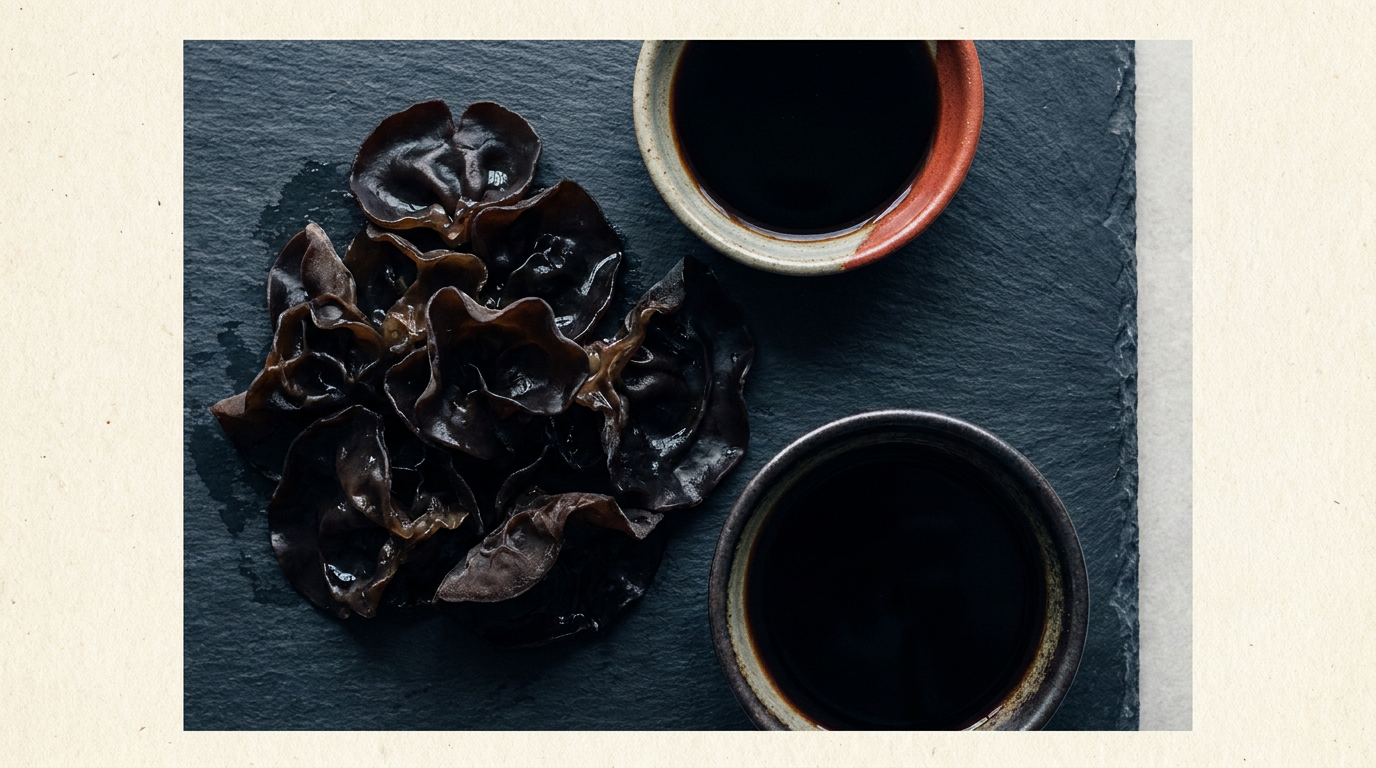
Wood ear mushroom (Auricularia heimuer) is an edible jelly fungus valued across East Asian cookery primarily for its cartilaginous, snapping texture rather than its aroma. Low in free glutamates, it carries little flavour of its own. Instead, its branched, water-soluble beta-glucan matrix absorbs seasoned liquids and oils, introducing resilient structural crunch to hot-and-sour soups, stir-fries, and cold dressed salads.
Most culinary mushrooms are prized for what they yield to a stockpot: free glutamic acid, 5'-ribonucleotides, and the savoury resonance known as umami. The wood ear mushroom refuses this brief entirely. It offers virtually no volatile aroma and only modest quantities of savoury amino acids [1]. Drop it into plain simmering water, and you will produce water that tastes of very little.
Yet across China, Japan, and Southeast Asia, Auricularia species have been gathered, cultivated on hardwood logs, and incorporated into cookery for well over a millennium. The point of wood ear is not what it gives off, but what it refuses to surrender: its bite.
The taxonomy of an ear
For decades, Western culinary texts lumped all dark, ear-shaped fungi under the European taxonomic banner Auricularia auricula-judae. Mycological revisions, bolstered by phylogenetic sequencing over the past decade, revealed that East Asian cultivars belong primarily to Auricularia heimuer, alongside the thicker, paler-backed Auricularia cornea [2].
In dried form, wood ear resembles crinkled bits of black asphalt or charred parchment. It is brittle, featherlight, and uninviting. Once submerged in water, however, the dehydrated fungal tissue rehydrates up to five or six times its dry weight. It swells into translucent, convoluted lobes with a dusky brown sheen and a smooth, gelatinous epidermis that feels surprisingly firm between the fingers.
Distinction matters in the pantry. Cooks frequently conflate wood ear with cloud ear (A. cornea or small-ear varieties), but their culinary behaviours diverge:
| Fungus | Primary Species | Physical Profile | Culinary Behaviour |
| :--- | :--- | :--- | :--- |
| Wood Ear | Auricularia heimuer | Broad, thin sheets; deep brown to black | Crisp snap (shuǎngcuì); ideal for quick stir-fries and cold dressings |
| Cloud Ear | Auricularia cornea | Smaller, thicker lobes; velvety underside | Firmer, slightly chewier bite; holds up well to extended braising |
| Snow Fungus | Tremella fuciformis | Frilled, translucent white clusters | Gelatinous, melting softness; dissolves partly into sweet soups |
The architecture of *shuǎngcuì*
In Mandarin, the defining sensory quality of wood ear is often described as shuǎngcuì (爽脆), an untranslatable texture sitting precisely at the intersection of crispness, elasticity, and clean slipperiness. It does not crunch like raw celery or fried crackling. It snaps like soft cartilage.
This acoustic and tactile snap stems from the chemical composition of its cell walls. Dried wood ears contain exceptionally high levels of dietary fibre, often exceeding 60 percent by dry weight, dominated by complex, water-insoluble structural glucans paired with acidic heteropolysaccharides [3].
Unlike the pectin in plant cell walls or the collagen in animal connective tissue, both of which dissolve into limpness under prolonged heat, the cross-linked polysaccharide network of Auricularia retains its mechanical integrity during cooking. You can drop rehydrated wood ear into a rolling, acidic hot-and-sour soup and simmer it for thirty minutes; it will emerge with its snapping boundary layer intact.
Because the mushroom itself is neutral, it functions as a mechanical scaffold for aggressive sauces. Its convoluted folds and undulating margins physically trap liquids through capillary action, catching black Chinkiang vinegar, toasted sesame oil, crushed garlic, and ground toasted Sichuan pepper. You taste the dressing immediately, delivered on a surface that yields to the teeth with clean, acoustic resistance.
Rehydration chemistry and a biological risk
Rehydration is not merely a waiting period; it is the fundamental cooking step. Because wood ear tissues are packed with hydrophilic polysaccharides, they draw water inward rapidly. Cold water produces the superior texture. When rehydrated slowly in cold or refrigerated water (roughly one to two hours), the cell walls expand evenly without their outer mucilaginous layers turning slimy.
Hot water rehydration is faster, taking fifteen minutes, but the sudden thermal expansion weakens the polysaccharide bonds at the surface, leaving the exterior slightly mushy while the interior remains tight.
There is also a documented biochemical safety boundary that home cooks must observe. Dried wood ear itself is shelf-stable, but leaving it to soak in ambient, lukewarm water for extended periods (such as overnight on a warm kitchen counter) creates an ideal environment for Burkholderia gladioli pathovar cocovenenans [4]. This bacterium produces bongkrekic acid, a potent, heat-stable mitochondrial toxin that cannot be destroyed by normal boiling or stir-frying.
The preventative rule is simple and absolute: rehydrate wood ear in cold water inside the refrigerator, never soak it for more than a few hours, and discard any batch that smells off or feels abnormally slick. A brief blanch in boiling water for one to two minutes after soaking neutralises common surface microbes and sets the texture firmly before dressing.
How to cook with intention
If you treat wood ear as a substitute for button or portobello mushrooms, you will be disappointed. It will not brown in butter, it will not caramelise, and it will not release savoury pan juices.
Treat it instead as structural punctuation. Slice rehydrated lobes into ribbons and toss them through cucumber salads dressed with cold garlic vinegar. Fold torn clusters into eggs scrambled with spring onions, where the slippery crunch offsets the soft curds. Or scatter it into clay-pot braises, letting its pleated edges hold spiced braising liquor while providing an unyielding bite against tender meat.
Frequently asked questions
### What does wood ear mushroom taste like?
Wood ear has a very mild, earthy, and neutral flavour. It contains low levels of free glutamate, so it does not possess the intense savoury punch of shiitake or porcini. Cooks value it almost entirely for its unique, cartilaginous, snapping texture and its ability to hold sauces.
### How long should you soak dried wood ear mushrooms?
In cold water, small-to-medium dried wood ear mushrooms fully rehydrate within one to two hours. Always soak them in the refrigerator rather than at room temperature to prevent microbial contamination. Avoid soaking for longer than four hours.
### Can you eat wood ear mushrooms raw?
No. Rehydrated wood ear mushrooms should always be cooked before serving. A quick blanch in boiling water for one to two minutes is standard practice even for cold salads; it sterilises the surface, rinses away residual grit, and tightens the snapping texture.
### Are wood ear and black fungus the same thing?
Yes. In grocery stores and recipes, "wood ear", "black fungus", "tree ear", and "cloud ear" are frequently used interchangeably. While "cloud ear" technically denotes smaller, more tender varieties (Auricularia cornea), both belong to the same genus and behave similarly in domestic cookery.
Sources & citations
- Mau, J. L., Lin, H. C., & Chen, C. C. (2001). Non-volatile taste components of several specialty mushrooms. Food Chemistry, 73(4), 461–466.
- Dai, Y. C., & Yang, Z. L. (2008). A revised checklist of edible fungi in China. Mycosystema, 27(6), 801–824.
- Sun, Y., & Liu, J. (2009). Structural characterization and antioxidant activity of acidic polysaccharides from Auricularia auricula-judae. Chemistry & Biodiversity, 6(8), 1239–1249.
- Anwar, M., et al. (2017). Bongkrekic acid: a review of its chemical properties, toxicity, and occurrence in food poisonings. Journal of Agricultural and Food Chemistry, 65(3), 512–521.