
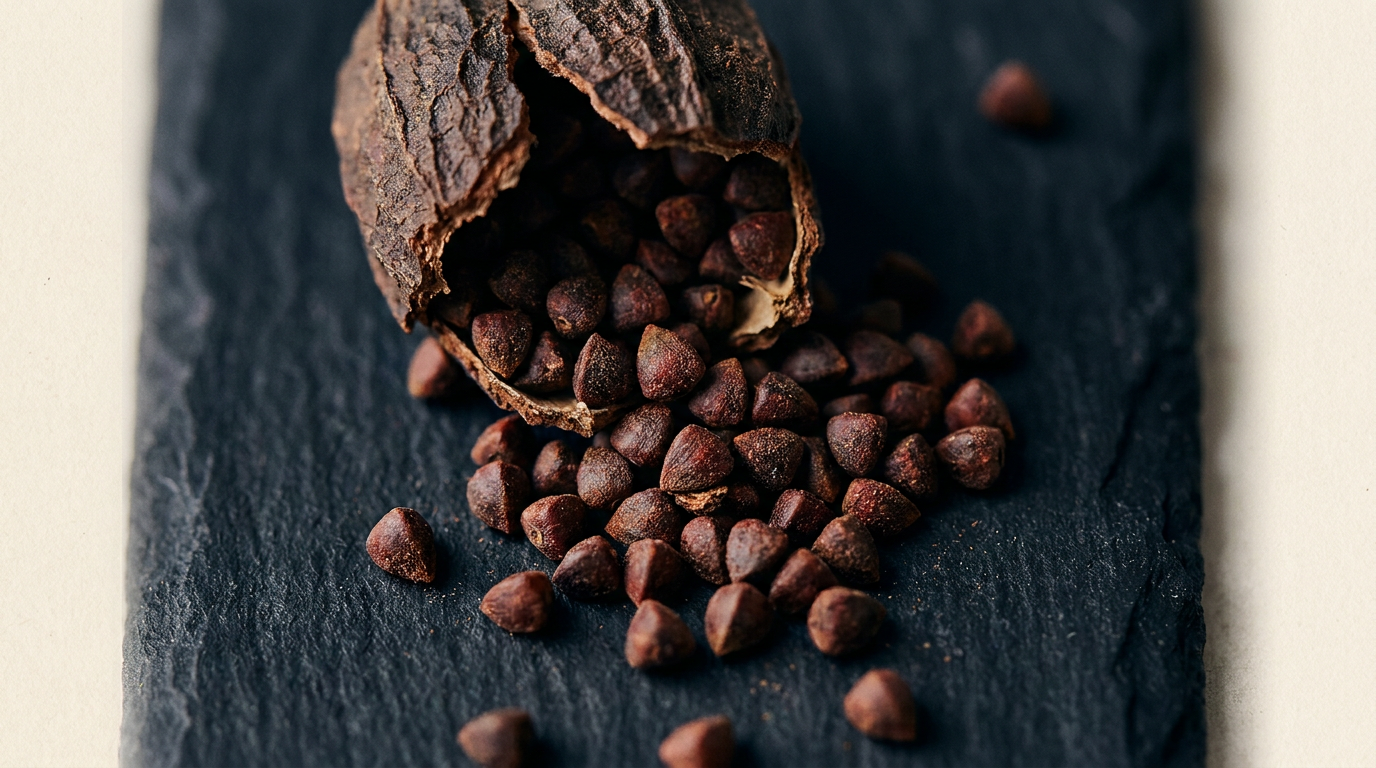
Grains of Paradise (Aframomum melegueta) is a West African spice belonging to the ginger family (Zingiberaceae). Characterised by small, reddish-brown pyramidal seeds, it offers a pungent, peppery bite overlaid with citrus, cardamom, and wood resin notes. Unlike black pepper's piperine, its lingering heat derives predominantly from aromatic phenolic compounds, notably 6-paradol, 6-gingerol, and 6-shogaol.
In Western kitchens, black pepper behaves like an inevitability. We grind dried drupes of Piper nigrum onto eggs and stocks without questioning how an Indian climbing vine became the default global pungency. Yet for nearly three centuries across medieval Europe, dinner frequently tasted of something else entirely: a glossier, aromatic seed brought across the Sahara from the Gulf of Guinea. Europeans named it grains of paradise on the calculated theological assumption that anything that aromatic must have originated in Eden. In West Africa, where it remains essential, the dried whole fruit is commonly known as alligator pepper.
You can explore our comprehensive botanical and culinary profile in the Grains of Paradise entry, but its sensory behaviour warrants a closer look through the lens of organic chemistry.
The chemistry of paradol
The heat of grains of paradise does not mirror black pepper or chilli. Black pepper relies on the alkaloid piperine, which binds to TRPV1 receptors on sensory nerve fibres, producing a sharp, fast prickle across the tongue. Chillies rely on capsaicin, which locks into the same receptor with far higher affinity and tenacity.
Aframomum melegueta achieves pungency through non-alkaloidal alkylphenols [1]. The primary pungency agent is 6-paradol (1-(4-hydroxy-3-methoxyphenyl)decan-3-one), supported by minor concentrations of 6-gingerol and 6-shogaol [2]. Structurally, 6-paradol resembles the active components of fresh ginger, but with a fully saturated alkyl chain. That structural detail changes how the tongue experiences it.
Paradol activates both the heat-sensing TRPV1 and the irritant-sensing TRPA1 ion channels [1]. The sensory onset is slower than piperine. It begins with a cool, resinous impression across the palate, followed by an escalating, radiant warmth that sits lower in the throat and does not desensitise the taste buds to adjacent flavours.
Beyond heat, the essential oil fraction (typically comprising 0.5% to 1.5% of seed weight) supplies an aromatic canopy. Gas chromatography reveals a volatile profile dominated by sesquiterpenes, particularly humulene and beta-caryophyllene, alongside oxygenated monoterpenes like linalool and alpha-terpineol [3]. This gives the spice its characteristic split personality: crack a seed with a pestle, and the first airborne aroma reads like crushed cardamom and kaffir lime peel before any peppery sting register on the nose.
A tale of two trade routes
During the thirteenth and fourteenth centuries, Aframomum melegueta was a linchpin of European haute cuisine. Venetian merchants purchased it in the trading ports of Alexandria and Tripoli, where it arrived via trans-Saharan camel caravans managed by Berber traders. In fourteenth-century France, Guillaume Tirel's manuscript Le Viandier called for it routinely alongside cinnamon and long pepper. It gave medieval spiced wines, such as hippocras, both floral lift and preservation-friendly warmth.
Its geopolitical fortunes turned on maritime access. By the late fifteenth century, Portuguese navigators reached the West African coast between Cape Palmas and the Cape of Mesurado—a shoreline so densely planted with Aframomum that cartographers labelled it the Grain Coast (now largely modern Liberia). For several decades, the Portuguese crown held a lucrative royal monopoly on malagueta trade.
Then Vasco da Gama rounded the Cape of Good Hope in 1498 and opened direct maritime trade with Malabar. Black pepper, unburdened by trans-Saharan overland tariffs or coastal West African trade negotiations, flooded European docks at scale. King Manuel I of Portugal actively suppressed grains of paradise imports to protect his newly secured Indian trade routes. Within a few generations, grains of paradise vanished from mainstream European cooking, surviving as an occasional bittering agent in Scandinavian aquavit, English craft beers, and regional gin formulations.
Sensory and chemical comparison
To understand where Aframomum melegueta fits in the spice rack, it helps to set its mechanics against its botanical relatives and traditional substitutes.
| Spice | Botanical family | Primary pungent compound | Volatile aroma markers | Culinary heat profile |
|---|---|---|---|---|
| Grains of Paradise (Aframomum melegueta) | Zingiberaceae | 6-paradol, 6-shogaol | Humulene, beta-caryophyllene, linalool | Slow, resonant warmth; citrus, cardamom, pine resin |
| Black Pepper (Piper nigrum) | Piperaceae | Piperine | Pinene, limonene, sabinene | Sharp, immediate bite; dry, woody, terpene-heavy |
| Cardamom (Elettaria cardamomum) | Zingiberaceae | Negligible (non-pungent) | 1,8-cineole, alpha-terpinyl acetate | Cool, highly camphorous, sweet eucalyptus, floral |
Working with the whole pod
In West African domestic kitchens, grains of paradise are often sold as alligator pepper: the dried, greyish-brown, wrinkled fruit pod housing dozens of individual seeds inside paper-thin partitions. In Igbo traditions, among others, presenting alligator pepper alongside kola nut (Cola acuminata) is a formal ritual of hospitality, blessing, and social contract.
For cooking, the seeds require physical rupture. Their hard outer testae protect the volatile terpenes inside, but whole seeds tossed into a braise will yield almost none of their aromatic top notes. They should be crushed in a heavy mortar or cracked through a dedicated pepper mill immediately before use.
Because 6-paradol is heat-stable, the warmth survives prolonged simmering in stews, West African pepper soups, and braises [4]. However, the lighter monoterpenes—linalool and limonene—are fugitive. If you want the distinctive cardamom-citrus top notes, finish the dish with a second, finer dusting of freshly ground seed just as the heat is switched off. It performs exceptionally well on fats that readily absorb terpene compounds, such as duck breast, browned butter, and roasted root vegetables.
Frequently asked questions
### Can I substitute black pepper for grains of paradise?
You can, but it is an incomplete substitution. Black pepper supplies sharp heat via piperine, but lacks the floral, cardamom-like lift provided by the sesquiterpenes in Aframomum melegueta. A closer culinary approximation is a mix of two parts freshly cracked black pepper to one part cracked green cardamom seeds.
### Is grains of paradise the same as alligator pepper?
Botanically, yes. In commerce, "grains of paradise" typically refers to the loose, cleaned seeds, whereas "alligator pepper" traditionally describes the whole dried pods containing the seeds, as frequently sold in West African markets.
### Does cooking destroy the flavour?
It splits the flavour. Extended simmering preserves the phenolic heat (6-paradol) while driving off the volatile citrus and pine-like essential oils. To retain both qualities, add half during cooking and finish with a fresh grind off the heat.
Sources & citations
- Riera, C. E., et al. (2009). Activation of TRPA1 and TRPV1 by non-pungent and pungent ginger components. British Journal of Pharmacology, 157(8), 1398–1409. https://doi.org/10.1111/j.1476-5381.2009.00285.x
- Sugita, J., et al. (2013). Grains of paradise (Aframomum melegueta) extract activates brown adipose tissue and increases whole-body energy expenditure in men. The British Journal of Nutrition, 110(4), 733–738. https://doi.org/10.1017/S0007114512005712
- Menut, C., et al. (2000). Aromatic plants of tropical Central Africa. Part XXXIV. Volatile constituents of Aframomum melegueta from Cameroon. Flavour and Fragrance Journal, 15(4), 275–279. https://doi.org/10.1002/1099-1026(200007/08)15:4<275::AID-FFJ904>3.0.CO;2-4
- National Research Council. (2008). Lost Crops of Africa: Volume III: Fruits. The National Academies Press. https://doi.org/10.17226/11879