
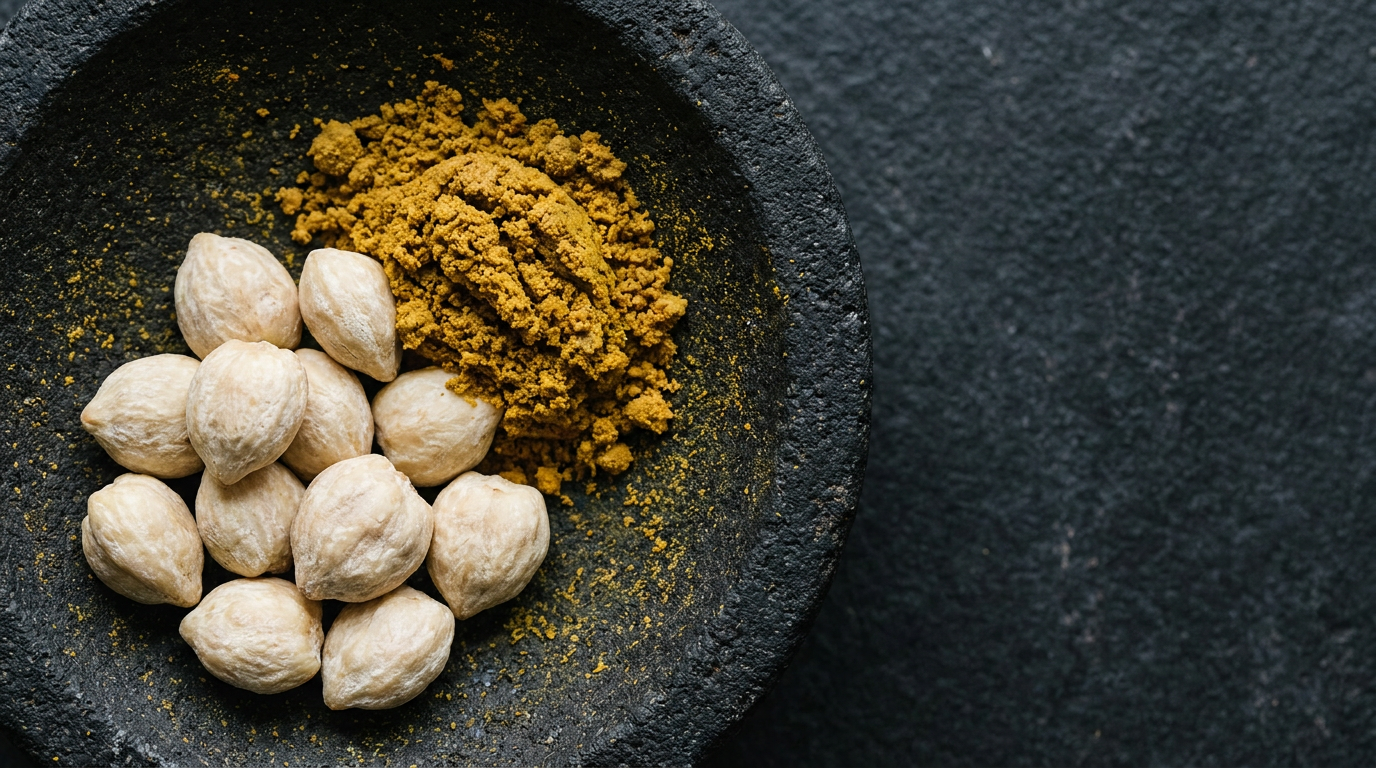
Candlenut (Aleurites moluccana), also known as kemiri or kukui, is an oil-dense seed native to Island Southeast Asia and the Pacific. Composed of over sixty percent lipids, it acts as a culinary emulsifier that thickens and enriches curries, pastes, and stews. Because it contains toxic saponins and phorbol esters, candlenut must always be thoroughly cooked before consumption.
In Western kitchens, nuts exist primarily as snacks, garnishes, or dessert bases. Candlenut belongs to an entirely different culinary category. It is treated as an active seasoning and structural foundation, ground into raw spice pastes before meeting the heat of oil or simmering coconut milk.
The chemistry of raw toxicity
Candlenut belongs to the Euphorbiaceae, or spurge family, which also counts the castor oil plant (Ricinus communis) and cassava (Manihot esculenta) among its relatives. Like many members of this family, the tree protects its seeds with chemical deterrents [1].
Raw candlenuts contain toxalbumins and phorbol esters, compounds capable of irritating the gastrointestinal tract severely enough to cause acute vomiting, cramping, and purgative diarrhoea. The concentration is high enough that eating even a single raw kernel raw can result in several miserable hours.
Heat neutralises these toxic proteins through denaturation. As cooking temperatures rise, the tertiary structure of the toxalbumins unfolds, destroying their biological activity. Traditional preparations reflect this biological necessity without needing a diagram of peptide bonds: Javanese cooks toast the nuts in a dry pan or pound them into a bumbu (spice paste) that is fried in hot oil for several minutes before any liquid enters the pot. In Hawaii, the kernels for inamona (a traditional poke seasoning) are roasted until deeply golden before being cracked and salted [2].
Lipid density and the art of the emulsion
A mature candlenut kernel is roughly sixty to sixty-five percent oil by weight. The dominant fatty acids are polyunsaturated linoleic acid (often thirty to forty percent) and oleic acid, paired with a small fraction of saturated fats [3].
This high oil content is why ancient Polynesians strung dried kernels on coconut palm fronds and burned them as slow, smokeless torches, earning the tree its English name. In cooking, this lipid density performs a physical task rather than an aromatic one.
When you pound candlenut in a mortar with shallots, garlic, and fresh chillies, the cell walls rupture, liberating trapped triglycerides. The moisture from the alliums meets the newly freed oils, and the cellular debris—chiefly insoluble fibre and plant proteins—serves as a stabilizing matrix. Pounding creates a mechanical emulsion.
When this paste hits hot fat in a wok, the water cooks off, leaving behind a fine suspension of solids coated in oil. Later, when you add coconut milk or water, the candlenut solids swell and bind the free liquid. Western sauces often rely on refined starch slurries or dairy fats to build body. Candlenut produces viscosity, sheen, and weight simultaneously, without tasting heavy or masking the sharper aromatics of galangal, lemongrass, and lime leaf.
Candlenut versus common substitutes
Because candlenuts spoil rapidly once shelled (their polyunsaturated oils oxidise quickly when exposed to air), cooks outside Southeast Asia often look for alternatives. The most common suggestions are macadamia nuts or raw cashews.
| Attribute | Candlenut (Aleurites moluccana) | Macadamia (Macadamia integrifolia) | Cashew (Anacardium occidentale) |
| :--- | :--- | :--- | :--- |
| Lipid content | ~60–65% | ~75% | ~44% |
| Dominant fat | Polyunsaturated (linoleic) | Monounsaturated (oleic/palmitoleic) | Monounsaturated (oleic) |
| Starch content | Minimal | Very low | Moderate (~23%) |
| Raw safety | Toxic; must be heated | Safe to eat raw | Commercially sold processed; safe |
| Flavour profile | Earthy, faint bitterness, neutral richness | Sweet, buttery, rounded | Sweet, mildly nutty, creamy |
| Sauce texture | Light, velvety, glossy suspension | Oily, silky, slightly granular | Dense, thick, opaque emulsion |
Macadamias provide the correct fat percentage, but their monounsaturated profile yields a noticeably sweeter finish. Cashews bring too much starch to the pot; they thicken a sauce into something approaching a puree rather than a glossy braising liquid. If using macadamias as a substitute, reducing other sweet components (such as palm sugar) helps restore the savoury balance.
Buying and keeping candlenuts
Buy whole, unbroken kernels from grocers with steady stock turnover. Fresh candlenuts are pale cream to ivory. If they look grey, yellowed, or smell faintly of old paint or cardboard, the linoleic acid has oxidised. Rancid candlenuts ruin a sauce instantly.
Because the oils are sensitive, store them in an airtight container in the freezer. They can be pounded straight from frozen. Before using them in any dish, dry-toast them in a heavy pan until fragrant and lightly mottled, or grind them directly into your wet spice base and ensure the paste is thoroughly cooked out in fat.
Frequently asked questions
### Can you eat candlenut raw?
No. Raw candlenuts contain toxic compounds including phorbol esters that cause acute gastrointestinal illness. They must always be roasted, fried, or boiled before consumption.
### What does candlenut taste like?
On its own, cooked candlenut is relatively mild. It has an oily, earthy, and faintly bitter flavour. It is valued far more for its texture and emulsifying properties than for a dominant flavour note.
### How many candlenuts should be used in a curry?
Most regional Indonesian and Malaysian recipes call for between three and six kernels for a family-sized pot. Because of their high lipid content, using more can cause the sauce to separate or become greasy.
### Why did my paste split after adding candlenuts?
If a spice paste splits, it usually means the paste was not fried long enough to cook out the water before adding liquid, or the heat was too high. The ground nut needs sufficient gentle cooking in oil to form a stable base before broth or coconut milk is introduced.
Sources & citations
- National Center for Biotechnology Information. PubChem Compound Summary for CID 442070, Phorbol. https://pubchem.ncbi.nlm.nih.gov/compound/Phorbol
- Elevitch, C.R. (Ed.). (2006). Traditional Trees of Pacific Islands: Their Culture, Environment, and Use. Permanent Agriculture Resources, Holualoa, Hawaii.
- Duke, J.A. (1983). Handbook of Energy Crops: Aleurites moluccana. Purdue University Center for New Crops & Plant Products.