
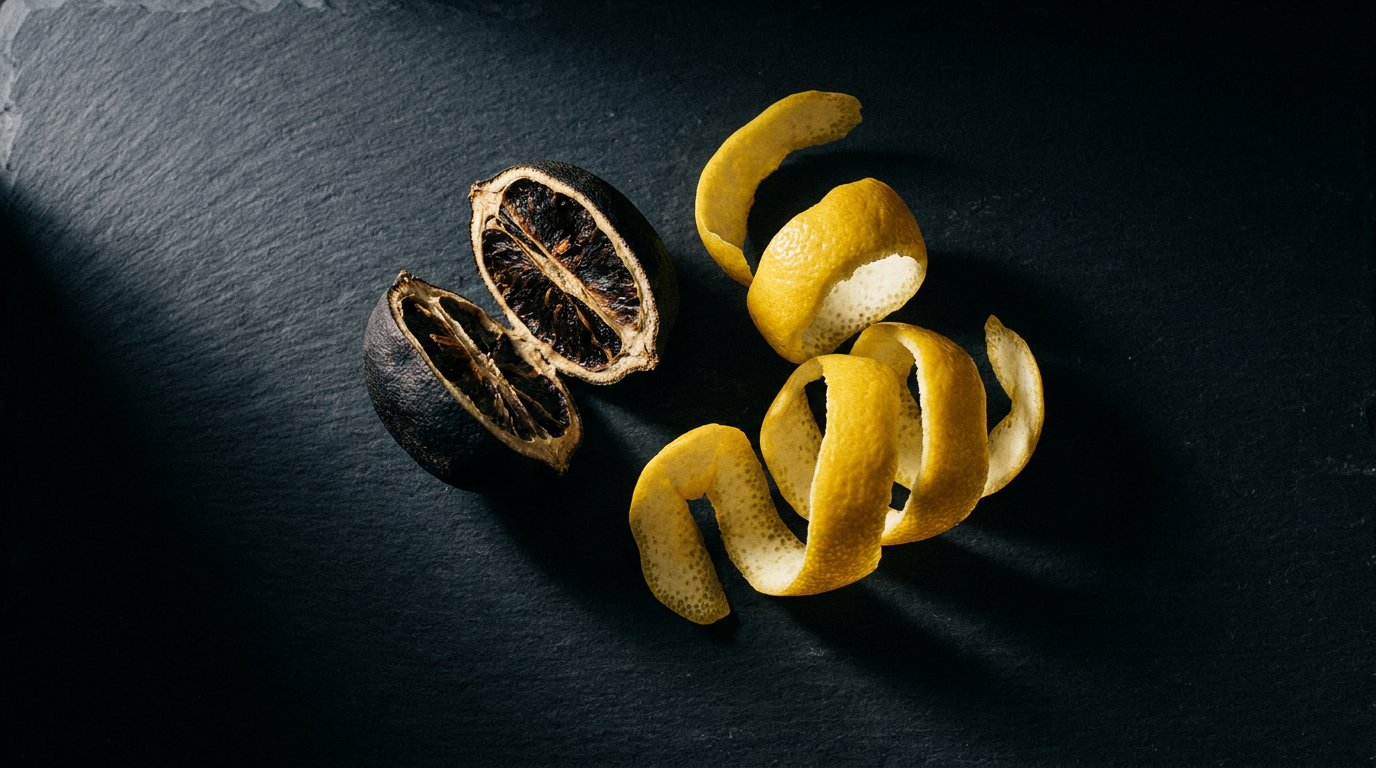
Lemon (Citrus limon) functions culinarily as both an acidulent and an aromatic spice, derived from the pulp and flavedo of the fruit. While the juice supplies sharp citric and malic acids that lower pH and stimulate salivation, the outer peel contains secretory cavities dense with volatile terpenes—principally d-limonene and citral—that deliver clean, hydrophobic citrus aroma [1].
Most kitchens conflate the juice with the fruit's aromatic capacity. Squeezing juice over a hot pan gives you acid and moisture, but almost none of the characteristic perfume that defined citrus cultivation across South Asia and the Mediterranean. The spice rack cares far more about the flavedo: the outermost coloured layer of the pericarp where lipid-soluble flavour lives.
In our entry on lemon, we track the fruit from the Citrus limon tree into savory and sweet applications. Understanding how it operates chemically requires dividing the fruit into two incompatible systems: water-soluble organic acids on the inside, and oil-soluble hydrocarbon terpenes on the outside.
The architecture of flavedo and albedo
A lemon peel is not homogenous. The coloured outer layer, the flavedo, is covered with minuscule, translucent pockets known as schizolysigenous glands. When you drag a microplane across the skin, you rupture these glands mechanically, aerosolising a mixture dominated by d-limonene (often exceeding 65 percent of the oil volume), paired with isomeric aldehydes: geranial and neral, together called citral [2].
Citral is what makes a lemon smell distinctively like lemon rather than an orange or grapefruit. It takes only parts per billion of citral in the air for the human olfactory bulb to register the fruit.
Directly beneath lies the albedo, the spongy white mesocarp. The albedo contains almost zero volatile aromatics. It contains bitter flavanone glycosides, predominantly hesperidin and neohesperidin, along with high concentrations of pectin. Cooks who grate too deep introduce intense, flat bitterness without gaining any volatile complexity. The boundary between sharp aromatic clarity and chalky bitterness is less than a millimetre thick.
What heat does to citral
Terpenes are chemically fragile. Citral is an unsaturated aldehyde, which means it reacts readily with oxygen, heat, and light. When fresh lemon zest or juice is boiled in a stock or sauce for more than a few minutes, citral degrades rapidly into secondary compounds such as p-cymene and p-cresol, which carry muddy, diesel-like, or kerosene off-notes [3].
This explains why a cook should never introduce fresh lemon zest at the start of a ninety-minute braise. The bright, high-frequency citrus notes will have vanished within ten minutes, leaving behind oxidized degradation products that drag the dish downward. Fresh zest belongs at the very end of cooking, folded in off the heat so that the carryover temperature volatilises the terpenes directly into the diner's nose.
Preserved, dried, and sun-cured citrus
When citrus is dehydrated or preserved, the flavour profile shifts from fleeting high notes to functional, ground-level seasoning. In Persian and Gulf cookery, whole small lemons or limes are boiled in brine and sun-dried on mats until rock-hard, dark brown or pitch black—a spice known as loomi or black lemon.
During sun-drying, enzymatic browning and slow oxidation strip away the sharp citral and sweet monoterpenes. What remains are heavier sesquiterpenes, degraded organic acids, and phenolic compounds that yield a pungent, smoky, fermented tang. Unlike fresh zest, loomi tolerates prolonged heat and is meant to simmer inside stews like ghormeh sabzi, where liquid slowly leaches through pierced rinds.
| Form | Primary Chemical Drivers | Dominant Flavour Profile | Best Culinary Use |
| :--- | :--- | :--- | :--- |
| Fresh Zest | d-Limonene, citral, linalool | Piercing, floral, bright citrus | Finishing oil, raw vinaigrettes, late additions |
| Dried Peel | Oxidised terpenes, hesperidin, pectin | Muted citrus, resinous, bittersweet | Dry spice rubs, tea blends, poaching broths |
| Black Lemon (Loomi) | Concentrated citric acid, degraded terpene derivatives | Musky, smoky, sour, fermented | Long braises, bean stews, grain dishes |
The acid mechanism in savory cooking
Lemon juice is roughly five to six percent citric acid by weight, giving it a pH typically between 2.0 and 2.6 [1]. This level of acidity performs distinct physical work that differs fundamentally from vinegar (acetic acid).
Citric acid is a tricarboxylic acid; it features three carboxyl groups that interact aggressively with mineral ions and protein structures. In raw fish preparations, the sudden plunge in pH protonates amino acid residues on protein surfaces, causing myosin chains to unfold and cross-link—mimicking the structural firming caused by thermal cooking. In fatty emulsions, citric acid increases ionic strength, stabilising suspensions by altering the electrostatic repulsion between dispersed fat globules.
On the tongue, the sourness triggers reflex salivary secretion. More saliva means faster dissolution of food particulates, accelerating the delivery of salt and hydrophobic flavour molecules to the taste buds. When a dish tastes flat despite adequate salt, it is rarely lacking more sodium; it lacks the hydronium ions that a squeeze of lemon or a grating of dried peel supplies.
Frequently asked questions
### Is lemon considered a spice or a fruit?
Botanically, lemon is a hesperidium, a specialized type of berry. In culinary classification, however, dried lemon peel, powdered peel, and sun-dried black lemons (loomi) are categorized and used strictly as spices due to their high concentration of volatile essential oils and stable storage life.
### Why does cooked lemon juice turn unpleasantly bitter?
Lemon juice contains limonin glucoside, a tasteless precursor found in the carpellary membranes. When exposed to heat and low pH, enzymatic or acid-catalysed conversion turns this compound into limonin, an intensely bitter triterpenoid. Boiling juice concentrates this bitterness while driving off volatile top notes.
### Can dried lemon peel substitute for fresh lemon zest?
Not directly in a 1:1 ratio. Dried peel has lost a significant portion of its monoterpenes (like citral) to evaporation, concentrating heavier, woodier, and slightly more bitter back-notes. Use dried peel for infusions, rubs, and slow-simmered dishes; use fresh zest when you need bright, volatile aromatics.
### How does black lemon differ from regular dried lemon peel?
Black lemon (loomi) is typically made by blanching small citrus in salted water before subjecting them to weeks of sun-drying. The combination of heat, brine, and prolonged solar UV radiation induces fermentation and enzymatic browning, creating complex, musky, almost fermented sour notes absent in mechanically dehydrated peel.
Sources & citations
- Ladaniya, M. (2008). Citrus Fruit: Biology, Technology and Evaluation. Academic Press, pp. 125–140.
- Sharon-Asa, L. et al. (2003). 'Citrus fruit flavor and aroma', Plant Molecular Biology, 51(3), pp. 453–464.
- Schieberle, P. and Grosch, W. (1988). 'Identification of potent flavor compounds in aqueous lemon oil emulsions', Journal of Agricultural and Food Chemistry, 36(4), pp. 797–800.