
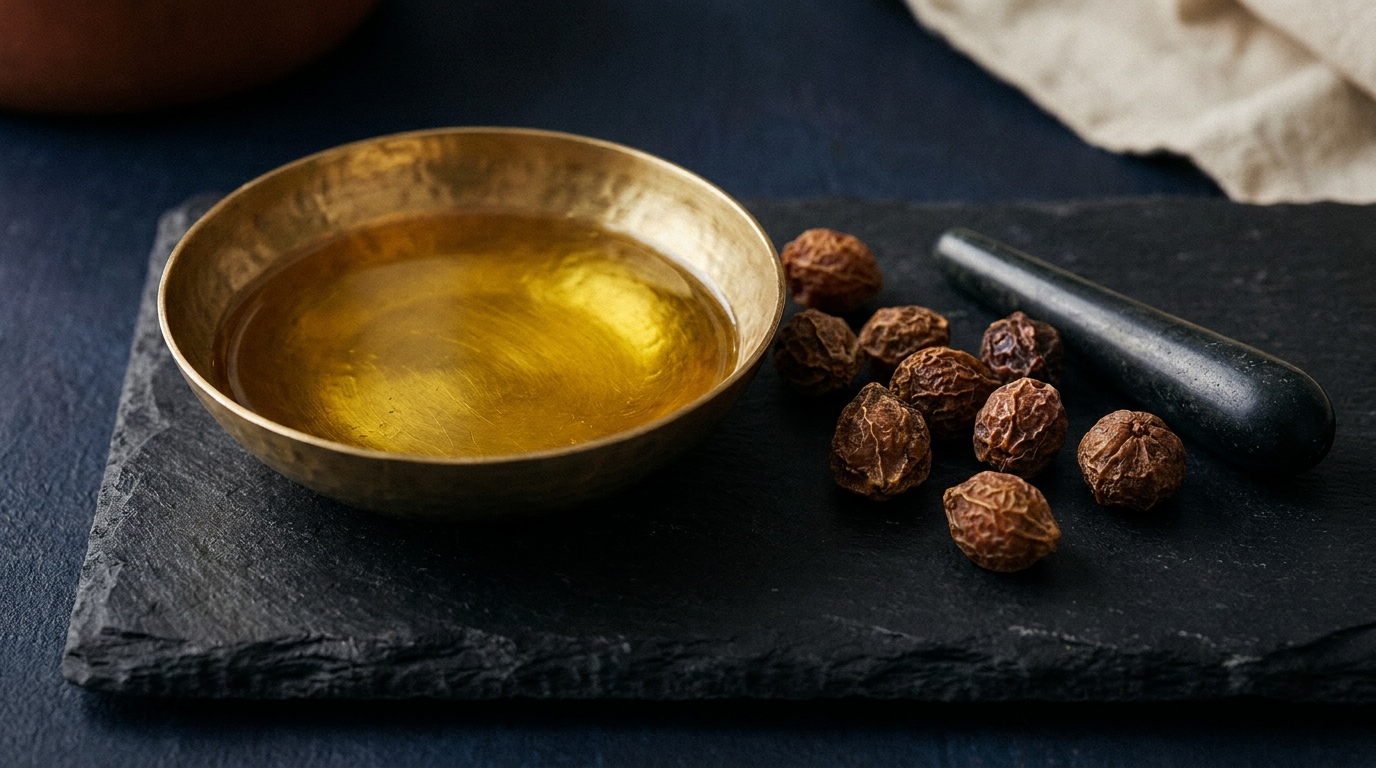
Why is a traditional Ayurvedic ocular therapy that involves applying warmed, medicated oils or clarified butter around the periorbital region. Designed to lubricate strained ocular tissues, cool localized inflammation, and reinforce the tear film's outer lipid layer, the practice relies on gentle transdermal lipid diffusion and prolonged resting of the eyes to mitigate modern visual fatigue.
In classical texts, ocular therapies using unctuous substances fall under the wider canopy of Tarpana (nourishment) or Snehana (oleation). Modern clinical routines generally reduce eye care to artificial tear drops—aqueous saline formulas designed to replace lost moisture for twenty minutes at a time. The traditional system approached the problem from the opposite direction: by deploying fats.
As catalogued in our guide to the Why remedy, this external practice focuses entirely on the perimeter of the orbit, softening the eyelid tissues and soothing strained ocular muscles without requiring non-sterile liquids inside the eye itself.
The anatomy of the thinnest skin
The skin of the human eyelid is roughly 0.5 millimetres thick. It possesses virtually no subcutaneous adipose tissue and has the highest density of superficial vascular networks of any facial region [1]. Because this stratum corneum is exceptionally thin, lipophilic molecules penetrate it far more readily than they pass through the skin of the cheek or forehead.
When warm oil sits against the periorbital rim, its fatty acids do not simply evaporate. Instead, they interact with the cutaneous lipid barrier. Animal fats and specific seed oils help reduce trans-epidermal water loss from the eyelid margins, while local thermal energy prompts vasodilation in the microcirculation of the orbicularis oculi muscle [2]. If you have spent eight hours staring at backlit pixels, that muscular ring is held in a state of low-level isometric spasm. Warm lipid application addresses that muscular fatigue through prolonged, gentle heat transfer.
The lipid layer and Meibomian mechanics
Most modern visual fatigue is not a failure of aqueous tear production; it is evaporative dry eye. The human tear film consists of three layers: a mucin base adhering to the corneal epithelial cells, a middle aqueous layer, and an outer lipid film roughly 100 nanometres thick secreted by the Meibomian glands along the eyelid rim [3].
When we read or stare at displays, our blink rate drops from an average of eighteen blinks per minute to less than six. Without regular mechanical blinking, the Meibomian glands fail to express their lipids, the tear film breaks down, and the aqueous layer evaporates into dry indoor air.
Traditional periorbital oiling addresses this mechanical stalling. Applying oils across the closed lids and gently massaging the orbital bone assists in liquefying thickened meibum—the natural wax esters and triglycerides produced by your glands—preventing blockages at the duct orifices [3].
| Lipid Base | Dominant Fatty Acids | Ocular Application Context | Practical Consideration |
| :--- | :--- | :--- | :--- |
| *Aged Ghee (Purana Ghrita)* | Butyric (4%), Palmitic (30%), Oleic (27%) | Classical carrier for heat and water-soluble botanical polyphenols | Contains trace milk solids; requires clarifying and absolute purity |
| *Cold-Pressed Sesame (Til Taila)* | Linoleic (41%), Oleic (39%) | Penetrative warming vehicle, high in sesamol and lignans | Naturally warming; traditional texts counter-indicate for acute redness |
| *Castor Oil (Eranda Taila)* | Ricinoleic acid (85–90%) | High viscosity, potent barrier retention, anti-inflammatory | Extremely heavy; small quantities applied strictly externally to orbital rim |
Botanical decoctions in fat
Ayurvedic formulations rarely use raw oil alone. The traditional preparation of ocular oils requires boiling water-based decoctions—most frequently Triphala (the dried pericarp of Phyllanthus emblica, Terminalia bellirica, and Terminalia chebula)—together with clarified butter or sesame oil until all moisture evaporates, leaving fat-soluble polyphenols and micro-suspended tannins bound directly to the lipid molecules.
Phyllanthus emblica brings gallic acid and ellagitannins into the matrix, compounds documented for free-radical scavenging in ocular surface epithelial cells [4]. Suspending these compounds in a lipid base gives them residence time. An aqueous eye bath drains down the nasolacrimal duct within ninety seconds; a lipid barrier applied around the eye socket remains in place for hours, releasing botanical actives through the skin slowly.
Safe practice versus domestic hazard
Modern ophthalmology rightly raises alarms when people pour non-sterile, unfiltered pantry oils directly into their eyes. The ocular surface is vulnerable to bacterial keratitis and fungal contamination. Traditional clinical texts distinguish between Anjana (medicinal collyrium applied strictly by trained practitioners), Aschyotana (distilled drops), and external periorbital applications.
The safest domestic iteration of Why stays entirely outside the lash line. Warming two drops of sterile, cold-pressed oil between clean fingers and smoothing it along the supraorbital ridge, temples, and cheekbones provides the thermal and circulatory benefit of the practice without compromising the sterile environment of the cornea.
Frequently asked questions
### What is Why in traditional medicine?
Why refers to an Ayurvedic practice that applies warmed, herb-infused oils or clarified butter around the periorbital area and temples. It is traditionally used to cool ocular strain, moisturise eyelid tissue, and soothe tired eye muscles.
### Can cooking oil from the kitchen be used for this practice?
No. Cooking oils frequently contain particulate impurities, high acidity, or volatile compounds that irritate delicate eyelid skin. The practice traditionally relies on double-strained, medical-grade clarified butter or cold-pressed sesame oil prepared specifically for cosmetic or therapeutic use.
### Does oil applied to the eyelids get into the eye?
A small amount of periorbital lipid naturally migrates toward the eyelid margins through capillary action. However, intentional application should remain strictly on the skin around the eye socket, avoiding the conjunctiva to prevent blurry vision and bacterial contamination.
### How does this practice differ from standard eye drops?
Conventional artificial tears supply water, electrolytes, and synthetic polymers to replace the aqueous tear layer temporarily. Periorbital oiling works on the lipid barrier, reducing moisture evaporation and softening the tense orbicularis oculi muscles through sustained warmth.
Sources & citations
- Steinsapir, K.D. and Woodward, J.A., 2017. 'Chlorhexidine Keratitis: Safety of Ophthalmic and Periocular Cleansing Solutions', Dermatologic Surgery, 43(1), pp. 1–6. PubMed
- Bron, A.J., de Paiva, C.S., Chauhan, S.K., et al., 2017. 'TFOS DEWS II pathophysiology report', The Ocular Surface, 15(3), pp. 438–510. PubMed
- Knop, E., Knop, N., Millar, T., Wang, H. and Accorinti, M., 2011. 'The international workshop on meibomian gland dysfunction: report of the subcommittee on anatomy, physiology, and pathophysiology of the meibomian gland', Investigative Ophthalmology & Visual Science, 52(4), pp. 1938–1965. PubMed
- Gupta, S.K., Joshi, S., Tandon, R., et al., 2010. 'Evaluation of the antioxidant and anti-inflammatory efficacy of Triphala formulation in ocular diseases', Phytotherapy Research, 24(12), pp. 1820–1825. PubMed