
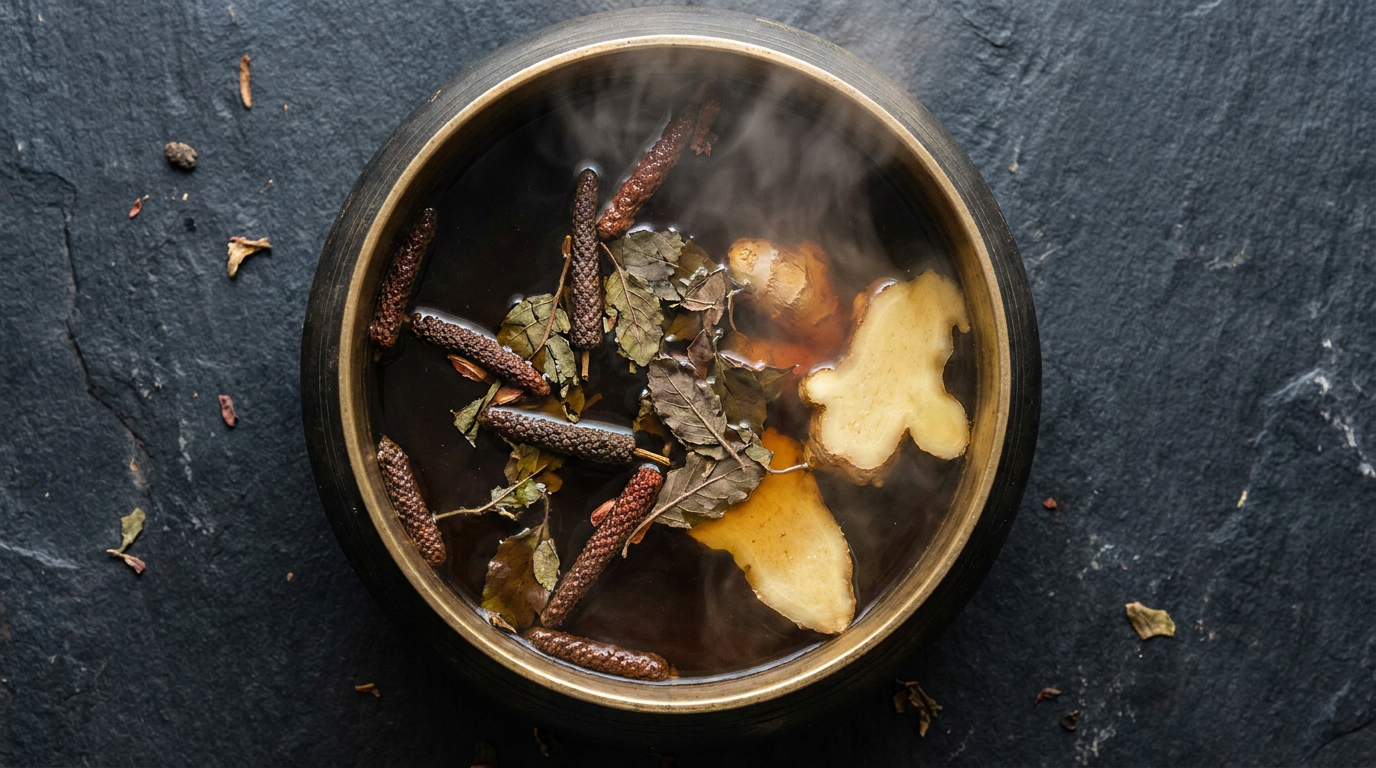
Founders' Kadha is a concentrated Ayurvedic herbal decoction made by simmering dense botanicals—principally holy basil (tulsi), long pepper (pippali), dry ginger, and clove—in water until reduced by half or three-quarters. Used historically across South Asia for respiratory comfort and seasonal defence, its physiological utility relies on heat-stable polyphenols, volatile terpenes, and pungent piperine alkaloids extracted through sustained thermal simmering.
Most modern commercial herbal teas are simple infusions: delicate leaves steeped in off-the-boil water for four minutes. The result is aromatic, light, and chemically thin. A kadha operates under a distinct pharmaceutical logic documented in classical Ayurvedic texts under the category of kvatha (or kashaya). When examining our preparation for Founders' Kadha, the distinction in physics is immediate. This is an aqueous extraction designed to crack open dense cellular walls in barks, dried seeds, and tough rhizomes [1].
The thermal mechanics of *kvatha*
If you drop a slice of fresh ginger or an intact pod of long pepper into hot water, you extract surface-level volatiles and easily soluble sugars. You do not extract the heavier, sparingly soluble compounds embedded deep within the lignified plant tissue. Classical pharmacy specified a strict ratio: one part coarsely crushed botanicals (yavakuta) boiled in sixteen parts water, simmered steadily without a lid until reduced to one-fourth of its initial volume [1].
This deliberate reduction changes the liquid in three ways:
- Solvent concentration: As water evaporates as steam, non-volatile constituents—such as tannins, bitter glucosides, and phenolic acids—concentrate heavily in the remaining liquid.
- Thermal transformation: Prolonged boiling at 100°C facilitates specific chemical conversions. In ginger (Zingiber officinale), mild boiling dehydrates gingerols into shogaols, compounds roughly twice as pungent as gingerols with distinct anti-inflammatory signalling properties [2].
- Micellar solubilisation: Certain sparingly soluble terpenes become suspended in the dense aqueous matrix through prolonged mechanical agitation from the boiling action, forming a rustic colloid rather than a clear solution.
| Extraction Method | Heat & Duration | Starting Material | Chemical Yield |
| :--- | :--- | :--- | :--- |
| *Infusion (Phanta)* | Off-boil water (85–95°C), 3–7 mins | Tender leaves, flowers | Volatile monoterpenes, free flavonoids, water-soluble esters |
| *Decoction (Kvatha)* | Vigorous simmer (100°C), 20–45 mins | Barks, roots, seeds, woody leaves | Non-volatile polyphenols, shogaols, alkaloids, complex tannins |
| Tincture | Ambient ethanol solution, weeks | Varied plant matter | Hydrophobic resins, lipid-soluble alkaloids, broad volatiles |
The chemistry of the botanical matrix
A proper kadha does not rely on a single isolated molecule. It relies on a matrix of compounds that address different mucosal and inflammatory mechanisms.
### Holy Basil (Ocimum sanctum / Tulsi)
Tulsi provides the foundation. Unlike sweet culinary basil (Ocimum basilicum), holy basil contains substantial concentrations of eugenol, rosmarinic acid, and ursolic acid [3]. While delicate top-note monoterpenes are inevitably lost to steam during a 30-minute boil, the non-volatile polyphenols—specifically rosmarinic acid—survive intact. Rosmarinic acid acts as a documented free-radical scavenger and inhibitor of lipoxygenase enzymes, dampening inflammatory cascades in epithelial tissue [3].
### Long Pepper (Piper longum) and Black Pepper (Piper nigrum)
The inclusion of the pepper family is not merely for culinary bite. The active alkaloid, piperine, alters intestinal and epithelial permeability. In modern pharmacology, piperine is widely studied as a natural bioenhancer; it inhibits hepatic and intestinal glucuronidation, effectively preventing metabolic enzymes from degrading accompanying polyphenols before they can be absorbed into systemic circulation [4]. In a boiling decoction, piperine partially solubilises into the water, assisting the uptake of otherwise poorly bioavailable compounds present in the other spices.
### Clove (Syzygium aromaticum)
Cloves are roughly 15 to 20 percent essential oil by dry weight, dominated by eugenol. When boiled, eugenol exerts a mild local anaesthetic and antimicrobial effect on the pharyngeal mucosa [5]. It soothes raw nerve endings in an irritated throat directly upon contact, which explains why a hot, spiced decoction produces an immediate sensation of airway relief long before any systemic immune effect could occur.
What the decoction can and cannot do
It is sensible to remain clear about what an herbal decoction does in the human body. Traditional claims often describe kadha as an "immunity booster." In immunological terms, the concept of generally boosting an immune system is biologically imprecise; a persistently hyper-activated immune response is an autoimmune disaster.
What a balanced kadha actually supports is mucosal defence and symptom regulation. The heat and astringency stimulate salivation and ciliary movement in the upper respiratory tract, assisting the clearance of trapped mucus and foreign particulates. The anti-inflammatory compounds temper local inflammatory cytokine production in the throat without suppressing normal baseline immune vigilance.
It will not cure viral influenza or neutralize bacterial pneumonia overnight. What it does offer is a reliable, time-tested delivery system for robust plant compounds that ease mucosal irritation and assist the body's native repair processes during seasonal challenges.
Frequently asked questions
### Can I make kadha by simply steeping ground spices in a mug?
Steeping will yield a weak, pleasant tea, but it does not reproduce the chemical profile of a kadha. Dense spices like ginger rhizome, whole clove, and pepper require sustained thermal energy to break through cellulose walls and extract non-volatile alkaloids and concentrated polyphenols.
### Does long boiling destroy the vitamin C in the herbs?
Yes. Ascorbic acid is notoriously heat-labile and degrades rapidly in boiling water. Traditional kadha is not consumed for vitamin C; its functional value derives from heat-stable polyphenols, tannins, and alkaloids that do not degrade at 100°C.
### Why does kadha leave a dry sensation in the mouth?
That drying sensation is astringency (kashaya rasa), caused primarily by tannins and polyphenols binding to proline-rich salivary proteins. This astringent action temporarily tightens mucous membranes and reduces excessive, runny secretions in the pharynx.
### Should sweeteners like honey be added during boiling?
Classical Ayurvedic guidelines explicitly advise against heating honey directly. Honey contains sugars that caramelise and degrade under high heat into compounds like 5-hydroxymethylfurfural (HMF). If sweetening is required to balance the sharp astringency, honey should be stirred in only after the liquid has cooled to drinking temperature.
Sources & citations
- The Ayurvedic Pharmacopoeia of India, Part I, Volume I. Government of India, Ministry of Health and Family Welfare, Department of AYUSH, 2001.
- Prasad, S., & Tyagi, A. K. (2015). Ginger and its constituents: role in prevention and treatment of gastrointestinal cancer. Gastroenterology Research and Practice, 2015, 142979.
- Jamshidi, N., & Cohen, M. M. (2017). The clinical efficacy and safety of Tulsi in humans: a systematic review of the literature. Evidence-Based Complementary and Alternative Medicine, 2017, 9217567.
- Stohs, S. J., Chen, O., & Ray, S. D. (2020). Postulated mechanisms of bioenhancement by piperine: a review. Phytotherapy Research, 34(7), 1546–1554.
- Batiha, G. E., et al. (2020). Syzygium aromaticum L. (Myrtaceae): Traditional uses, bioactive chemical constituents, pharmacological and toxicological activities. Biomolecules, 10(2), 202.