
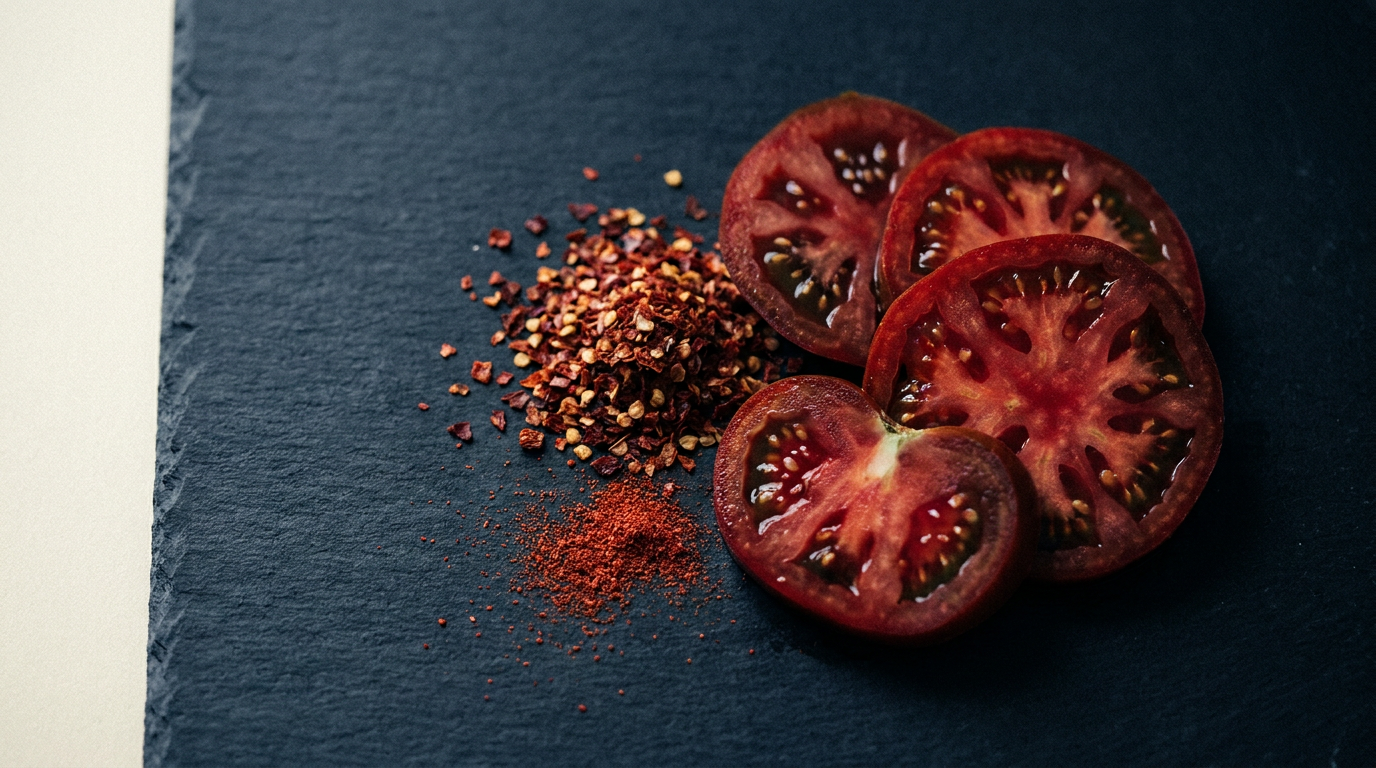
Heirloom tomatoes are open-pollinated, non-hybrid cultivars passed down through generations, cherished for their diverse flavours, colours, and irregular shapes. Unlike modern commercial cultivars bred for uniform ripening and shipping durability, heirlooms preserve active transcription factors like GLK2, yielding higher concentrations of soluble sugars, organic acids, and aroma volatiles that transform into potent savoury seasoning when dried.
To understand why heirloom tomatoes behave almost like a spice in culinary applications—particularly when dehydrated into flakes, powders, or pastes—one has to look at what commercial agriculture removed in the middle of the twentieth century.
The uniform ripening trade-off
For roughly seventy years, commercial tomato breeders selected for a single visual trait: uniform green shoulders before ripening. Wild and heritage varieties typically display dark green shoulders caused by an accumulation of chloroplasts near the stem end. While these green crowns signal flavour potential, packers found them uneven and difficult to grade for transit.
In 2012, plant geneticists pinpointed the mutation responsible for this change: a defective transcription factor called GOLDEN2-LIKE (GLK2) [1]. The commercial u (uniform ripening) mutation disables GLK2, suppressing chloroplast development throughout the fruit. Chloroplasts are not merely colour packets; they are the cellular factories that produce sugars via photosynthesis and manufacture lycopene, carotenes, and flavour precursors. When breeders selected for uniformly pale fruit to suit cardboard shipping crates, they inadvertently dismantled the machinery that synthesises flavour.
Heirlooms, possessing functional GLK2 alleles, pack their flesh with significantly higher baseline concentrations of soluble sugars (fructose and glucose), organic acids (citric and malic), and carotenoid pigments. In our dedicated profile of the botanical tomato on Spiced with Science, we treat dried tomato tissue as a functional spice precisely because these compounds concentrate into a dense chemical matrix.
| Trait | Heirloom Cultivars (Open-Pollinated) | Modern Commercial Hybrids | Concentrated Culinary Impact |
| :--- | :--- | :--- | :--- |
| Genetics | Open-pollinated; diverse, stable lineages | F1 Hybrids; proprietary single-generation crosses | Heirlooms retain regional adaptations and distinct volatile profiles |
| GLK2 Gene | Functional; dark green immature shoulders | Inactive (u mutation); uniform pale green shoulders | Active gene yields 20–40% higher sugar and carotenoid precursors [1] |
| Free Glutamate | High (frequently exceeds 200 mg/100g fresh) | Moderate to low (diluted by water weight) | Dehydrated heirloom tissue acts as a clean, savoury flavour enhancer |
| Aroma Volatiles | Broad spectrum (apocarotenoids, esters, aldehydes) | Narrow spectrum; dominated by hexanals | Pungent, complex aroma when ground into finishing powders |
| Firmness / Water | Softer pericarp, higher soluble solids | Rigid cell walls, high water retention | Heirloom dries faster into stable flakes without woody texture |
The volatile bouquet and free glutamate
A tomato does not taste like a tomato through sugar and acid alone. Research led by Harry Klee at the University of Florida analysed hundreds of heirloom accessions to identify which chemical compounds actually govern human flavour preferences [2].
True heirloom flavour relies on a constellation of volatile organic compounds derived from three pathways:
- Apocarotenoids: Compounds like $\beta$-ionone, $\beta$-damascenone, and geranylacetone arise from the oxidative cleavage of carotenoids. They supply floral, fruity, and warm aromatic notes.
- Lipid-derived volatiles: Short-chain aldehydes like (Z)-3-hexenal and hexanal provide the brisk, green, cut-leaf aroma.
- Amino-acid-derived volatiles: Phenylacetaldehyde and 2-phenylethanol provide sweetness perception, independent of sugar content.
Crucially, heirloom varieties accumulate substantial amounts of free glutamic acid—often exceeding 200 mg per 100 grams of fresh fruit [3]. When you dehydrate an heirloom cultivar such as 'Brandywine' or 'Cherokee Purple', the moisture drops from roughly 94% down to under 8%. Free glutamic acid concentrates exponentially. Combined with trace amounts of naturally occurring 5'-ribonucleotides (like adenosine monophosphate), the dried heirloom tomato functions biochemically as an umami booster, amplifying savoury notes in stocks, rubs, and grain dishes much like dried mushrooms or fermented pastes.
Working with concentrated heirloom tomato
Treating heirloom tomato as a botanical seasoning rather than a fresh salad ingredient changes how you store and apply it.
Because dried tomato contains hygroscopic fructose and glucose, exposure to air causes rapid clumping. Keep tomato powders or crushed flakes in airtight glass away from light. When introduced to direct, dry pan heat, the sugars caramelise and burn quickly; instead, add the powder to warm fat along with your ground spices, or whisk it into deglazing liquids to allow its organic acids and glutamates to disperse evenly through the sauce base.
Frequently asked questions
### What formally defines an heirloom tomato?
An heirloom tomato is an open-pollinated cultivar that has been grown, selected, and preserved for at least forty to fifty years, or passed down through generations within specific families or farming communities. They breed true to type from saved seed, unlike commercial F1 hybrids.
### Can dried tomato powder replace commercial MSG in cooking?
Tomato powder cannot replace monosodium glutamate gram for gram because it also contains significant citric and malic acids and fructose. However, dehydrated heirloom tomatoes are exceptionally rich in free glutamate and deliver a balanced, savoury acidity that functions as a natural flavour potentiator.
### Why does dried heirloom tomato taste sweeter than supermarket tomato powder?
Heirloom tomatoes possess active GLK2 transcription factors that drive higher photosynthesis rates in the fruit walls, producing more natural sugars and carotenoids. Commercial powders made from processing tomatoes tend to have higher acidity and fewer volatile compounds, giving them a sharper, flatter profile.
### Does sun-drying damage the aroma volatiles in heirlooms?
Excessive thermal heat or direct prolonged UV radiation destroys delicate lipid-derived aldehydes and apocarotenoids. Gentle low-temperature dehydration (below 55°C) preserves both the volatile aroma profile and the deep carotenoid pigments far better than aggressive commercial drum-drying.
Sources & citations
- Powell, A.L. et al. (2012). Uniform ripening encodes a SlGLK2 transcription factor that regulates tomato fruit chloroplast development. Science, 336(6089), 1711–1715. https://doi.org/10.1126/science.1222218
- Tieman, D. et al. (2017). A chemical genetic roadmap to improve tomato flavor. Science, 355(6323), 391–394. https://doi.org/10.1126/science.aal1556
- Halpern, B.P. (2000). Glutamate and the flavor of foods. The Journal of Nutrition, 130(4), 910S–914S. https://doi.org/10.1093/jn/130.4.910S