
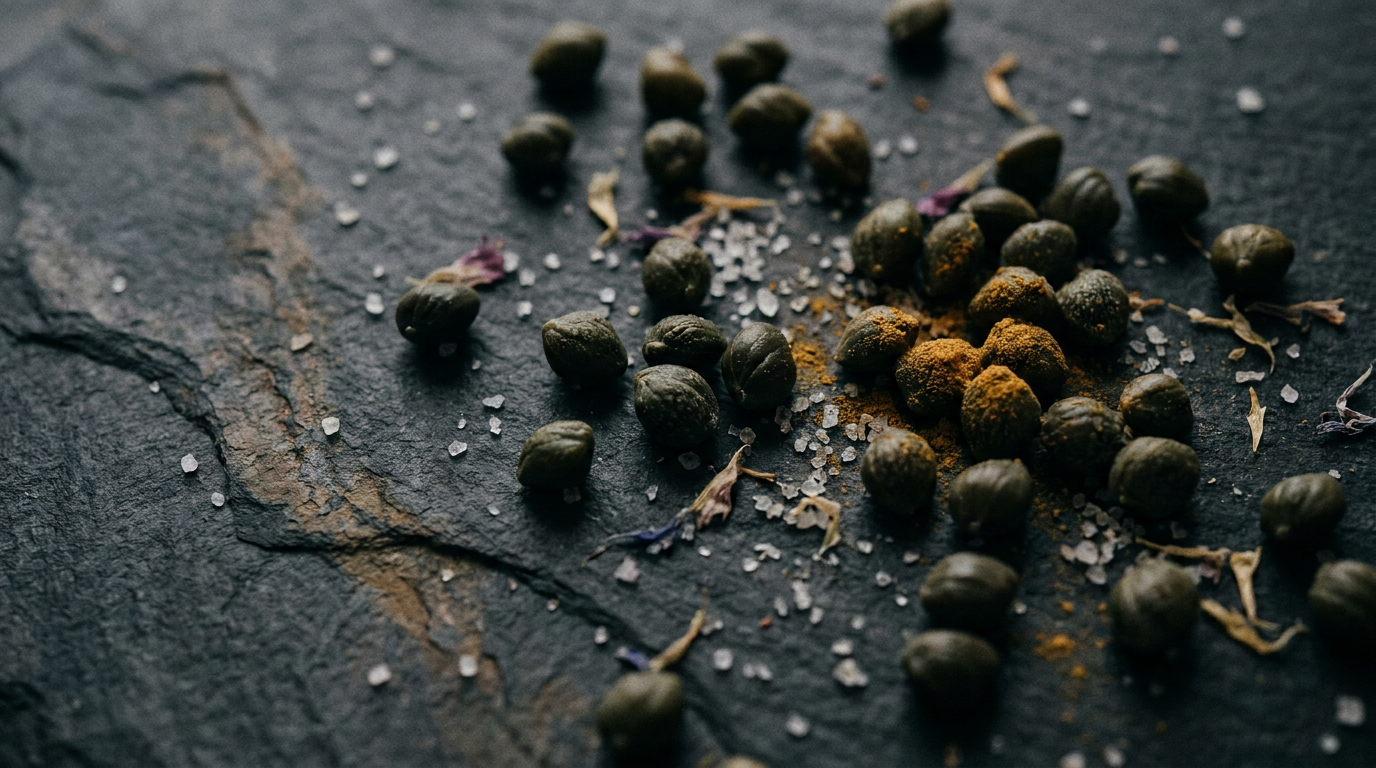
Capers are the immature, unopened flower buds of the caper bush (Capparis spinosa), a drought-tolerant perennial shrub native to the Mediterranean basin and western Asia. Eaten fresh, they are fiercely bitter. Their characteristic pungent, tangy, and savoury profile develops only after enzymatic breakdown and lactic fermentation in salt or brine, which transforms native glucosinolates into sharp isothiocyanates [1].
Pick a bud straight from a wild Capparis spinosa clinging to a limestone wall in Pantelleria or dry coastal cliff, crush it between your teeth, and you will regret it immediately. The bitterness is sharp, resinous, and stubborn. The plant produces these buds under severe heat and water stress, loading its tissues with secondary metabolites designed specifically to deter herbivores.
Transforming an inedible floral bud into a staple of Mediterranean cooking is not a matter of simply drowning it in vinegar. It is a controlled process of enzymatic hydrolysis and microbial fermentation.
The mustard oil defence: glucocapparin and methyl isothiocyanate
Like mustard, horseradish, and wasabi, the caper bush belongs to the order Brassicales. This botanical relationship explains its primary chemical defence: the glucosinolate-myrosinase system [1].
In undamaged caper tissue, the predominant glucosinolate is glucocapparin (methyl glucosinolate). Glucocapparin sits quietly inside the plant's vacuoles, chemically inert and relatively odourless. In separate cellular compartments lies an enzyme called myrosinase. When an insect chews into the bud, or when a cook crushes it, the cellular walls collapse. Enzyme meets substrate in an aqueous environment, and myrosinase cleaves the glucose group from glucocapparin.
The resulting aglycone rapidly rearranges into methyl isothiocyanate. This volatile compound is responsible for the sharp, nasal pungency that pricks your senses when you bite into a properly prepared caper. It triggers the TRPA1 receptor in sensory nerve endings, the exact channel that registers the sinus-clearing sting of mustard seeds and grated radishes.
Curing out the bitterness: salt, brine, and lactic bacteria
Fresh buds contain significant amounts of rutin, a bitter flavonoid glycoside, alongside high levels of unhydrolysed glucosinolates. To make them palatable, producers subject the buds to dry salting or brine submergence for anywhere from three weeks to several months [2].
Dry salting, typical of the southern Italian islands and the Aegean, draws out cellular water by osmosis. This collapses the cell structures, triggering the myrosinase reaction under controlled, high-salinity conditions. Halophilic and lactic acid bacteria, predominantly strains of Lactiplantibacillus plantarum, gradually colonise the brine formed by the drawn moisture [2].
These bacteria produce lactic and acetic acids, which steadily lower the pH. The acidic environment, combined with continuous enzymatic activity, degrades the excessively bitter precursors and generates a mixture of volatile organic acids, esters, and benzaldehyde. The result is that rounded, savoury tang.
If you inspect high-grade, dry-salted capers, you will often notice tiny white specks clinging to their dark green ridges. Home cooks frequently mistake these specks for mould or salt deposits. They are actually microcrystals of rutin, precipitated out of the bud's tissues as water leaves and moisture evaporates [3]. Far from a defect, these crystals indicate thorough curing.
Buds, berries, and leaves: what the bush yields
Commercial grading of capers is strictly tied to bud size. The smallest buds, termed nonpareilles (under 7 millimetres), command the highest prices. Larger buds, scaling up to grusas (over 14 millimetres), are softer, have higher internal petal development, and taste slightly less concentrated.
However, the bud is only one stage of the plant's culinary output. In parts of Greece, Turkey, and Italy, other parts of Capparis spinosa undergo similar curing treatments.
| Part of Plant | Harvest Stage | Predominant Texture | Primary Culinary Use |
| :--- | :--- | :--- | :--- |
| Caper bud | Unopened flower bud | Firm, compact, slightly crunchy | Sauces, dressings, browned butter, fish garnishes |
| Caperberry | Fertilised, developing fruit | Fleshy with soft internal seeds | Tapas, antipasti, coarse relishes |
| Caper leaf | Tender young foliage | Leathery, silken when cooked | Salads, braised greens, smoked fish wrapping |
Caperberries possess thicker walls and less intense methyl isothiocyanate release than the young buds. They retain more mucilaginous pectins, giving them a juicy crunch rather than an explosive pop of acidity and sulphur.
Handling capers in the pan
How capers are packaged dictates how they behave in cooking. Salt-packed capers retain their structural integrity better than vinegar-brined alternatives because salt draws water out while preserving cellular rigidity. Brined capers absorb dilute acetic acid, which can overwhelm the more subtle floral and herbal notes produced during fermentation.
To use salt-packed capers, soak them in cool water for ten to fifteen minutes, then drain and pat dry. This removes surface sodium chloride while leaving the internal flavour compounds intact.
When added to hot fats, such as olive oil or clarified butter, capers behave distinctively. Residual surface water flashes off rapidly. As the outer layers dehydrate in hot oil, the tiny folded petals of the bud blossom outward, turning crisp and brittle while the core stays slightly chewy. Brief frying mellows the volatile methyl isothiocyanates, giving way to nutty, toasted flavours that pair effectively with fatty fish, eggs, and brassicas.
Frequently asked questions
### Are capers related to nasturtiums?
No. Although pickled nasturtium seeds (Tropaeolum majus) are often called "poor man's capers" due to their peppery bite, nasturtiums belong to the family Tropaeolaceae, whereas capers belong to Capparaceae. Both plants contain glucosinolates that yield isothiocyanates, which explains their sensory similarity.
### What are the white spots on cured capers?
The white flecks visible on the surface of cured capers are crystallised rutin, a natural flavonoid glycoside. During the curing process, rutin leaches out through damaged plant cell walls and forms stable microcrystalline deposits. They are safe to eat.
### Should I buy salt-packed or brine-packed capers?
Salt-packed capers generally provide better texture and a cleaner flavour profile because they rely on their own fermented organic acids rather than added vinegar. Brine-packed capers are convenient, but their high acetic acid content can mask the delicate savoury nuances of the fermented bud.
### Can raw capers be eaten without curing?
Fresh, untreated capers are extremely bitter and unpalatable due to high concentrations of raw glucosinolates and rutin. They require curing in salt or brine to trigger the enzymatic and microbial conversions that produce their characteristic flavour.
Sources & citations
- Romeo, F.V., et al. (2007). 'Characterisation of volatile compounds of pickled capers (Capparis spinosa L.)', Food Chemistry, 105(4), pp. 1422–1428. https://doi.org/10.1016/j.foodchem.2007.05.029
- Pulvirenti, A., et al. (2014). 'Fermentation of caper (Capparis spinosa L.) berries: microbiology and volatile profile', Journal of Food Science, 79(8), pp. M1584–M1591. https://doi.org/10.1111/1750-3841.12529
- Inocencio, C., et al. (2000). 'Total antioxidant activity and polyphenol content in commercial caper products', Journal of Agricultural and Food Chemistry, 48(12), pp. 6095–6100. https://doi.org/10.1021/jf000624w