
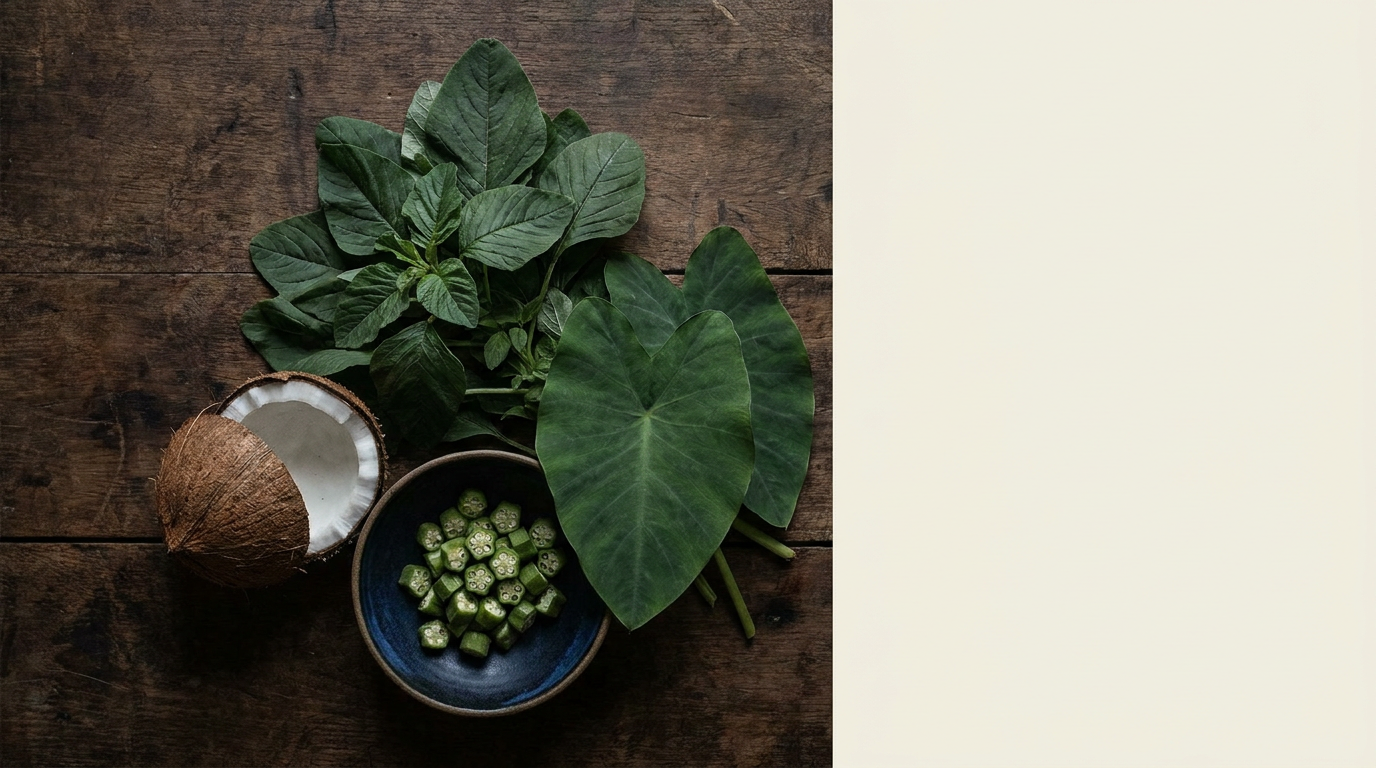
Callaloo refers both to specific leafy green vegetables—primarily Amaranthus species in Jamaica and dasheen leaves (Colocasia esculenta) in the southern Caribbean—and the savoury, stewed dishes prepared from them. Characterised by high levels of calcium, iron, and protective oxalate crystals, these disparate plants require deliberate heat and fat to render their harsh botanical defences into rich, velvety sustenance.
Ask for callaloo in Kingston, and you will receive a plate of tender, steamed amaranth greens sautéed with scotch bonnet, thyme, scallions, and perhaps salted cod. Order it in Port of Spain, and you will be handed a bowl of thick, dark green, soup-like stew made from simmered dasheen bush, okra, coconut milk, and crab. The shared name conceals a practical botanical split, united by migration, survival, and the persistent challenge of plant chemical defences.
A Tale of Two Genera
The word itself likely derives from the Tupi-Guarani or Central African languages carried through transatlantic chattel slavery, yet the plants that fill Caribbean markets under this moniker belong to entirely distinct botanical families.
| Region | Primary Botanical Source | Common Name | Key Chemical Challenge |
| :--- | :--- | :--- | :--- |
| Jamaica | Amaranthus viridis, A. dubius | Amaranth, Chinese spinach | Soluble and insoluble oxalates, mild bitterness |
| Trinidad, Grenada, Dominica | Colocasia esculenta | Dasheen bush, taro leaves | Insoluble calcium oxalate raphides with prickle effect |
| Eastern Caribbean (alternate) | Xanthosoma brasiliense | Calalu, tannia, tahitian spinach | Low-acridity raphides, tender leaf lamina |
In Jamaica, callaloo is synonymous with the genus Amaranthus [1]. These fast-growing, broad-leaf annuals produce substantial foliage under equatorial sun. The leaves contain betalains, nitrates, and non-heme iron, but like most members of the order Caryophyllales, they accumulate oxalic acid.
Travel south toward Trinidad, Guyana, and the Windward Islands, and callaloo shifts to the Araceae family. Here, cookery relies on the young heart-shaped leaves of Colocasia esculenta, locally termed dasheen bush. If you cook taro leaves like you cook amaranth—quick-steaming them in a hot skillet—you will spend the next three hours regretting the decision.
The Needle in the Leaf
The Araceae family defends its foliage through mechanical warfare. Dasheen leaves contain calcium oxalate monohydrate organised into microscopic, double-ended needles called raphides [2]. These crystals sit bundled within specialised cells known as idioblasts.
When a pest, an animal, or an impatient cook bites into an undercooked dasheen leaf, the idioblast cell ruptures, forcibly ejecting the sharp crystals into the mucous membranes of the tongue and throat. Worse, the surface of these needles carries proteolytic enzymes that act directly on tissue, intensifying the sensation into an unbearable, burning itch often referred to across the islands as "scratch".
Boiling does not dissolve calcium oxalate needles; calcium oxalate is practically insoluble in neutral water. What prolonged boiling does is denature the associated irritant enzymes and thermally disrupt the crystalline bundles, rounding off their punitive edges [3]. This is why traditional Trinidadian callaloo is simmered gently for forty-five minutes to an hour, often stirred with a traditional wooden swizzle stick until the cellular architecture collapses entirely.
Fat plays an uncredited structural role here. Simmering dasheen bush in coconut milk does more than provide flavour. The saturated lipids form an emulsion that coats the mouth, muting any micro-mechanical abrasion that survives the boil, while fat-soluble carotenoids within the greens dissolve directly into the rich broth.
Amaranth and the Sauté Pan
Jamaican amaranth poses a different problem. It does not carry spring-loaded raphide spears. Its oxalic acid is primarily dispersed, either free in solution or stored as fine druses that lack the mechanical bite of dasheen.
Because it lacks violent acridity, Jamaican amaranth can tolerate minimal cooking. A brief sweat in a covered pan preserves its green pigmentation and delicate herbaceous bite. The traditional addition of allium and capsicum serves a scientific purpose: the organic acids from scallions and tomatoes slightly drop the cooking pH, preserving chlorophyll a and b from rapid pheophytin degradation, which turns greens into a drab olive slurry.
Amaranth foliage is notably dense in beta-carotene, lutein, and magnesium [4]. However, soluble oxalates can bind to dietary calcium and iron, creating complexes the human gut cannot readily absorb. Light cooking helps soften the fibrous matrix and solubilise some free oxalates into discarded rinse waters, striking a balance between retaining volatile aromatics and improving micronutrient bioavailability.
Neither preparation is accidental. Long before cellular microscopy explained raphide idioblasts or oxalate binding, Caribbean cooks established precise thresholds: you simmer dasheen bush slowly with fat until its defences soften into velvet; you sauté amaranth briskly with herbs to keep its clean vitality intact. The names match. The chemistry demands respect.
Frequently asked questions
### Can I substitute spinach for callaloo?
In recipes calling for Jamaican callaloo (amaranth), mature English spinach or Swiss chard is a decent substitute, though chard has thicker ribs that require longer cooking. For southern Caribbean callaloo stews requiring dasheen bush, spinach will turn into an unstructured purée without providing the earthy, body-building thickness of taro leaves.
### Why does my throat itch after eating callaloo?
If you ate a southern Caribbean callaloo made from dasheen (Colocasia esculenta), the leaves were likely undercooked. The burning itch comes from calcium oxalate raphide needles that were not sufficiently deactivated through prolonged heat.
### Is canned callaloo already cooked?
Yes. Canned callaloo (almost always Jamaican amaranth) is pre-steamed and preserved in brine. It does not require boiling to break down toxins, only rinsing to adjust salt levels followed by a brief warm-through with your seasoning base.
### How does okra function in callaloo stew?
Beyond flavour, okra acts as a physical binder. Its soluble mucilage polysaccharides hydrate in the coconut broth, creating a cohesive, velvety mouthfeel that suspends the disintegrated dasheen leaves evenly throughout the liquid.
Sources & citations
- Food and Agriculture Organization of the United Nations. Traditional Crops: Amaranth. FAO Plant Production and Protection Division, 2018. https://www.fao.org/traditional-crops/amaranth/en/
- Franceschi, V. R., and Horner, H. T. "Calcium oxalate crystals in plants." The Botanical Review, vol. 46, no. 4, 1980, pp. 361–427. https://doi.org/10.1007/BF02860532
- Bradbury, J. H., and Nixon, R. W. "The acridity of raphides from the edible aroids." Journal of the Science of Food and Agriculture, vol. 76, no. 4, 1998, pp. 608–616. https://doi.org/10.1002/(SICI)1097-0010(199804)76:4<608::AID-JSFA996>3.0.CO;2-2
- Rastogi, A., and Shukla, S. "Amaranth: A promising wealth of nutritional values." Molecular Breeding, vol. 31, 2013, pp. 783–796. https://doi.org/10.1007/s11032-012-9817-1