
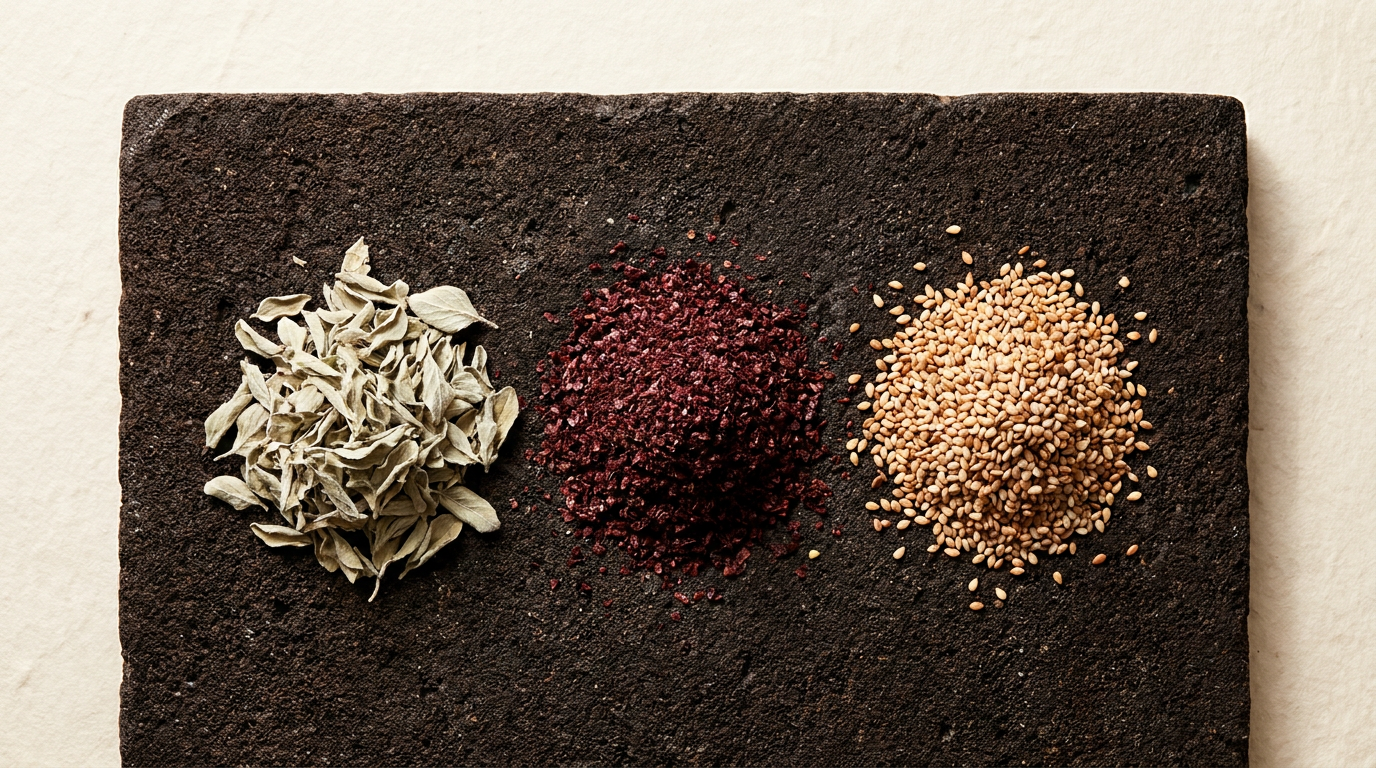
Za'atar refers both to wild Levantine herbs—primarily Origanum syriacum—and the condiment blend made from their dried leaves, toasted sesame, sumac, and salt. Documented in biblical and Talmudic texts as ezov, its pungent profile is governed by the volatile phenols carvacrol and thymol. Formulae vary across the Levant, altering the balance between sharp acidity and herbaceous warmth.
The plant before the mixture
In Western supermarkets, za'atar is sold exclusively as a dry mixture in a jar. In the eastern Mediterranean, the word belongs first to the living shrub. The plant is Origanum syriacum, often called Syrian oregano or wild thyme, though botanically it sits in the oregano genus alongside marjoram.
This linguistic conflation between the wild herb and the condiment has ancient roots. In the Mishnah and the Talmud, codified between the second and fifth centuries CE, the plant appears under the Hebrew name ezov [1]. The rabbis were not writing cookbooks; they were categorising ritual purifications and Sabbath preparations. In Tractate Shabbat (109b) and Tractate Uktzin (2:2), the text takes care to specify that when the law demands ezov, it means the wild, ordinary variety consumed by households—not "Roman hyssop", "desert hyssop", or decorative garden mints [1]. Historical botanists identify this legally standard ezov with Origanum syriacum [2]. For two millennia, the standard table herb of the southern Levant has retained a recognisable chemical fingerprint.
Carvacrol, thymol, and botanical defence
The sensory identity of Origanum syriacum relies on two isomeric monoterpenoid phenols: carvacrol and thymol. Both possess the same chemical formula ($C_{10}H_{14}O$), but they differ in the position of their hydroxyl group relative to the isopropyl group on the aromatic ring.
```
Carvacrol: 2-methyl-5-(propan-2-yl)phenol
Thymol: 5-methyl-2-(propan-2-yl)phenol
```
These compounds do not exist to complement olive oil. They are defensive secondary metabolites synthesised in glandular trichomes on the leaf surface to deter herbivores, inhibit bacterial infection, and prevent fungal rot under the hot, dry Mediterranean sun [3]. When you crush a dried leaf, these peltate glands rupture, releasing the volatile phenols immediately.
Carvacrol provides the assertive, piercing warmth characteristic of oregano. It activates human transient receptor potential channels TRPV3 (warmth) and TRPA1 (irritant and pungent sensations). Thymol provides a slightly medicinal, cooling, camphoraceous undertone, the same phenol responsible for the bite of garden thyme (Thymus vulgaris). In wild Origanum syriacum, carvacrol typically dominates, accounting for 40 to 80 per cent of the total essential oil content, with thymol functioning as the secondary phenol, alongside precursors such as p-cymene and $\gamma$-terpinene [3].
When combined with sumac (Rhus coriaria), which introduces malic and citric acids, and roasted sesame seeds (Sesamum indicum), which introduce neutral lipids and roasted pyrazines, the blend achieves sensory stability. The oil from the sesame coats the palate, slowing the evaporation of volatile carvacrol, while the acid from the sumac sharpens the lingering phenol bitterness.
Regional formulas across the Levant
No single statutory recipe governs za'atar. Because wild oregano chemotypes fluctuate based on soil alkalinity, elevation, and rainfall, blending traditions adapted to what grew locally and what preserved best.
| Region | Herb Foundation | Acid & Astringency | Secondary Additions | Profile Notes |
| :--- | :--- | :--- | :--- | :--- |
| Palestinian | Origanum syriacum | High sumac ratio | Toasted sesame, salt | Intense green, phenolic, high acidity; sharp bite |
| Lebanese | O. syriacum or Satureja thymbra | Moderate sumac | Heavy white sesame, salt | Brighter green, more floral and herbal, lower tannin |
| Syrian (Aleppian) | Origanum with wild thyme | Sumac or boiled sumac paste | Coriander, cumin, anise, fennel, caraway | Dark, warm, complex; distinct seed-spice aromatics |
| Jordanian | Origanum syriacum | Heavy coarse sumac | Sesame, salt | Earthy, intensely red-tinted, sharp acid edge |
In Aleppo, the tradition often diverges into za'atar ahmar (red za'atar), where dried herbs share equal space with roasted melon seeds, pomegranate molasses, ground coriander, and cumin. In Palestine and Jordan, purity of the wild green herb takes precedence; any addition beyond sesame, sumac, and salt is often regarded as unnecessary adulteration.
The modern adulteration problem
Because authentic Origanum syriacum must be harvested in specific seasons and dried without excessive heat, cheap commercial alternatives proliferate. The most common compromise is the substitution of dried marjoram (Origanum majorana) or European culinary oregano (Origanum vulgare). These species contain lower concentrations of carvacrol and higher levels of sabinene, terpinen-4-ol, or linalool, yielding a softer, perfumed, or woodier profile that lacks the distinctive throat-catching bite of Levantine ezov.
More cynical commercial shortcuts replace sumac with synthetic citric acid dyed with low-grade vegetable colourings, and bulk out the herbs with roasted wheat bran or powdered hulls. The test for an authentic blend is straightforward: mixed with cold-pressed olive oil, the dried leaf should retain an assertive, slightly bitter phenolic heat that registers clearly at the back of the mouth, rather than dissolving into a sour, salty paste.
Frequently asked questions
Is the hyssop in English Bibles the same as za'atar?
Botanically, no. English translations of the Bible historically translated ezov as "hyssop", which led later European herbalists to identify it with Hyssopus officinalis, a blue-flowered plant native to southern Europe. However, historical and botanical consensus confirms that biblical ezov was the native Levantine plant Origanum syriacum [1, 2].
Can you make authentic za'atar with standard supermarket oregano?
It will taste pleasant, but it will not replicate the flavour profile. European culinary oregano (Origanum vulgare) and Mediterranean marjoram (Origanum majorana) have different dominant volatile compounds and noticeably less carvacrol punch than Origanum syriacum.
Why does za'atar vary so much in colour?
The colour depends on two factors: the ratio of sumac to herb, and the curing technique of the leaves. Blends high in whole crushed sumac berries take on a dark, brick-red hue, while mixtures dominant in quickly shade-dried Origanum syriacum remain vibrant olive-green.
Sources & citations
- Amar, Z. (2012). Flora of the Bible and Mishnah. Bar-Ilan University Press.
- Fleisher, A., & Fleisher, Z. (1988). Identification of biblical hyssop and origin of the traditional use of oregano-group herbs in the Mediterranean area. Economic Botany, 42(2), 232–241.
- Dudai, N., et al. (1992). Essential oil composition of Origanum syriacum L. Journal of Agricultural and Food Chemistry, 40(6), 942–945.
- Lukas, B., et al. (2015). Composition and variability of essential oils in the genus Origanum. Phytochemistry, 119, 32–40.