
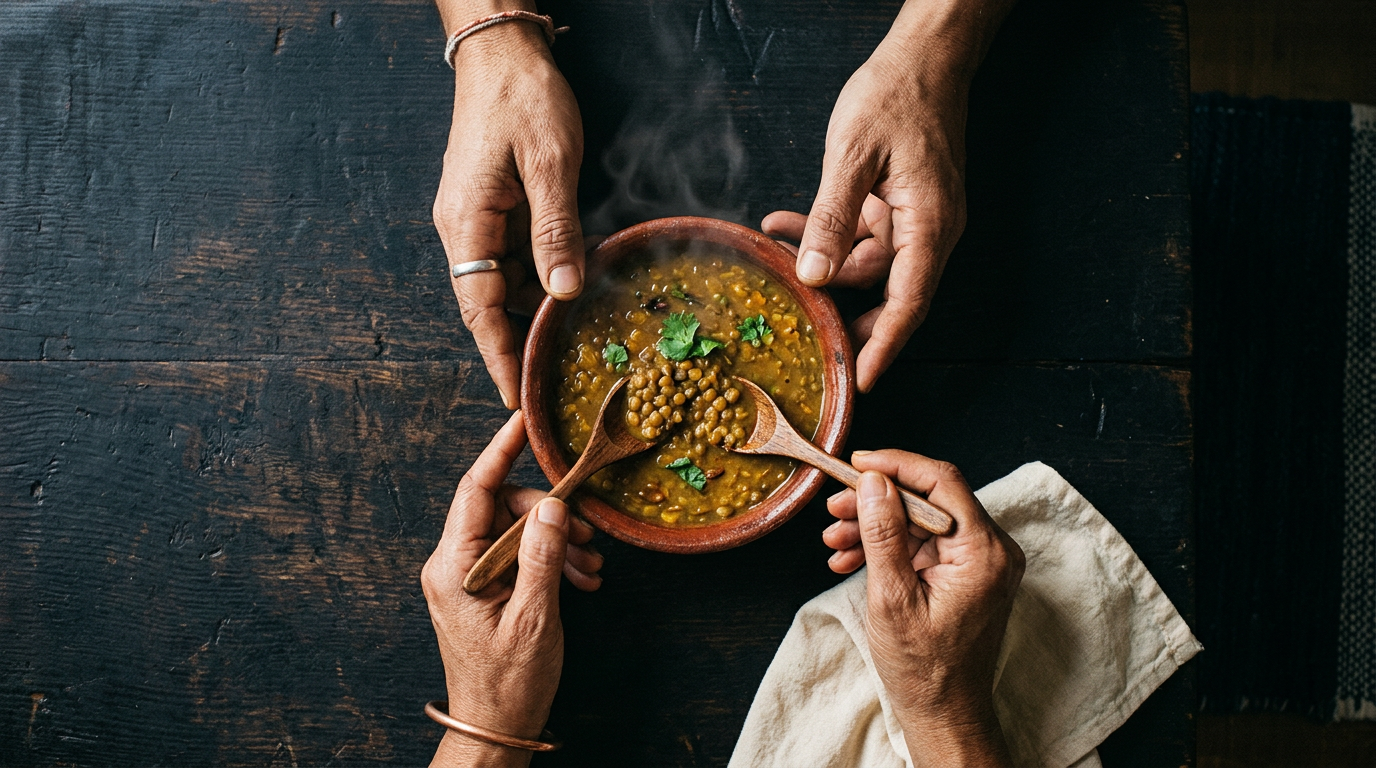
The science of sharing food friendship reveals a profound biological truth: eating together is one of the most powerful bonding experiences available to us. It triggers the release of oxytocin, the same neurochemical that floods our system during a long hug, reinforcing social ties and generating feelings of trust and well-being. This isn't just a cultural phenomenon; it's a deeply wired part of our human hardware.
As we approach the International Day of Friendship on July 30th, it’s a good moment to look at the chemistry behind our connections. We often think of friendship as an emotional or psychological construct, but it has a physical, measurable dimension. The simple act of breaking bread—or sharing a bowl of dal, or passing a plate of tacos—is where that physicality comes to life.
The Hug Hormone, on a Plate
Oxytocin is often nicknamed the “cuddle hormone” or “love drug,” and for good reason. Our bodies produce it during moments of connection—from childbirth and nursing to holding hands or simply making eye contact with someone we trust. It acts as a neuromodulator in the brain, reducing stress and anxiety while enhancing our sense of empathy and bonding [1].
For years, research focused on physical touch. But newer studies are expanding this understanding to commensality, the practice of eating at the same table. It turns out that the coordinated, pro-social behavior of a shared meal—the passing of dishes, the matching of eating rhythms, the shared sensory experience—can also trigger a significant oxytocin release. It’s a signal to our primate brain: these are your people. You are safe.
Think of it as a collective exhale. The stresses of the outside world dim as the aromas of the meal heighten your senses. A shared meal isn't just about refueling the body; it's about re-calibrating our social nervous system.
Commensality is a Universal Language
Every culture understands this intuitively. It's why major life events, from weddings to funerals, are marked with food. It’s why a business deal is sealed over dinner, and a first date often involves a meal. Food is the setting, but connection is the script.
This principle is a true globetrotter. In the bustling Djemaa el-Fna square in Marrakech, you’ll find families and friends gathered around bubbling earthenware tagines, the air thick with the scent of cumin and slow-cooked lamb. In Oaxaca, Mexico, communities spend days together preparing vast quantities of mole negro, a complex sauce that is the centerpiece of celebration. In the Or Tor Kor market in Bangkok, vendors offer shared plates of fresh fruit and sticky rice, turning a simple transaction into a moment of connection.
Even our language reflects this. The word “companion” comes from Latin: com- (“with”) and -panis (“bread”). A companion is, quite literally, the person with whom you share bread.
| Feature | Solo Desk Lunch | Shared Communal Meal |
| :--- | :--- | :--- |
| Primary Hormone | Cortisol (stress) | Oxytocin (bonding) |
| Eating Rhythm | Rushed, unconscious | Synchronized, mindful |
| Social Signal | Isolation, efficiency | Belonging, trust |
| Sensory Focus | Screen, work | Food, conversation, people |
Cumin: The Warmth of Connection
If commensality had a flavor, it might be the warm, earthy, and slightly pungent note of cumin. Cumin is one of the world's most popular spices, second only to black pepper, and its reach speaks to its role as a unifier. You'll find it generously sprinkled in Mexican chili, forming the backbone of Indian curries, and toasting in the dry pans of Middle Eastern kitchens.
We source our cumin (Cuminum cyminum) from the sandy loam soils of Gujarat in [/region/india], where farmers have cultivated it for generations. Its primary aromatic compound, cuminaldehyde, is responsible for that signature warmth that feels both grounding and expansive. When you use a spice of this quality, you’re not just adding flavor; you’re participating in a story of trade and tradition that has connected cultures for millennia [2]. That warmth in your bowl is the sensory echo of the warmth in the room.
This International Day of Friendship, instead of just sending a text, consider sharing a meal. Make a simple, nourishing lentil soup, generously spiced with toasted cumin. The science of sharing food friendship suggests it might just be the best gift you can give. You can find our simple [recipe here](/recipe).
### Frequently Asked questions
1. What is commensality?
Commensality is the practice of eating together. The term originates from the Latin com (together) and mensa (table). It's a field of study in sociology and anthropology that explores the social and cultural significance of shared meals.
2. Does the type of food shared matter for the oxytocin effect?
While indulgent or 'comfort' foods can have their own pleasure-inducing effects, the research on commensality suggests the social act of sharing is the primary driver of oxytocin release, more so than the specific menu. The key is the cooperative, shared experience [3].
3. Is sharing a meal really as good as a hug?
From a neurochemical perspective, both activities can increase oxytocin levels, promoting feelings of bonding and well-being. While they are different experiences, they tap into the same biological system designed to strengthen social ties. A shared meal could be thought of as a very long, very delicious hug.
4. What is the International Day of Friendship?
The International Day of Friendship was proclaimed by the UN General Assembly with the idea that friendship between peoples, countries, and cultures can inspire peace efforts and build bridges between communities. It is celebrated annually on July 30th [4].
Sources & citations
- Freedman, R. (2020). A new look at the “cuddle hormone”. UCLA Health. https://connect.uclahealth.org/2020/09/25/a-new-look-at-the-cuddle-hormone/
- Britannica, The Editors of Encyclopaedia. (2024). Cumin. Encyclopedia Britannica. https://www.britannica.com/plant/cumin
- Tarr, J., et al. (2022). Food and social connection. In The Psychology of eating: From trusted expert sources (pp. 51–64). MIT Press.
- United Nations. International Day of Friendship. https://www.un.org/en/observances/friendship-day