
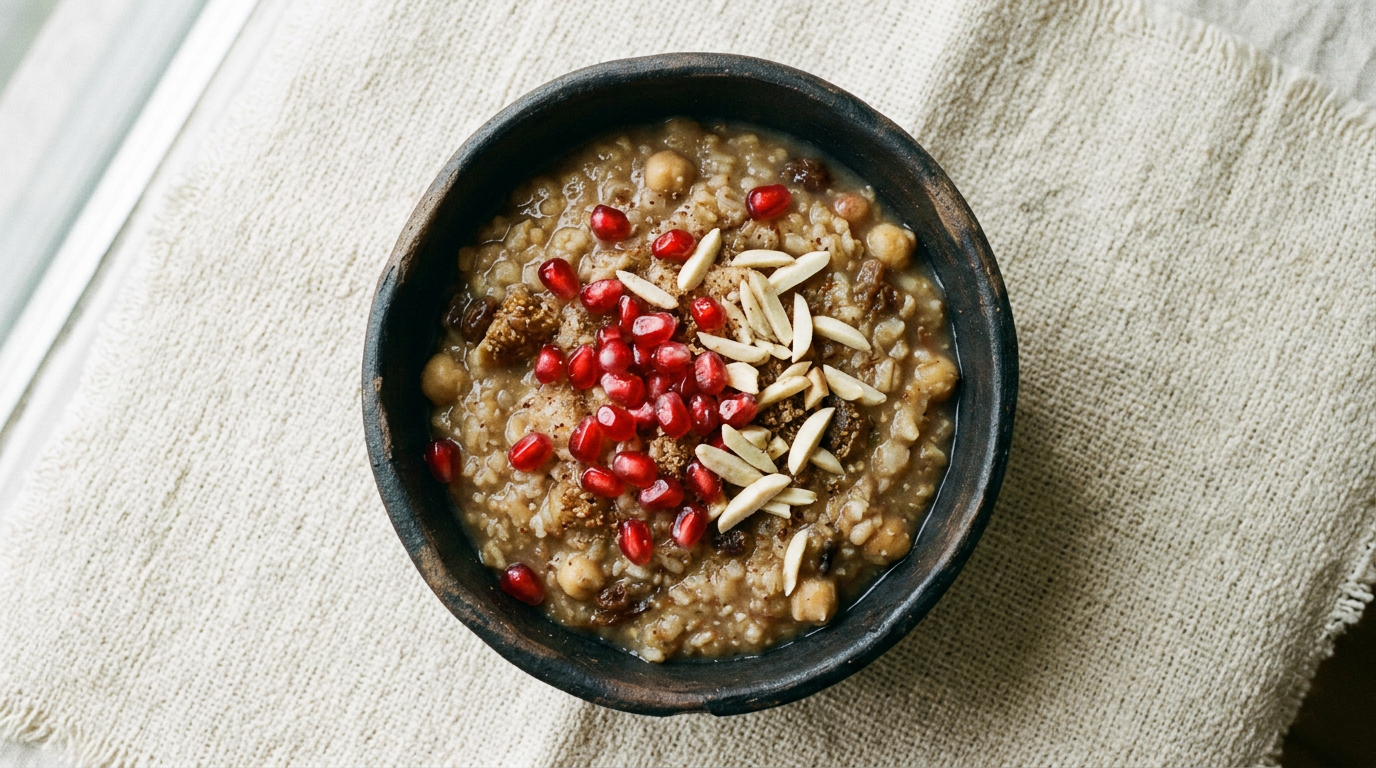
This is the ideal Ashura pudding recipe for anyone who has ever wondered why it works. For years, I just followed instructions. A scoop of this, a handful of that. It was an act of faith. Now, as we approach Ashura on the Islamic calendar date 1448, I can finally see the elegant science my elders practiced by instinct, a culinary wisdom passed down through generations in places like the [/region/uae](UAE), Iraq, and beyond.
Every year, my grandmother would describe the pudding as a symbol of unity, a dish made from the last provisions on Noah’s Ark after the flood [1]. It was a beautiful story, but it was also a masterclass in food chemistry, texture, and nutrition.
The Symphony of Starches
The foundation of any great Ashura pudding is the grain. We use pearled wheat, but depending on the region, it could be barley or rice. This is paired with legumes like chickpeas and white beans. For years, I saw this as just ‘bulk.’ Now I see it as a carefully constructed matrix of complex carbohydrates.
When you slow-cook the wheat, its starches—amylose and amylopectin—gelatinize, absorbing water and creating that signature creamy, comforting thickness. The chickpeas and beans do more than just add bite; they introduce resistant starch and fiber, which are brilliant for gut health [2]. They also contribute to the Maillard reaction, the gentle browning process that creates deep, savory-sweet background notes. The Iraqi version, sometimes called `qaymah`, leans heavily into this slow cooking, turning the wheat into an almost seamless porridge.
A Spectrum of Sweetness
Next come the fruits. I remember trips to the Deira Spice Souk in Dubai to buy Turkish apricots and Iranian figs. My friend in Hyderabad insists on adding a handful of cashews and local `kishmish` (raisins). In our family’s version, we use chopped Khudri dates from Saudi Arabia, prized for their firm texture and restrained, caramelly sweetness.
This isn't just about adding sugar. Dried apricots provide a tartness from malic and citric acid, cutting through the richness. Figs offer a jammy texture and tiny, crunchy seeds. Dates bring a deep, molasses-like flavor. Critically, these whole fruits deliver their sweetness packaged with fiber, which slows the absorption of fructose and glucose into the bloodstream. It's a more intelligent, satisfying sweetness than you'd ever get from refined sugar alone.
The Nutmeg Revelation
For me, the real magic happens with the spices. The scent of a kitchen where Ashura is being made is unforgettable. While many recipes use a blend, the anchor in ours was always nutmeg, freshly grated at the last moment.
This isn’t just for show. The rough rasp of the grater against the hard seed is a mechanical process that ruptures the plant's cell walls, releasing an incredibly complex bouquet of volatile oils. The dominant compound in nutmeg is myristicin, but it's accompanied by sabinene (woody), limonene (citrusy), and pinene (pine-like) [3]. These molecules are what create that warm, intoxicating aroma.
Pre-ground nutmeg, sitting in a jar for months, has lost most of these volatile compounds to oxidation. The elders knew this. “Always grind it fresh,” they’d say. Now I know why: you are not just adding flavor, you are performing a small, fragrant chemical extraction. While nutmeg provides this warm, woody base, a pinch of green [/spice/cardamom](cardamom) can add a bright, eucalyptus-like top note, a perfect contrast.
This legendary Ashura pudding recipe is more than a tradition. It is a time-tested protocol for nutrient-dense, slow-release energy. It's a lesson in balancing fats from nuts, sugars from fruits, and starches from grains. Science doesn't diminish the mystery of my grandmother's cooking; it illuminates her genius. She was a chemist, a nutritionist, and a storyteller, all stirring one magnificent pot.
Frequently Asked Questions
1. What is Ashura pudding?
Ashura pudding, also known as Noah's pudding, is a celebratory sweet porridge made across the Middle East, South Asia, and the Balkans. It consists of a mix of grains, legumes, dried fruits, nuts, and spices. It is traditionally prepared to commemorate the Day of Ashura.
2. Why is it eaten on the Day of Ashura?
It symbolizes the meal Prophet Noah is said to have made with the last of his provisions after the Ark rested on Mount Ararat. Sharing the pudding with family, friends, and neighbors is an act of community, remembrance, and charity [4].
3. Can I make this Ashura pudding recipe vegan?
Absolutely. The recipe's core ingredients are naturally plant-based. If your family version includes dairy milk, you can easily substitute it with water, oat milk, or almond milk for a fully vegan dish.
4. What is the scientific role of spices in Ashura pudding?
Beyond providing aroma and flavor, spices like nutmeg and cloves were historically prized for their antimicrobial properties, which helped preserve food. Modern science shows the volatile compounds in these spices, like myristicin in nutmeg, have a range of bioactive properties that are subjects of ongoing research [3]. Grating them fresh maximizes the availability of these compounds.
Sources & citations
[1] Encyclopaedia Britannica. "Day of Ashura". www.britannica.com.
[2] Food and Agriculture Organization of the United Nations. "Whole grains and pulses". www.fao.org.
[3] Shulgin, A. T. (1963). "Composition of the Volatile Oil of Nutmeg." Nature, 197(4865), 379–379. doi:10.1038/197379a0. Available at: www.nature.com.
[4] The National UAE. (2021). "What is the Islamic New Year and why is Ashura marked? An explainer". www.thenationalnews.com.