
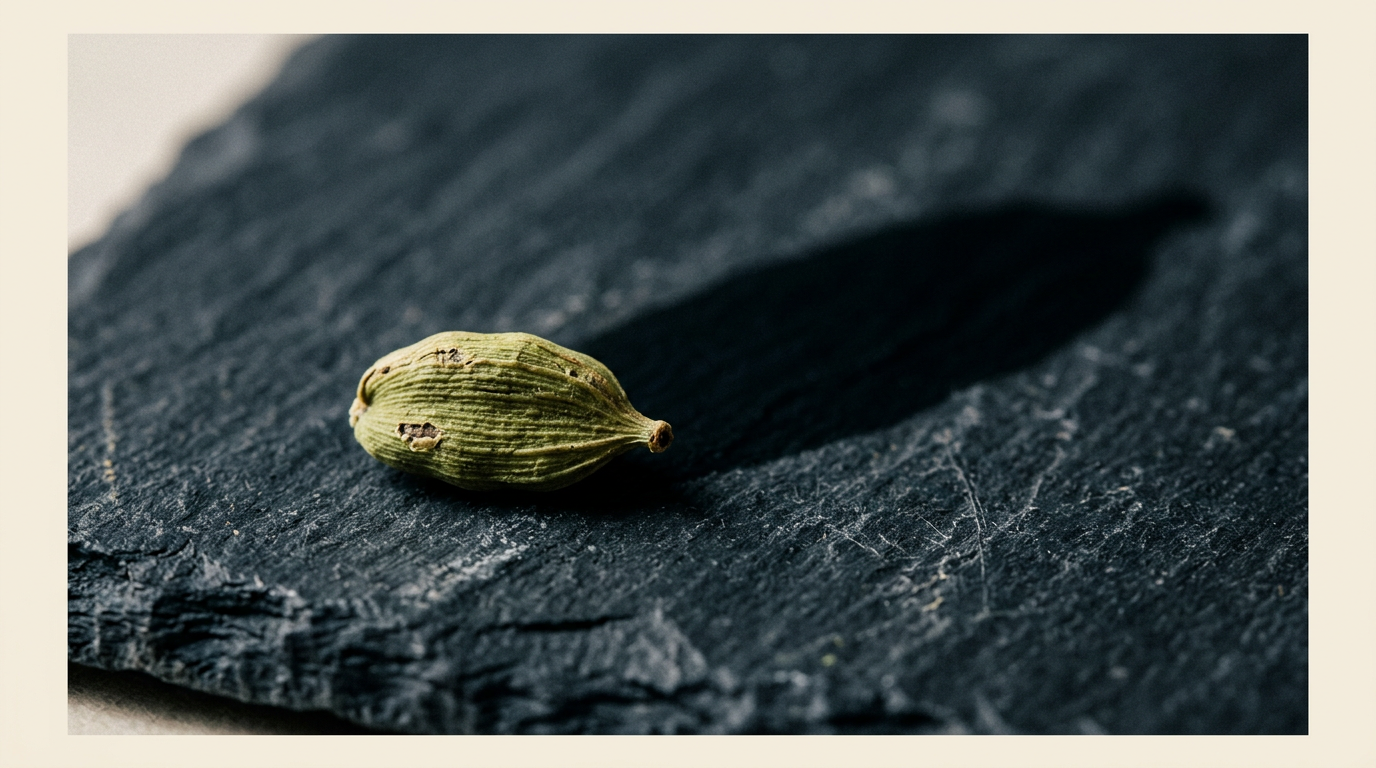
What is the cardamom carbon footprint UK consumers should know about? A kilogram of conventionally grown, air-freighted Indian cardamom landing on a London shelf can carry a footprint of 20-30 kg of CO2 equivalent (CO2e). This figure, however, is a blunt instrument. It papers over crucial decisions in farming, processing, and logistics that can alter the final number by a factor of ten, revealing a complex story of climate impact.
Imagine the scent: a warm, floral-pine note blooming in a cup of chai at a Borough Market stall. It’s the fragrance of green cardamom, Elettaria cardamomum, the queen of spices. Now, trace that scent 8,000 kilometres back to its source: the misty, biodiverse Cardamom Hills of the Western Ghats in Kerala. The journey is not just one of distance, but of energy. And understanding that energy is the key to understanding its true cost.
The Journey Begins: Soil and Shade
Cardamom is a specific plant. It thrives not in open, tilled fields, but in the dappled light beneath the canopy of a taller forest. The best cardamom grows in agroforestry systems that mimic its native habitat. This method is good for the plant and good for the planet. The multi-story canopy of trees acts as a carbon sink, the leaf litter creates a rich humus layer that retains water, and the biodiversity supports pollinators and natural pest control. This is ancient, ecological wisdom, and its carbon ledger is often balanced, if not negative.
However, rising demand has pushed some cultivation towards more intensive methods. This can mean clearing forest cover and relying on synthetic nitrogen fertilisers. These fertilisers are energy-intensive to produce and, when applied to the soil, release nitrous oxide (N2O), a greenhouse gas nearly 300 times more potent than carbon dioxide [1]. The climate story of a cardamom pod begins here, in the soil.
Curing: The Hidden Energy Hog
After harvest, green cardamom pods are nearly 85% water. To become the shelf-stable spice we recognise, they must be dried to around 10% moisture. This curing process is the most energy-intensive stage of cardamom's journey and a critical, often-overlooked, factor in its final carbon tally.
The traditional, and lowest-carbon, method is sun-drying. It's slow and entirely dependent on reliable, sunny weather. In the monsoon-heavy climate of Kerala, this isn't always practical.
The common alternative is the bhatti, a type of curing house that uses burnt firewood or diesel to generate hot air, which is then piped through drying chambers. These rudimentary systems can be inefficient, consuming large amounts of fuel and releasing significant CO2 and particulate matter [2]. The choice of fuel, the efficiency of the kiln, and the skill of the operator all create wild variations in the energy cost.
This is a place where small interventions have an outsized impact. Shifting to high-efficiency, electric-powered heat pumps, or even solar-powered dryers, can dramatically slash the carbon footprint of this single, critical step. It’s a detail that separates a truly climate-conscious supply chain from a conventional one.
The 8,000-Kilometre Question
Once cured, the pods—now much lighter—begin their long trip from the hills of Idukki to a port like Kochi, and then on to the /region/uk. Here, the choice of transport is paramount. High-value, low-weight goods like spices are often air-freighted to meet the 'just-in-time' demands of modern retail and to ostensibly preserve freshness. The climate implications, as a glance at the numbers shows, are stark.
| Transport Method | Speed (Kochi to London) | Approx. CO2e per tonne-km | Total CO2e for 1kg (8,000 km) |
| :--- | :--- | :--- | :--- |
| Air Freight | 1-2 days | ~500g [3] | ~4.0 kg |
| Sea Freight | 25-30 days | ~15g [3] | ~0.12 kg |
Note: These are estimates for the freight leg only.
As the table shows, flying a kilogram of elaichi (the Hindi name for cardamom) to the UK emits over 30 times more carbon than sending it by sea. A supply chain built on sea freight requires more planning, more capital tied up in inventory, and a deep trust between grower and buyer. It is, in short, harder. But it demonstrates a serious commitment to reducing impact.
Beyond the Carbon Count
When we trace the cardamom carbon footprint UK markets generate, we find it’s a story of a thousand small decisions. The farmer's choice to use compost over chemicals. The processor's choice of curing fuel. The exporter’s choice of sea over air. The brand’s choice of packaging. Summed up, these choices can reduce a spice’s embedded carbon by 90% or more.
But this isn't just about the numbers. The path to a lower-carbon /spice/cardamom is also the path to a better spice. Agroforestry systems produce more complex, aromatic cardamom. Careful, slower curing preserves volatile oils better than rapid, high-heat drying. Sea freight, when managed in climate-controlled containers, can deliver a product just as vibrant as its air-shipped cousin. Thinking about climate forces us to think about quality, and that leads to a better outcome for everyone, from the soil of the Western Ghats to the spoon in your hand.
### FAQ
1. Is sea freight always better than air freight for spices?
From a carbon emissions perspective, yes, by a significant margin. However, it requires careful management of moisture and temperature in the container to maintain the quality of sensitive spices over the longer journey.
2. What does CO2e or 'carbon dioxide equivalent' mean?
CO2e is a standard unit for measuring carbon footprints. It converts the impact of different greenhouse gases, like methane (CH4) or nitrous oxide (N2O), into the equivalent amount of carbon dioxide (CO2) [4]. This allows for a single, comparable number.
3. Does organic cardamom have a lower carbon footprint?
Often, yes. Organic farming forbids synthetic nitrogen fertilisers, a major source of nitrous oxide emissions. It also promotes soil health, which can increase the amount of carbon stored in the ground. However, the total footprint also depends heavily on processing and transport.
4. How can I, as a consumer, choose lower-impact spices?
Look for brands that are transparent about their supply chains. Do they talk about how their spices are grown, dried, and transported? Do they work with farmers who use regenerative or agroforestry practices? Supporting brands that prioritise these details is a powerful choice.
Sources & citations
- Foley, J.A., Ramankutty, N., Brauman, K.A., et al. (2011). Solutions for a cultivated planet. Nature, 478, 337–342. Available at: https://www.nature.com/
- Singh, H. & T. K., Anup. (2012). Development and evaluation of a biomass-fired furnace for a small-scale cardamom dryer. Journal of Agricultural Engineering, 49. Available at: https://www.isAE.in/
- Department for Environment, Food & Rural Affairs (DEFRA). (2023). Greenhouse gas reporting: conversion factors 2023. Available at: https://www.gov.uk/government/publications/greenhouse-gas-reporting-conversion-factors-2023
- United States Environmental Protection Agency (EPA). (n.d.). Understanding Global Warming Potentials. Available at: https://www.epa.gov/ghgemissions/understanding-global-warming-potentials