
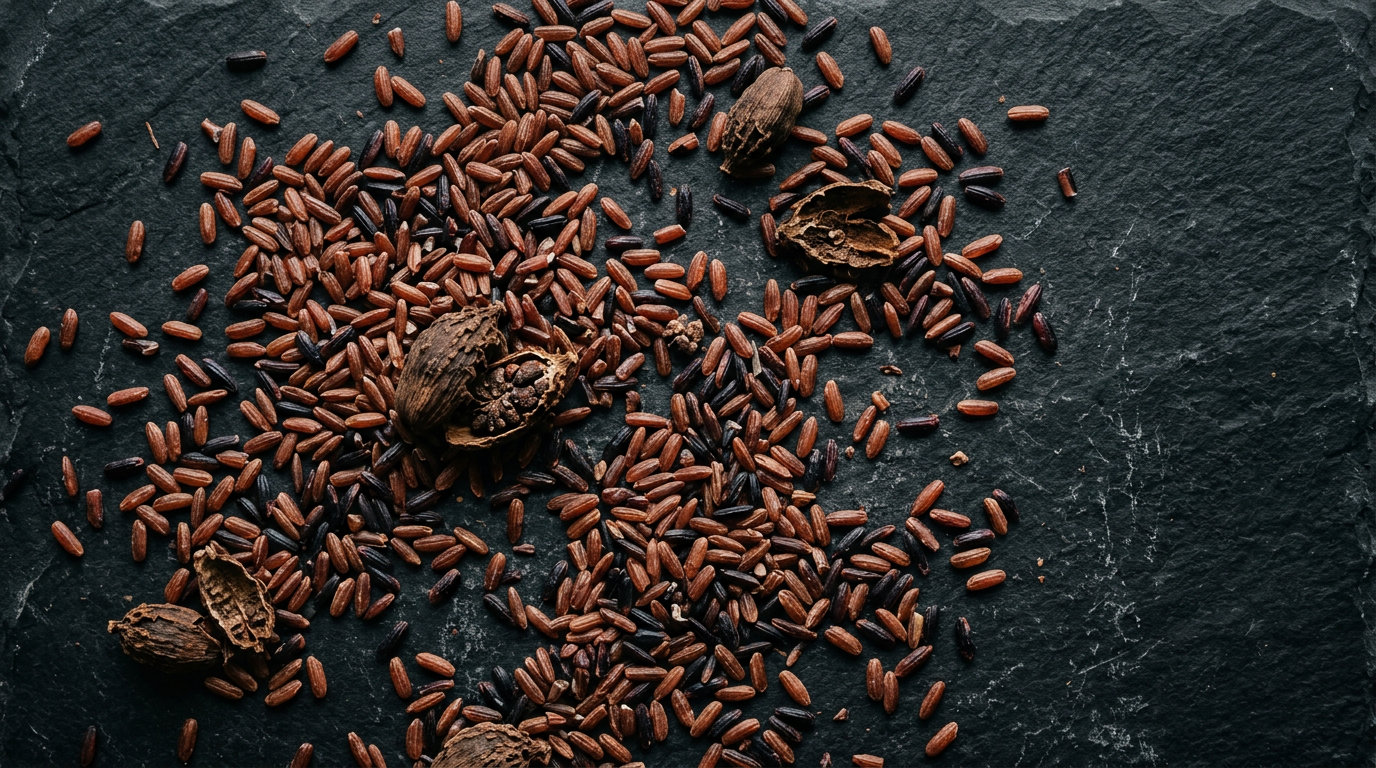
Heirloom rice varieties—including pigmented black rice (Chak-hao), deep red rices, and parboiled Kerala Matta—are genetically distinct, ancestral cultivars preserved outside industrial monoculture breeding programs. Unlike polished white rice stripped of its bran, heirloom grains retain intact aleurone layers dense with bioactive anthocyanins, protective plant lignans, and bioavailable minerals like magnesium, iron, and zinc, delivering profound metabolic resilience [1].
The Cost of the Polished Grain
For roughly six decades, grain breeding prioritized three blunt variables: yield per hectare, ease of mechanical milling, and shelf stability. The Green Revolution undoubtedly transformed caloric output, but it did so by shearing off the aleurone layer—the razor-thin outer cellular coat where a seed concentrates its defensive chemistry [2]. What remained was endosperm: an efficient, uniform block of rapidly digestible amylopectin and amylose. In trade, we exchanged an intricate biochemical library for pure, shelf-stable starch.
Yet across coastal Kerala, the hills of Manipur, and the terraced soils of Bhutan, multi-generational farming enclaves quietly maintained landraces that look and behave nothing like commercial long-grain white rice. These grains do not yield easily to combine harvesters. They cook slowly, smell of wet slate and toasted hazelnuts, and steep cooking water into hues of deep ink and burgundy. What modern palates originally dismissed as rustic coarse grains are now proving to be sophisticated nutrient delivery systems that modern industrial hybridization inadvertently erased.
The Pigment Chemistry: Anthocyanins Beyond Berries
The inky, purple-black hue of varieties like Manipuri Chak-hao is not cosmetic; it is a clinical marker. The pericarp of black rice contains dense concentrations of anthocyanins, predominantly cyanidin-3-glucoside (C3G) and peonidin-3-glucoside [3]. While mainstream nutrition obsessively catalogs blueberries and acai for these molecules, pigmented heirloom rices frequently match or exceed them in total antioxidant capacity on a dry-weight basis—without the accompanying fructose.
In human trials, cyanidin-3-glucoside functions as an epigenetic and metabolic modulator. It has been shown to upregulate hepatic AMP-activated protein kinase (AMPK), suppressing lipogenesis and slowing the rate at which digestive enzymes hydrolyze starch [1]. When you consume heirloom black rice, these pigments act as natural alpha-glucosidase inhibitors, buffering postprandial glucose excursions and flattening the glycemic response curve that makes refined carbohydrates so metabolically taxing.
Lignans and the Aleurone Layer
Red varieties—such as the terracotta-colored Palakkadan Matta from southern India or Himalayan Red rice—derive their pigment from proanthocyanidins rather than anthocyanins. But their quiet superpower lies in plant lignans. These diphenolic compounds, particularly secoisolariciresinol, reside bound within the insoluble fiber matrix of the bran.
When heirloom rice reaches the colon intact, the microbiome ferments these plant precursors into bioactive mammalian enterolignans: enterodiol and enterolactone [4]. Circulating enterolignans bind weakly to cellular estrogen receptors, exerting a stabilizing, anti-proliferative effect across sensitive tissues and demonstrating inverse associations with cardiovascular mortality [4]. Industrial milling strips 90 percent of these compounds into animal feed; heirloom cooking keeps them on the dinner plate.
Furthermore, the extensive root architectures of these ancient landraces draw up deep trace minerals that short-cycle modern dwarfs simply miss. Unpolished Kerala Matta consistently displays robust quantities of magnesium, zinc, and bioavailable iron, encased in a parboiled pericarp that forces water-soluble nutrients directly into the grain's starchy core during traditional hydrothermal processing [2].
Comparing the Grains
| Grain Variety | Primary Phytochemicals | Predominant Fiber & Lignans | Mineral Density | Culinary Behavior |
| :--- | :--- | :--- | :--- | :--- |
| Polished White | Trace polyphenols | Minimal (<1g/100g); negligible lignans | Stripped during milling; low Mg/Zn | Soft, neutral, fast-cooking, high GI |
| Black (Chak-hao) | Cyanidin-3-glucoside, peonidin | High soluble fiber, abundant anthocyanin-lignin matrix | High in iron, zinc, and selenium | Nutty, floral, deep indigo, firm tooth |
| Kerala Matta | Proanthocyanidins, catechins | Dense insoluble fiber, secoisolariciresinol | Rich in magnesium, iron, and calcium | Earthy, plump, chewy, robust mouthfeel |
| Himalayan Red | Condensed tannins, ferulic acid | High resistant starch, complex plant lignans | Elevated zinc and trace minerals | Russet hue, toasted nut profile, holds shape |
Culinary Alchemy: The Resonance of Black Cardamom
Cooking ancestral grains requires abandoning the rapid-boil mentality of white rice. Because the bran layer is intact, these grains demand slow hydration. In our kitchens, we pair the deep, tannin-rich profile of red and black heirloom grains with smoky black cardamom (badi elaichi).
Unlike green cardamom, which is dried gently to preserve floral, sweet terpinyl acetate, black cardamom is dried over open fires, yielding high concentrations of 1,8-cineole alongside smoky pyrazines. When simmered together, the cineole cuts through the dense, heavy waxes of the rice bran, tenderizing the grain and blooming its natural hazelnut aromatics. It is an intentional botanical pairing: the cineole enhances gastric motility, ensuring that the high-fiber aleurone layer digests cleanly without bloating.
Frequently Asked Questions
Does soaking heirloom rice destroy its beneficial nutrients?
No. Soaking heirloom grains for 4 to 8 hours activates endogenous phytases, enzymes that degrade phytic acid. This process unlocks bound zinc, iron, and magnesium, making them significantly more bioavailable while cutting cooking time in half.
Can people with glucose sensitivity eat heirloom rice safely?
While heirloom rice remains a carbohydrate source, its rich matrix of intact fibers, resistant starches, and polyphenolic alpha-glucosidase inhibitors produces a significantly lower glycemic response than polished white rice [1]. Portion control remains sensible, but the metabolic trajectory is markedly different.
Why does parboiled Kerala Matta feel so heavy compared to jasmine rice?
Matta rice undergoes traditional parboiling—soaking, steaming, and drying in the husk before milling. This drives the bran's micronutrients into the grain and gelatinizes the starch, shifting its crystalline structure into resistant starch. The resulting grain is far more dense, satiating, and slow to digest.
Sources & citations
- Food Chemistry. Anthocyanin composition, antioxidant activity, and metabolic effects of pigmented rice. foodchemistryjournal.com
- Food and Agriculture Organization (FAO). Nutritional quality of ancestral and parboiled cereal cultivars. fao.org
- Journal of Agricultural and Food Chemistry. Cyanidin-3-glucoside and bioactive profiles of indigenous black rice varieties. pubs.acs.org
- PubMed / The American Journal of Clinical Nutrition. Dietary plant lignans, gut microbial metabolism, and cardiovascular risk. pubmed.ncbi.nlm.nih.gov