
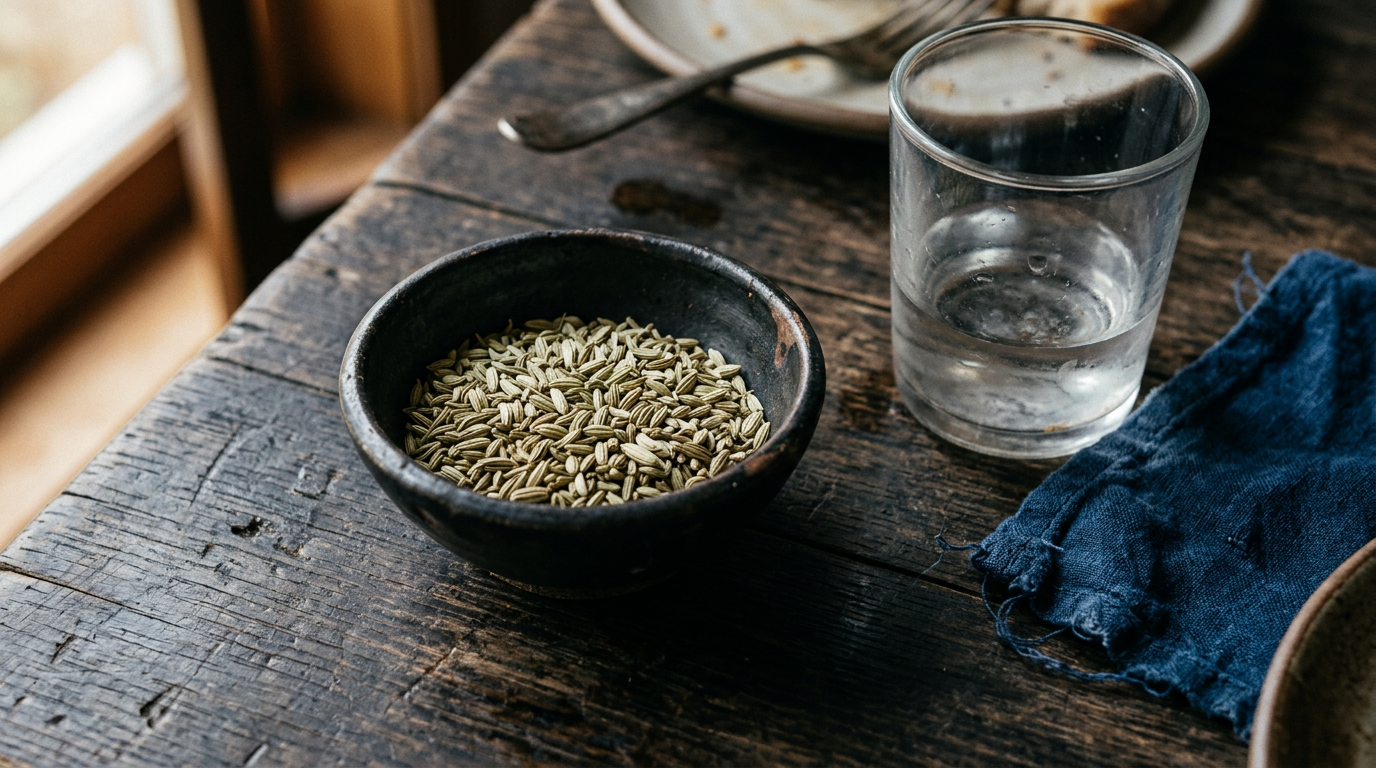
Fennel seeds, often served after meals, are a time-honored remedy for digestion. Far more than a simple breath freshener, their efficacy is rooted in science. Key compounds in fennel, like anethole, act as antispasmodics, relaxing the smooth muscles of the gut. This promotes healthy motility, easing the bloating and discomfort that can follow a large meal.
The Ritual in the Little Bowl
Walk out of a certain kind of restaurant—Indian, Italian, Middle Eastern—and you’ll often find a small bowl of seeds by the door. Sometimes they are raw, sometimes candy-coated into a confetti-like mix called mukhwas. The gesture feels like a folksy courtesy, a simple breath mint from a pre-industrial age. But it is one of the most enduring and widespread examples of functional food in plain sight.
This isn't just about masking the scent of garlic. The practice of chewing fennel seeds (Foeniculum vulgare) after a meal is a deeply embedded piece of culinary wisdom. Roman soldiers were said to have carried it to keep them strong on long marches. In Ayurveda, it's known as saunf and is prized for its ability to stoke agni, or the digestive fire, without overheating the system. For millennia, intuition told us that these tiny, aromatic seeds settled the stomach. Now, the language of clinical science is beginning to explain why.
From Folklore to Gut Motility
The feeling of being “uncomfortably full” or bloated isn’t just about the volume of food in your stomach. It’s often a problem of movement—or a lack thereof. Gastrointestinal motility refers to the coordinated, wave-like muscular contractions of your digestive tract that propel food from your esophagus through to the exit [1]. When this rhythm is disrupted, food and gas can get stuck, leading to pressure, cramping, and bloating.
This is where fennel’s ancient reputation meets modern pharmacology. The seed's essential oil is rich in potent aromatic compounds, chiefly anethole, along with fenchone and estragole. Studies show these molecules have a powerful antispasmodic effect, meaning they help relax the smooth muscle tissue that lines the intestinal wall [2].
Instead of the gut spasming or clenching in response to a large or rich meal, the anethole in fennel encourages it to relax. This allows trapped gas to move along and pass, relieving pressure and the sharp pains of colic. It’s not just masking the symptoms; it's addressing the mechanical process that causes them. This mechanism is why fennel is a principal ingredient in traditional gripe water for colicky infants, a practice supported by clinical trials showing it can reduce the intensity of crying fits [2].
A Plant-Based Process, A Synthetic Alternative
It’s useful to see how this natural mechanism contrasts with a common over-the-counter alternative.
| Feature | Fennel Seed (Anethole) | Simethicone (e.g., Gas-X) |
| :--- | :--- | :--- |
| Mechanism | Antispasmodic; relaxes intestinal smooth muscles to ease passage [2]. | Anti-foaming agent; a surfactant that breaks down the surface tension of gas bubbles. |
| Origin | Plant-based; active compounds from the Foeniculum vulgare seed. | Synthetic; a man-made polymer of silicone dioxide. |
| Primary Action | Addresses muscle cramping and promotes motility to help gas move. | Collapses small, trapped gas bubbles into larger, easier-to-pass ones. |
| History | Thousands of years of culinary and medicinal use [3]. | Developed as a pharmaceutical drug in the mid-20th century. |
Neither approach is inherently “better,” but they are fundamentally different. One is a complex botanical that co-evolved with our diets, working with our body’s musculature. The other is a targeted synthetic compound engineered to solve a specific physics problem. Understanding the distinction is key to appreciating the quiet intelligence of our food traditions.
Not All Fennel is Equal
The potency of these benefits, of course, depends on the plant itself. The concentration of anethole in a fennel seed is a direct function of its terroir—the soil, climate, and harvesting practices. Fennel grown for its bulb as a vegetable has a different chemical profile than fennel grown for its potent seeds. Some of the most sought-after seeds come from regions like Lucknow, India, where specific cultivars are prized for their high essential oil content and superior aromatic profile. Sourcing from growers who understand this and harvest at peak potency is not a trivial detail; it is the difference between a flavorful garnish and a truly functional ingredient.
That little bowl of seeds is a link in a chain of remarkable knowledge—connecting the farmer who selects the right cultivar to the ancient healer who first observed its effects, and finally to the modern lab that can isolate, measure, and validate them. It's a tradition that tastes good, and a science that feels even better.
***
### Frequently Asked Questions
1. What's the best way to use fennel for digestion?
Chewing about a teaspoon of raw or lightly toasted seeds after a meal is the most traditional and effective method. You can also brew them into a tea by steeping a teaspoon of crushed seeds in hot water for 5-10 minutes.
2. Is fennel safe for everyone?
For most people, fennel seeds used as food are very safe. However, due to their potent compounds and mild estrogen-like effects, concentrated fennel extracts or large medicinal doses are not recommended during pregnancy or for individuals with hormone-sensitive conditions without consulting a doctor. The World Health Organization advises against medicinal use in infants and young children without professional guidance [2].
3. Does cooking destroy fennel's digestive benefits?
High heat can degrade some of the volatile essential oils, including anethole. While cooked fennel bulb is still a healthy, fiber-rich vegetable, using the raw seeds after the meal is the best way to get the full digestive benefits of their essential oils.
4. What's the difference between fennel seeds and anise seeds?
They look and taste similar because both contain anethole, the licorice-flavored compound. However, they are from two different plants. Fennel seeds (Foeniculum vulgare) are larger and more greenish-brown, while anise seeds (Pimpinella anisum) are smaller and grayer. While both are used as digestives, fennel is generally considered the more potent of the two for this purpose.
Sources & citations
- Aich, P., et al. (2018). Gut Motility and the Gut-Brain Axis. Cellular and Molecular Gastroenterology and Hepatology, 6(4), 481–483.e1.
- World Health Organization. (1999). WHO Monographs on Selected Medicinal Plants - Volume 1. Geneva: WHO Press. (Chapter: Fructus Foeniculi).
- Badgujar, S. B., Patel, V. V., & Bandivdekar, A. H. (2014). Foeniculum vulgare Mill: A Review of Its Botany, Phytochemistry, Pharmacology, Contemporary Application, and Toxicology. BioMed Research International, 2014, 842674.
- Britannica, The Editors of Encyclopaedia. (2023, August 29). fennel. In Encyclopædia Britannica. Retrieved from https://www.britannica.com/plant/fennel