
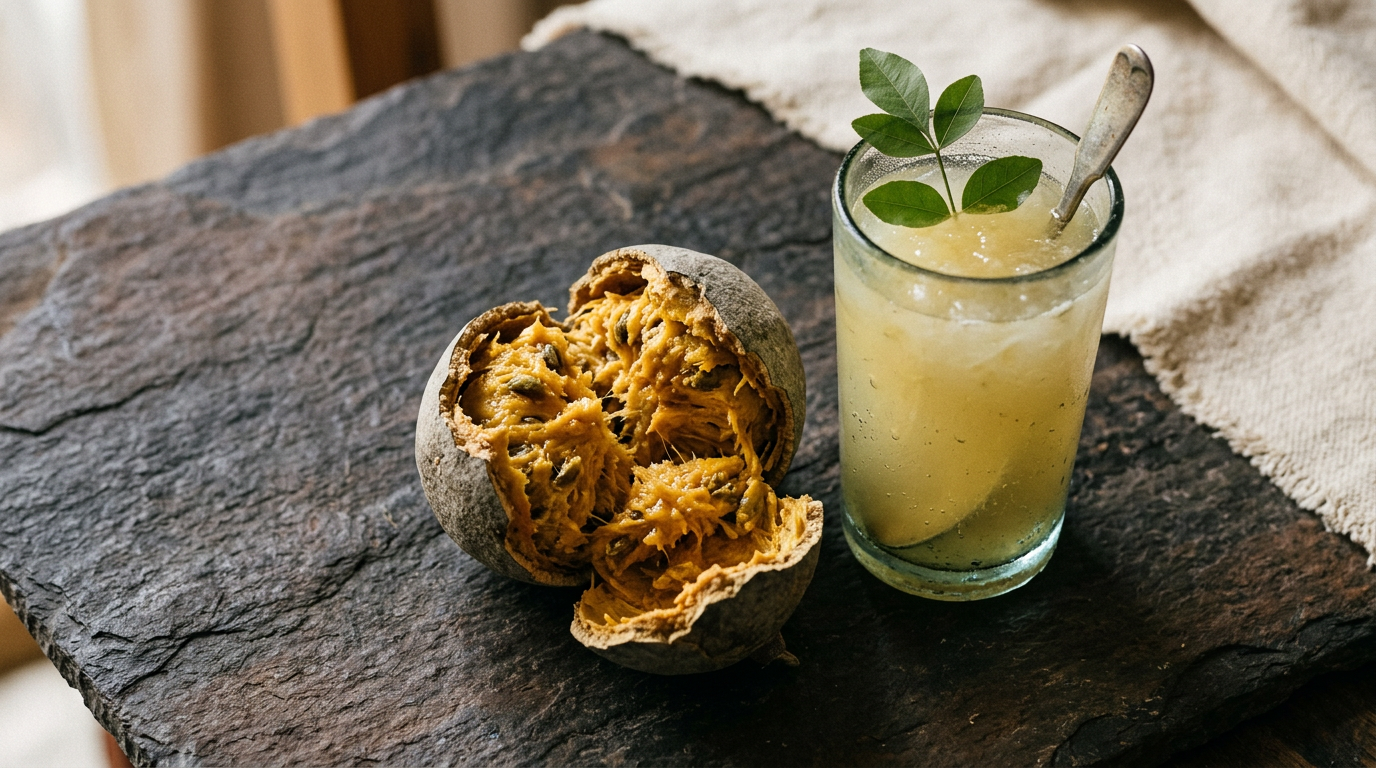
Bael fruit, known scientifically as Aegle marmelos, is a traditional South Asian summer cooler long valued for digestive health. For centuries, it has been a household remedy for gut ailments. Now, modern research is beginning to validate its role as a powerful prebiotic, showing how its unique fiber and compounds can selectively nourish a healthy and resilient gut microbiome [1].
A Memory in a Glass
Before there were venture-backed seltzers and lab-grown probiotics, there was the thud of a bael fruit hitting a stone floor. Its shell, as hard and unassuming as wood, gives no hint of the fragrant, golden pulp within. Cracking it open releases a scent that is difficult to pin down—part ripe pear, part marmalade, with a resinous, almost sacred, aroma.
For generations, this pulp has been mashed with water and a touch of jaggery to create a sherbet, a drink that cools the body on a scorching summer afternoon. It wasn't marketed as a “wellness” product; it was simply what you drank when your stomach felt off, or when the heat became unbearable. This was kitchen wisdom, passed down through observation and experience. A grandmother wouldn't have used the term ‘gut-brain axis,’ but she knew a happy stomach led to a calmer disposition.
This fruit wasn't just food; it was a cornerstone of Ayurvedic practice, revered for its ability to restore digestive balance. The unripe fruit, powerfully astringent, was used to manage diarrhea and dysentery. The ripe fruit, sweet and fibrous, was used to ease constipation [2]. This duality—a single plant source that can both bind and release—points to a complex biological activity that modern science is just beginning to unravel.
From Ancient Text to Clinical Trial
The gut microbiome—that bustling city of trillions of bacteria, fungi, and viruses in our intestines—is now at the forefront of medical research. We know that its health influences everything from our immune system and digestion to our mood and metabolism. The key to a healthy microbiome isn't just about adding 'good' bacteria (probiotics), but about feeding the ones you already have (prebiotics).
And this is where the humble bael fruit re-enters the conversation.
Bael fruit pulp is rich in mucilage, a thick, gelatinous substance, as well as pectin and other dietary fibers. These aren't just inert fillers; they are complex carbohydrates that our own digestive enzymes can't break down. Instead, they travel to the colon, where they become the preferred food for beneficial bacteria like Bifidobacterium and Lactobacillus [3].
When these microbes feast on bael’s fibers, they produce short-chain fatty acids (SCFAs) like butyrate. Butyrate is cellular gold. It's the primary fuel for the cells lining our colon, helping to strengthen the gut barrier, reduce inflammation, and regulate the immune system [4]. In essence, a glass of bael sherbet isn't just hydrating you; it's delivering a targeted nutritional package to the most important microorganisms you host.
| Feature | Bael Fruit Pulp (Natural Prebiotic) | Typical Fiber Supplement (Synthetic) |
|---|---|---|
| Source | Whole fruit, minimally processed | Isolated powders (e.g., inulin, FOS) |
| Composition | A complex matrix of soluble/insoluble fibers, mucilage, vitamins, polyphenols | A single type of synthesized fiber |
| Mechanism | Feeds a diverse range of beneficial microbes; provides additional antioxidant benefits | Feeds a narrow range of microbes; can sometimes cause gas or bloating |
| Heritage | Millennia of documented use in traditional medicine systems | Decades of use in processed foods |
The Comeback of a 'Difficult' Fruit
If bael is so remarkable, why did it fade into relative obscurity, especially outside of South Asia? The answer lies in its defiance of industrial food logic. Bael fruit is not uniform. Its rock-hard shell makes it difficult to process mechanically. Its sticky, fibrous pulp is a challenge for mass production lines designed for simple juices. It doesn't fit the template of a convenient, hyper-palatable, shelf-stable commodity.
In a way, its perceived flaws are its greatest strengths. The 'inconvenient' shell protects the potent compounds within. The 'difficult' pulp is precisely what makes it such a powerful prebiotic. The complexity that industry shuns is what our microbiome craves.
As consumers and scientists alike grow wary of the reductionist approach to health—the single-vitamin pills, the isolated-fiber powders—we are seeing a return to whole-food systems. We are beginning to appreciate that nature's solutions are rarely simple. They are complex, synergistic, and time-tested.
The re-emergence of bael is not the discovery of a new fad. It is the remembering of something ancient, a piece of deep-rooted knowledge that was simply waiting for our science to catch up.
---
Frequently Asked Questions
1. What does bael fruit taste like?
The flavor is unique and aromatic. When ripe, it's mildly sweet with a tangy, marmalade-like quality and a distinctive resinous fragrance. It's an acquired taste for some, but many find it delicious and refreshing.
2. Is bael a laxative or does it stop diarrhea?
It can be both, depending on its ripeness. The unripe fruit is astringent due to its high tannin content and is traditionally used to treat diarrhea and dysentery. The ripe fruit is rich in fiber and acts as a natural laxative, helping to relieve constipation.
3. Is it safe to consume bael fruit every day?
In moderation, as a seasonal drink or fruit, it is generally considered safe for most people. However, due to its potent medicinal properties, excessive consumption isn't recommended. As with any functional food, it's wise to listen to your body.
4. Where can I find bael fruit?
In South and Southeast Asia, you can find it fresh in local markets during the summer season. Elsewhere, you may find it as a dried powder, pulp, or ready-to-drink sherbet in South Asian grocery stores or online from specialty food purveyors.
Sources & citations
- Rathore, M. (2022). Health-promoting phytochemicals and functional attributions of Bael (Aegle marmelos): A review. Journal of Applied and Natural Science, 14(2), 527-537. https://journals.ansfoundation.org/index.php/jans/article/view/3233
- Maity, P., Hansda, D., Bandyopadhyay, U., & Mishra, D. K. (2009). Biological activities of crude extracts and chemical constituents of Bael, Aegle marmelos (L.) Corr. Indian Journal of Experimental Biology, 47(11), 849–861. http://nopr.niscpr.res.in/handle/123456789/7317
- Gautam, M. K., et al. (2014). A comprehensive review on Aegle marmelos: A potential medicinal plant. International Scholarly Research Notices, vol. 2014, Article ID 592381. https://www.hindawi.com/journals/isrn/2014/592381/
- Ríos-Covián, D., et al. (2016). Intestinal Short Chain Fatty Acids and their Link with Diet and Human Health. Frontiers in Microbiology, 7, 185. https://www.frontiersin.org/articles/10.3389/fmicb.2016.00185/full