
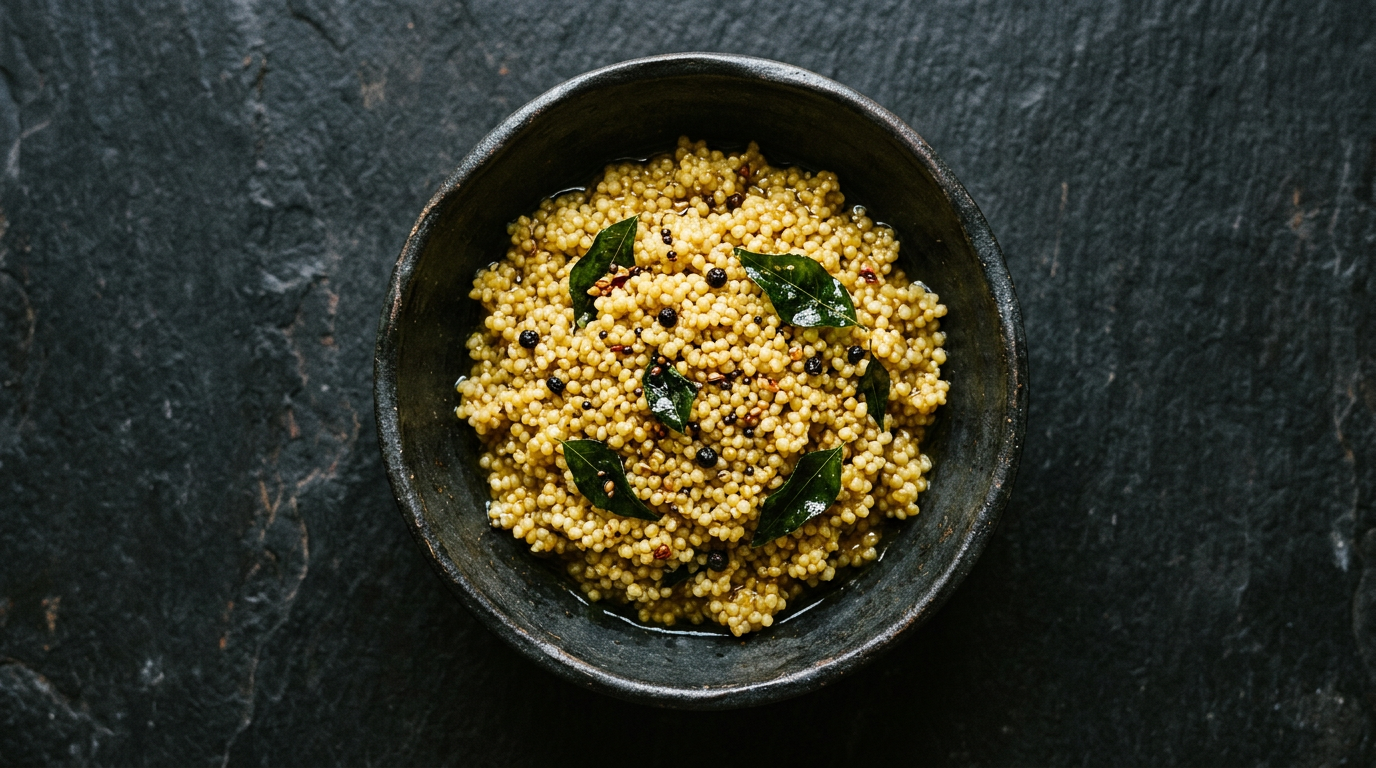
Foxtail millet (Setaria italica) is an ancient, drought-hardy grain experiencing a modern culinary revival driven by its low glycemic index and exceptional fiber architecture. Naturally rich in slowly digestible starch, resistant starch, and insoluble dietary fiber, foxtail millet moderates postprandial blood glucose spikes and enhances satiety far more effectively than refined white rice, re-establishing itself as a foundational metabolic staple.
For roughly seventy years, the daily plate across vast swathes of Asia and the diaspora underwent an unheralded monoculture experiment. Driven by irrigation infrastructure and yield subsidies of the mid-twentieth century, indigenous coarse grains were progressively cleared from farm furrows and pantries to make way for polished white rice and dwarf wheat. The trade-off was insidious. What was gained in sheer caloric volume was lost in metabolic composure, leading directly to the contemporary epidemic of insulin resistance and type 2 diabetes across urban populations [1].
Now, the plate is swinging back. Quietly, without the marketing blitz of synthetic health foods, foxtail millet is reclaiming space alongside dal and seasonal vegetables.
The Molecular Anatomy of Slow Energy
At the heart of foxtail millet's resurgence is its carbohydrate composition. White rice is predominantly composed of rapidly digestible starch (RDS), which hydrolyzes rapidly in the upper gastrointestinal tract, dumping glucose into the bloodstream at a pace that demands an aggressive insulin response. Foxtail millet, by contrast, possesses a high proportion of slowly digestible starch (SDS) and resistant starch (RS) [2].
Resistant starch bypasses enzymatic digestion in the small intestine altogether, arriving intact in the colon where native microbiota ferment it into beneficial short-chain fatty acids (SCFAs), notably acetate, propionate, and butyrate. Butyrate serves as the primary fuel source for colonocytes and plays an indispensable role in maintaining the integrity of the gut barrier and suppressing systemic inflammation.
| Grain Metric (per 100g dry) | Foxtail Millet (Kangni) | Polished White Rice | Whole Wheat (Gehun) |
| :--- | :--- | :--- | :--- |
| Glycemic Index (GI) | 50–54 (Low) | 72–82 (High) | 62–68 (Medium) |
| Total Dietary Fiber | 8.0 – 10.2 g | 0.4 – 1.0 g | 10.5 – 12.0 g |
| Resistant Starch | 2.3 – 4.5 g | 0.2 – 0.6 g | 1.1 – 1.8 g |
| Protein Content | 11.2 – 12.3 g | 6.5 – 7.2 g | 11.8 – 13.0 g |
| Water Requirement | ~300 mm | ~1,200–1,400 mm | ~500–600 mm |
The clinical consequences are palpable. Randomized crossover trials have consistently revealed that substituting polished white rice with foxtail millet yields significantly lower peak postprandial glucose levels and reduced area-under-the-curve (AUC) insulin measurements in both diabetic and non-diabetic cohorts [3].
The Fiber Architecture: More Than Just Bulk
Food scientists often discuss dietary fiber as a monolithic number, but its physical microstructure dictates its physiological behavior. Foxtail millet retains a dense endosperm envelope packed with both insoluble and soluble fiber fractions, predominantly arabinoxylans and beta-glucans.
This cellular matrix acts as a physical barrier, trapping starch granules inside intact cell walls. Even after standard domestic boiling, digestive enzymes encounter mechanical resistance when attempting to access the grain's carbohydrate reserves. The result is a prolonged, flattened glucose curve that sustains cognitive energy and blunts afternoon lethargy—a familiar ailment that has plagued high-glycemic rice eaters for generations.
Moreover, the non-starchy polysaccharides in foxtail millet bind to bile acids within the lumen, promoting their excretion and prompting the liver to utilize circulating low-density lipoprotein (LDL) cholesterol to manufacture new bile salts [4].
The Culinary Tempering: Why Indigenous Technique Matters
There is a historical reason why ancestral kitchens never consumed foxtail millet plain. Unlike white rice, which submits to gentle boiling, the starch matrix of foxtail millet requires specific culinary interactions to unlock both flavor and bioavailability.
In traditional southern peninsular cooking, foxtail millet is rarely boiled in isolation. It is prepared as a fragrant pongal or khichdi, tempered aggressively with cold-pressed sesame or mustard oil, whole black pepper, split cumin seeds, and hand-torn curry leaves. This is not merely aesthetic; it is applied food science:
- Lipid-Starch Complexation: Introducing healthy fats (such as cold-pressed oils or grass-fed ghee) during or immediately after the cooking process allows fatty acids to complex with free amylose chains. This creates type-5 resistant starch (RS5), which further depresses the glycemic index.
- Phytate Attenuation: Soaking the grains overnight before cooking triggers endogenous phytases, breaking down the phytic acid that naturally binds to foxtail millet's rich reserves of iron, magnesium, and zinc [5].
- Volatile Activation: The natural, mildly earthy aroma of foxtail millet is counterbalanced by the pinene and caryophyllene present in tempered curry leaves and cracked peppercorns, transforming a dryland survival crop into a deeply craved comfort dish.
The Agronomic Reality Modern Supply Forgot
What makes foxtail millet particularly compelling today is not simply its clinical sheet, but its refusal to participate in the resource-depleting economics of commercial agriculture. While wetland paddy cultivation demands upwards of 1,200 millimeters of water and emits substantial volumes of agricultural methane through anaerobic soil conditions, foxtail millet thrives in arid Deccan soils on roughly 300 millimeters of rainfall.
The challenge that kept millets off supermarket shelves for decades was mechanical: dehulling. Foxtail millet has an abrasive, non-edible husk protecting the nutrient-dense caryopsis. Traditional processing relied on labor-intensive hand-pounding, which retained the bran; early industrial mills, built for rice, either shattered the tiny grain or obliterated its bran coat altogether. A quiet wave of precision rubber-roller hulling machinery developed over the last five years has finally solved this bottleneck, allowing whole, bran-intact grains to reach kitchens at scale with their glycemic and micronutrient properties uncompromised.
Eating foxtail millet is an intentional act of plate restoration—an acknowledgment that our metabolic biology was calibrated for slow, complex, sun-baked grains long before the modern food system decided to strip them clean.
Frequently Asked Questions
### Does foxtail millet taste like white rice?
Foxtail millet has a mild, faintly nutty flavor with a light, non-sticky texture. When steamed with a pinch of sea salt, it absorbs curries and gravies similarly to medium-grain rice, though it feels noticeably lighter and less gelatinous in the mouth.
### How should foxtail millet be prepared to maximize its nutrient absorption?
Soak the whole, dehulled grains in room-temperature water for 4 to 6 hours prior to cooking. This activates native enzymes that deconstruct phytic acid, significantly improving the bioavailability of its zinc, magnesium, and non-heme iron.
### Can foxtail millet completely replace white rice for people managing blood sugar?
Yes. Clinical studies suggest that replacing 50% to 100% of white rice in a daily diet with foxtail millet can significantly reduce fasting blood sugar, lower HbA1c values over 90 days, and improve lipid profiles in individuals with impaired glucose tolerance.
### Does foxtail millet contain gluten?
No. Like all true millets, foxtail millet is naturally gluten-free. However, because it contains no gluten proteins to form an elastic network, it behaves differently in baking and is best consumed as whole grains, porridges, or blended with binder flours for flatbreads.
Sources & citations
- International Diabetes Federation. "IDF Diabetes Atlas, 10th Edition." (2021). https://diabetesatlas.org
- Anitha, S., et al. "Can Millet Consumption Help Manage Diabetes? A Systematic Review and Meta-Analysis of the Bioactive Compounds and Clinical Studies." Frontiers in Nutrition 8 (2021): 687428. https://pubmed.ncbi.nlm.nih.gov/34485368
- Ren, X., et al. "Effects of foxtail millet consumption on glycemic response, blood pressure, and inflammation in subjects with impaired glucose tolerance." Journal of Functional Foods 45 (2018): 264–272. https://pubmed.ncbi.nlm.nih.gov
- Food and Agriculture Organization of the United Nations. "Sorghum and Millets in Human Nutrition." FAO Food and Nutrition Series, No. 27 (1995). https://www.fao.org
- Sireesha, Y., et al. "Effect of domestic processing methods on nutritional and anti-nutritional factors in foxtail millet (Setaria italica)." Journal of Food Science and Technology 48.6 (2011): 742–746. https://pubmed.ncbi.nlm.nih.gov