
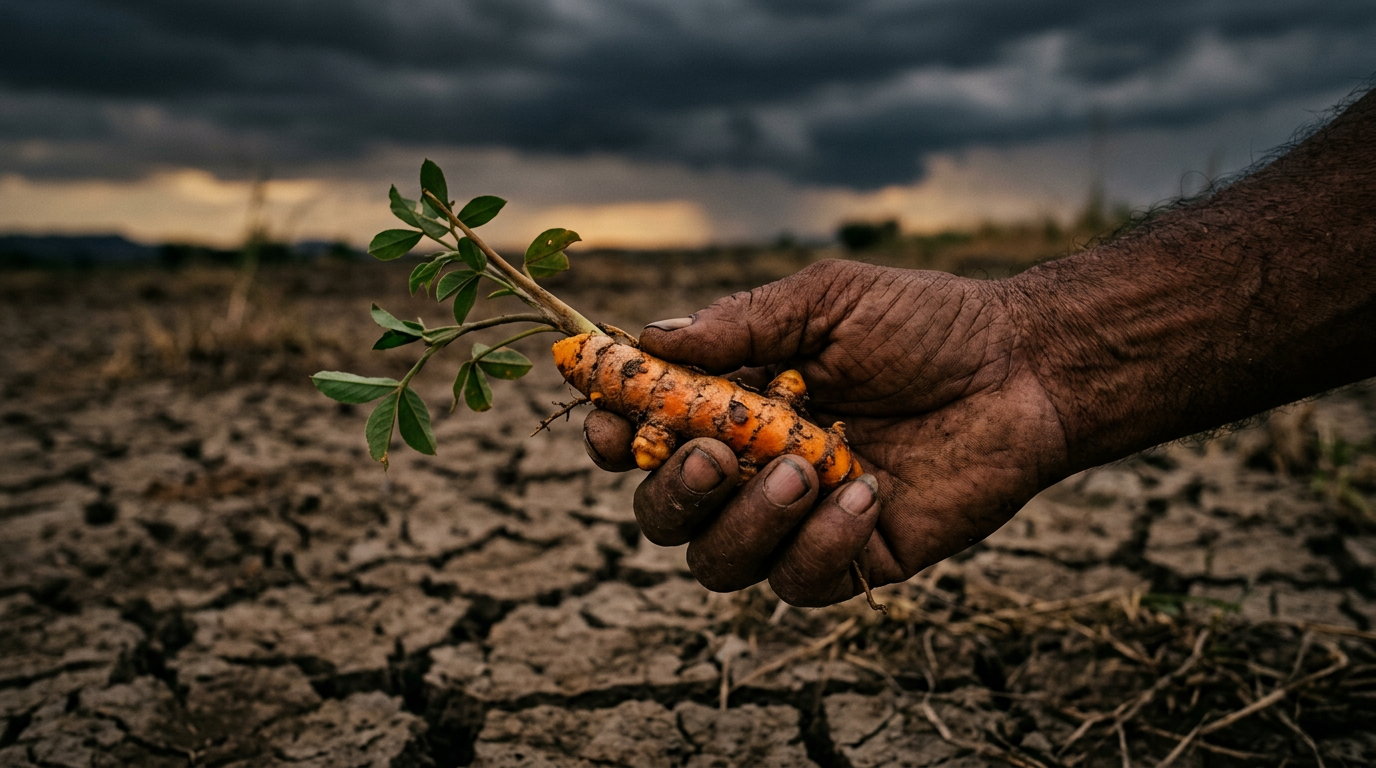
There is a word in many South Asian languages for the smell of the first rain on dry earth: petrichor. It’s a scent of relief, of life renewed. For millennia, the monsoon was a dependable, continent-scale metronome, its arrival marking the time to plant, to wait, and to harvest. This rhythm is the bedrock of ancient agricultural wisdom, particularly for the small family farms that grow the world's most aromatic spices in the hills of places like Kerala, India.
Today, that metronome has broken. The monsoon hasn't vanished; it has become erratic, violent, and unpredictable. Where a steady, week-long drizzle once nurtured young turmeric rhizomes, a catastrophic deluge now washes away topsoil and rots the crop from below. Where gentle showers were needed for the delicate pollination of cardamom flowers, a month-long dry spell can bake the forest floor, stunting the plants that require 70% shade and constant humidity to thrive [1]. This isn't a future problem. It's the reality for farmers right now.
The Farmer's Clock Is Broken
Consider a family that has farmed the same two-hectare plot for generations, growing black pepper, turmeric, and ginger. Their knowledge is their most valuable asset—a complex, inherited understanding of their specific patch of earth. They know that a certain slope is best for pepper vines as it sheds excess water, and that a lower, sandier field is perfect for turmeric. This knowledge, however, was calibrated to a predictable climate.
Now, the old rules no longer apply. The Indian Meteorological Department's own data shows a significant increase in the frequency and intensity of extreme rainfall events over the last several decades [2]. For a spice farmer, this volatility is brutal. Extreme rain can physically shatter pepper vines and knock unripe berries to the ground. A late-arriving monsoon means turmeric rhizomes planted in anticipation of rain can fail to sprout in the dry ground. An early withdrawal means the crop won't have enough water to mature, resulting in smaller, less potent spices.
This turns an act of cultivation into a high-stakes gamble. Smallholders, who produce a staggering 75% of the world's spices, have little to no financial cushion [3]. A single failed harvest isn't a quarterly loss to be written off; it can mean pulling children from school, taking on predatory loans, or abandoning the farm altogether.
The Tremor in Your Spice Cabinet
This distant agricultural chaos has a way of showing up in our kitchens, though often in disguise. The immediate consequence of a volatile harvest is a volatile supply chain. A sudden shortage of high-quality cardamom from the Idukki district in Kerala doesn't just mean a bad year for farmers; it creates a ripple effect across the globe.
In the local markets, desperate farmers may be forced to sell their diminished harvest at rock-bottom prices to opportunistic middlemen. In other cases, a widespread crop failure can send prices soaring, creating shockwaves that travel through exporters, processors, and brands, all the way to the shelf at your local grocery store. That sudden jump in the price of your favorite turmeric-ginger tea isn't just inflation; it may be the financial echo of a monsoon that arrived six weeks too late, 8,000 miles away.
This uncertainty punishes everyone. It harms the farmer who can't plan for the future. It harms the consumer who faces unpredictable prices and, often, a decline in quality as desperate suppliers blend or adulterate their products to meet volume demands. And it reveals the fragility of a global system built on the assumption that nature's patterns are fixed.
Rebuilding a more resilient system requires a different kind of thinking. It means moving beyond a purely transactional relationship with the source of our food. It requires a model that values the stability of the farmer as much as the potency of the spice. The ancient wisdom embedded in these spices was never just about their use in a kitchen or an apothecary; it was also about an agricultural system that worked in concert with the climate. To honor and preserve that heritage, we have to help its stewards weather the coming storm [4].
Sources & citations
- K.S. Krishnamurthy, V. Srinivasan, and K. V. Peter, "Climate Change and Cardamom Production," Indian Institute of Spices Research, 2011.
- R. Krishnan et al., "Assessment of Climate Change over the Indian Region: A Report of the Ministry of Earth Sciences (MoES), Government of India," Springer, 2020.
- "Building inclusive and sustainable spice value chains," Food and Agriculture Organization of the United Nations (FAO), 2022.
- Aathira Perinchery, "India’s shifting monsoons leave farmers with acurse of choice," The Third Pole, October 2021.