
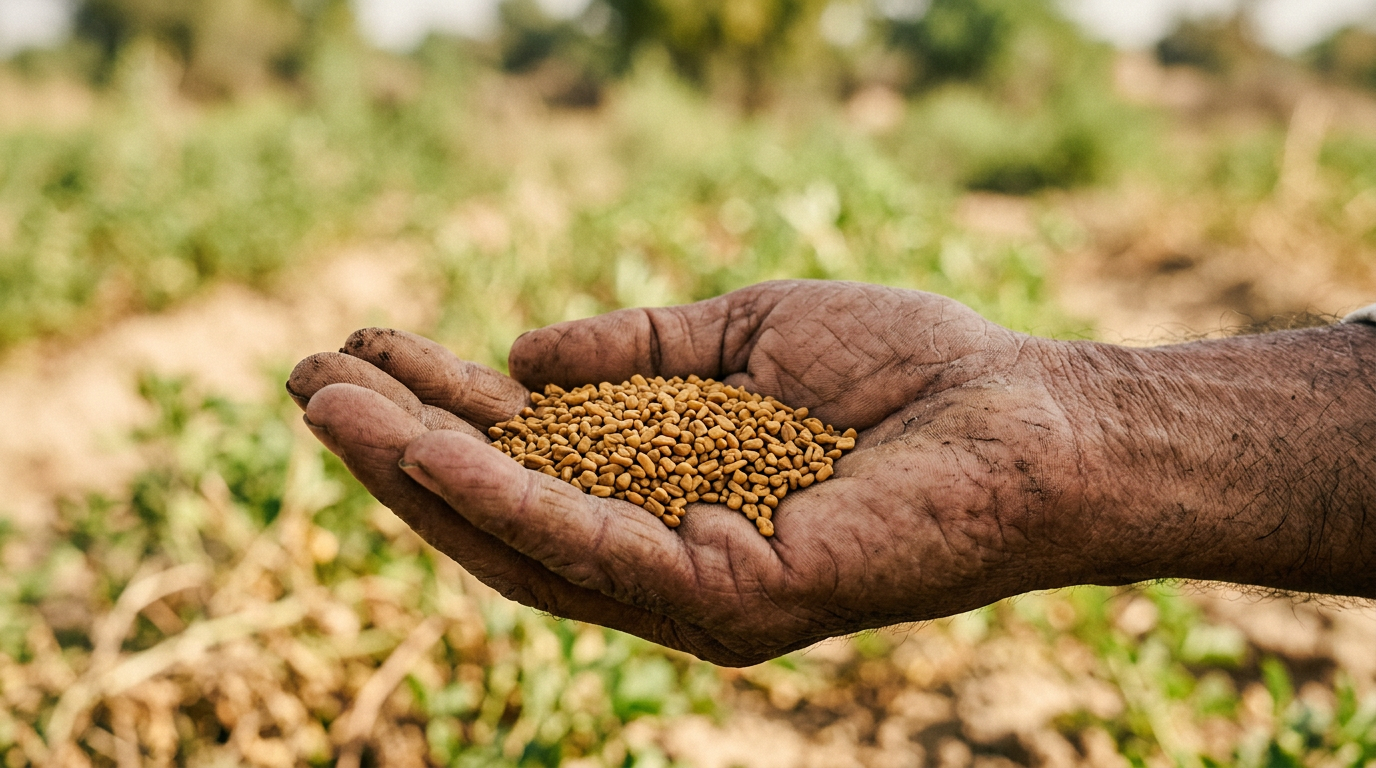
A single field of fenugreek is often seen as a simple crop, but a closer look reveals it can be a living methi seed bank in Rajasthan. Unlike commercial farms, these plots cultivated with farmer-saved seeds represent a dynamic, multi-generational library of genetic information, uniquely adapted to local climate and soil. This forms the cornerstone of regional seed-sovereignty.
Travel through the arid landscapes of [Rajasthan](/region/india), and you’ll see flashes of defiant green against the ochre earth. Some of that green is methi, or fenugreek. Before the harvest, the air carries its distinctive scent: a faint, bittersweet note, like scorched sugar and celery. It’s a foundational flavor of the region, essential for dishes like gatte ki sabzi.
But the real story isn't the harvest; it's the seed that came before it. On a small farm, a woman named Sunita might explain that her seeds don't come from a foil packet. Her family has been saving, planting, and re-saving this specific methi for generations. They call it ‘Desi Methi,’ and it’s nothing like the uniform, large-grained commodity fenugreek sold by the quintal. Her small, hard, golden-brown seeds represent a living archive—a direct link to the taste and resilience of this specific place.
The Genome in the Granary
Sunita’s ‘Desi Methi’ is what scientists call a “landrace.” It hasn't been designed in a lab for a single trait like maximum yield. Instead, it has been co-created over centuries by the hands of farmers and the pressures of the environment. A landrace is not one single genetic profile; it is a population of related, yet diverse, individuals. This genetic variance is its superpower.
In a tough year with little rain, some plants in the field might struggle, but others, carrying a slightly different genetic code, will survive and produce seed. Over time, the entire population becomes better adapted to drought. This is in stark contrast to most modern commercial seeds.
Many commercial seeds are F1 hybrids, created by crossing two distinct parent lines. They produce vigorous, uniform, high-yielding plants. But there’s a catch: the seeds from these hybrid plants won't grow “true to type.” If you plant them, you’ll get a bizarre and unpredictable mix of plants, with none of the vigor of the parent. This means the farmer cannot save her seed; she is forced to buy new seeds from the company every single year. This system breaks a cycle of farmer autonomy and adaptation that has been the bedrock of agriculture for 10,000 years.
Uniformity's Unseen Price
When a community abandons its diverse landraces for a single, uniform hybrid, something profound is lost. The Food and Agriculture Organization (FAO) reports that since the 1900s, some 75 percent of plant genetic diversity has been lost as farmers worldwide have switched to these uniform varieties [1].
Each time a landrace like Desi Methi disappears, we lose a unique set of genetic solutions to problems like drought, disease, and heat. We lose the subtle nuances of flavor and aroma that define a regional cuisine. We lose a piece of our collective agricultural heritage. The pursuit of sterile uniformity creates fragility in the food system.
| Feature | Landrace Seeds ('Desi Methi') | Commercial Hybrid Seeds |
|---|---|---|
| Genetic Pool | Diverse; a population of variants | Uniform; genetically identical |
| Climate Resilience | High; adapted to local drought, pests | Often low; requires stable inputs |
| Farmer Autonomy | High; seeds saved and replanted | Low; seeds must be purchased annually |
| Input Dependency | Low; adapted to local soil fertility | High; requires synthetic fertilizers |
| Source of Knowledge | Farmer-led, continuous local adaptation | Corporate-led, centralized breeding |
Reading the Genetic Archive
Here’s where indigenous wisdom and modern science converge. For generations, farmers like Sunita have selected seeds not just for yield, but for flavor, resilience, and even medicinal properties. She may not use the words “bioactive compound,” but she knows which methi is best for a new mother's lactation or for managing blood sugar.
Today, researchers are finally catching up. They are analyzing different landraces of fenugreek (Trigonella foenum-graecum) and discovering what farmers have always known: they are not all the same. One population from a dry region might possess higher concentrations of galactomannan, a soluble fiber that helps moderate digestion [2]. Another, from a different valley, might be richer in the amino acid 4-hydroxyisoleucine, which has been studied for its role in insulin function [3].
This is why the work of a farmer who maintains a local methi seed bank in Rajasthan is so critical. She is not a relic of the past; she is the curator of a highly sophisticated library of genetic material. Her field is a laboratory where adaptation continues in real time. It contains a wealth of untapped potential for nutrition, flavor, and climate resilience that sterile, centralized systems simply cannot replicate.
This is the essence of seed-sovereignty. It's the quiet, powerful act of saving a seed—a bundle of memory, resilience, and identity—and planting it again.
### FAQ
1. What is a landrace seed?
A landrace is a domesticated, local variety of a plant that has adapted over time to the specific ecological and cultural environment where it is grown. Unlike commercial varieties, they are genetically diverse and are maintained by farmers saving seeds from one harvest to plant in the next.
2. Why is 'seed-sovereignty' important?
Seed-sovereignty is the right of farmers to save, use, exchange, and sell farm-saved seeds. It is critical for maintaining farmer autonomy, protecting agrobiodiversity, and ensuring that food systems are resilient and controlled locally, rather than by a few large seed corporations.
3. Is methi from one region really different from another?
Absolutely. Just like wine grapes, the terroir—a combination of soil, climate, and cultivation practices—has a profound impact [4]. A landrace methi from the dry plains of Rajasthan will have a different genetic makeup, flavor, and phytochemical profile than one grown in the more humid conditions of Gujarat or Punjab.
4. Can't we just store these seeds in a global seed vault?
Global vaults like the one in Svalbard are essential as a 'backup' of genetic diversity, but they are static archives [5]. A farmer's field is a living seed bank where landraces can continue to evolve and adapt to shifting climate conditions year after year. Both static and living conservation are necessary.
Sources & citations
- Food and Agriculture Organization of the United Nations. (n.d.). What is agrobiodiversity? Retrieved from https://www.fao.org/home/en/
- Wani, S. A., & Kumar, P. (2018). Fenugreek: A review on its nutraceutical properties and usage in various food products. Journal of the Saudi Society of Agricultural Sciences, 17(2), 181-190. Retrieved from https://www.sciencedirect.com/journal/journal-of-the-saudi-society-of-agricultural-sciences
- Neelakantan, N., Narayanan, M., de Souza, R. J., & van Dam, R. M. (2014). Effect of fenugreek (Trigonella foenum-graecum L.) intake on glycemia: a meta-analysis of clinical trials. Nutrition journal, 13, 7. Retrieved from https://www.ncbi.nlm.nih.gov/pmc/
- Britannica, The Editors of Encyclopaedia. (2023, August 3). terroir. In Encyclopædia Britannica. Retrieved from https://www.britannica.com/
- Crop Trust. (n.d.). Svalbard Global Seed Vault. Retrieved from https://www.croptrust.org/