
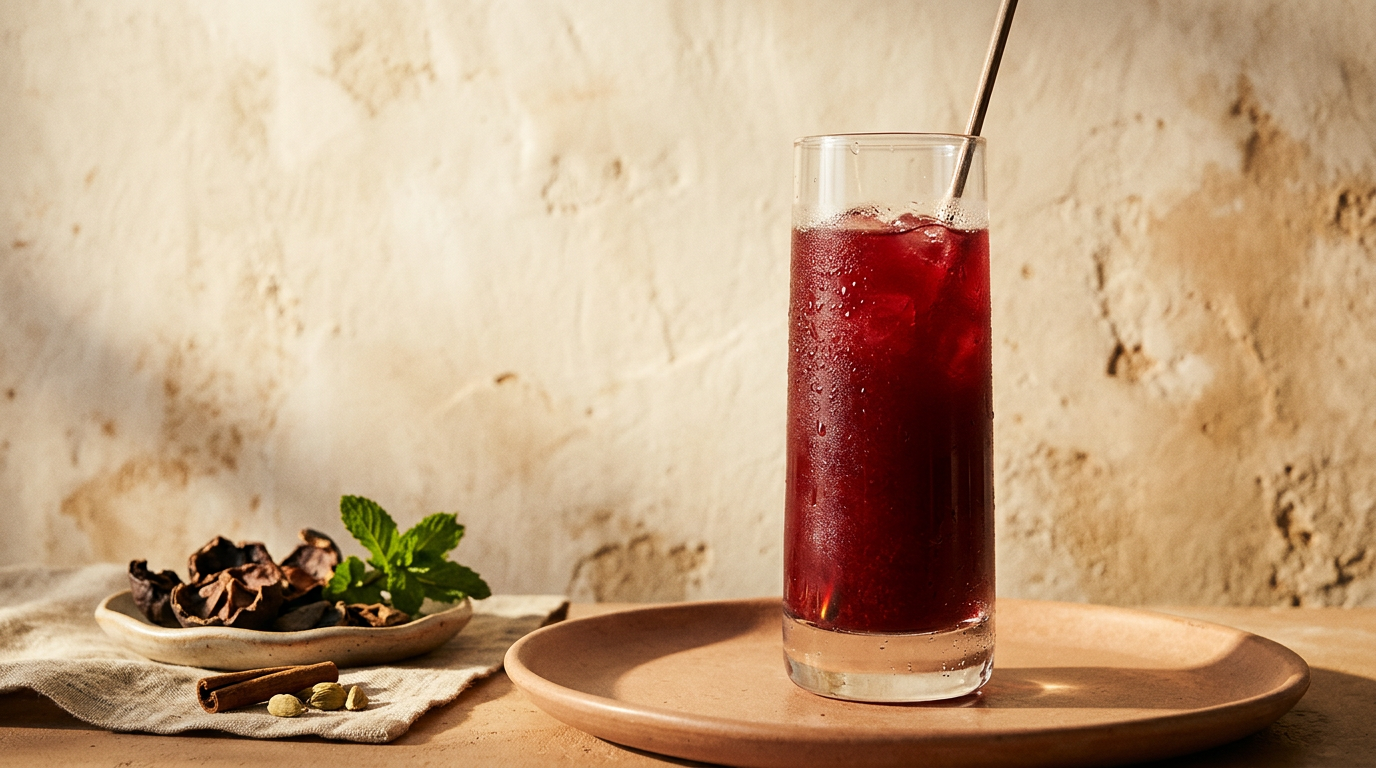
The first sip of a true kokum sherbet recipe in summer is a revelation. It’s tart, faintly sweet, and deeply savory, a world away from the monolithic sweetness of modern sports drinks. This traditional cooler from India's Konkan coast isn't just a relic; it's a sophisticated hydration system developed over centuries, long before electrolytes came in brightly-coloured plastic bottles.
Today, the hydration aisle of any supermarket is a lurid rainbow of powders and pre-mixed drinks. They promise to replenish what we lose through sweat, backed by lab coats and celebrity endorsements. Yet beneath the marketing, they are often metabolic liabilities: little more than refined sugar, salt isolates, artificial colors, and factory-made “natural” flavors, all packaged in single-use plastic. We've traded the wisdom of the pantry for the convenience of the factory, and in doing so, we've forgotten what real functional beverages look like.
Meet Garcinia indica
The antidote to the neon-blue sports drink is a dried, deep-purple fruit rind. [Kokum](/ingredient) (Garcinia indica) is a fruit tree native to the Western Ghats of India, a lush, mountainous chain designated as one of the world's biodiversity hotspots. The fruit itself is a small red sphere, but it's the sun-dried peel that is prized in the kitchen. When steeped in water, it leeches a stunning ruby color and a clean, sharp sourness that doesn't pucker the mouth so much as it cleanses the palate.
You can find these dried purple-black husks, which resemble flattened plums, in any decent South Asian grocer from Mumbai to Southall in London. They are the cornerstone of coastal Indian cooking, used to balance the richness of coconut milk and the fire of fresh chilis.
The Science of a Pre-Industrial Sports Drink
What makes kokum sherbet so effective isn't magic; it's a brilliant, time-tested formulation. The drink is a masterclass in food synergy—where the whole is far greater than the sum of its parts.
The star ingredient, kokum, is a source of potent antioxidants, most notably garcinol, which has demonstrated anti-inflammatory properties in laboratory settings [1]. It's also the original source of hydroxycitric acid (HCA), a compound that has been studied for its effects on appetite and metabolism. But its real genius lies in its role as a pitta pacifier in Ayurveda—what we might call a thermoregulatory agent. It cools the body from the inside out.
But the sherbet is a system, not a single ingredient. The traditional recipe combines four key elements that function almost identically to the Oral Rehydration Solution (ORS) formula promoted by the WHO [2]:
- Water: The solvent for life, and the base of the drink.
- Kokum: Provides a tart flavor, antioxidants, and a natural source of potassium.
- Salt (Sodium Chloride): Replenishes the primary electrolyte lost in sweat.
- Jaggery (Unrefined Sugar): Provides glucose, which the body needs to transport sodium and water effectively into its cells. It's not just for taste; it's a transport mechanism.
When you build a table comparing it to the modern alternative, the contrast becomes stark.
| Feature | Traditional Kokum Sherbet | Typical Sports Drink |
| ------------------- | ---------------------------------------------------------- | ----------------------------------------------- |
| Electrolytes | Sodium, Potassium & Magnesium (from whole ingredients) | Sodium & Potassium (added isolates) |
| Sweetener | Jaggery or raw sugar (unrefined, with trace minerals) | High-fructose corn syrup or sucrose |
| Active Compounds | Garcinol, HCA (antioxidant, anti-inflammatory) [1,4] | None; sometimes added caffeine |
| Color | Natural anthocyanins from the fruit peel | Artificial dyes (e.g., Red 40, Blue 1) |
| Source | Specific to the Konkan coast; smallholder sourced | Industrial; opaque global supply chains |
The Kokum Sherbet Recipe Summer Demands
Making this drink connects you to a long chain of mothers and grandmothers who have prepared it for centuries. It's a ritual of care. Across the Konkan coast of [India](/region/ind), this drink is a daily necessity, known simply as kokum sharbat or as the cooling base for sol kadhi.
This is less a strict recipe than a template. Adjust the sweet, sour, and salt to your own palate.
Ingredients:
- 10–12 pieces of dried kokum
- 4 cups water, divided
- 4–5 tbsp powdered jaggery or raw sugar (to taste)
- ½ tsp black salt (kala namak)
- ½ tsp roasted cumin powder
- A pinch of sea salt
Instructions:
- Soak the Kokum: Place the dried kokum pieces in a bowl with 1 cup of hot water. Let them soak for at least an hour, or until they are soft and have released their deep color.
- Extract the Pulp: Using your hands, squeeze the softened kokum pieces into the water until they begin to fall apart. This extracts the maximum flavor and color. The water will be a beautiful, dark ruby red.
- Strain: Pour the mixture through a fine-mesh sieve into a pitcher, pressing on the solids to get all the liquid out. Discard the spent kokum pieces.
- Season and Serve: Add the remaining 3 cups of water to the pitcher. Stir in the jaggery, black salt, roasted cumin powder, and sea salt until everything is fully dissolved. Taste and adjust seasoning. Chill thoroughly before serving, ideally over ice.
This simple, honest kokum sherbet recipe for summer is a reminder that our ancestors knew things we have forgotten. They didn't need laboratories to design powerfully effective foods; the knowledge was embedded in the culture itself, passed down through taste, ritual, and observation. The wisdom isn't in a single isolated compound, but in the entire glass.
***
### Frequently Asked Questions
What does kokum sherbet taste like?
It has a unique flavor profile that is primarily sour, but not sharp like lemon. This is balanced by a subtle sweetness from jaggery and a savory, mineral complexity from black salt and roasted cumin. It's incredibly refreshing.
Where can I buy dried kokum?
You can find dried kokum (sometimes labeled amsul or kokum rinds) in most Indian or South Asian grocery stores, as well as from online spice merchants. Look for pliable, dark pieces, not brittle, old stock.
Can I use kokum concentrate instead of dried fruit?
You can, but proceed with caution. Many commercial concentrates are loaded with refined sugar, preservatives, and artificial colors, defeating the purpose of a natural cooler. If you do, look for an unsweetened, pure concentrate and dilute it to your taste.
Is kokum sherbet healthy?
As a functional beverage, yes. It's a natural way to replenish fluids and electrolytes, free from the artificial additives of commercial drinks. It provides antioxidants and digestive benefits from kokum and cumin. As with any beverage containing sugar, it is best consumed in moderation as part of a balanced diet.
Sources & citations
- Joshi, V.S., and Pawar, H.A. "A comprehensive review on Garcinia indica." International Journal of Research in Pharmacy and Pharmaceutical Sciences, vol. 1, no. 1, 2015, pp. 66-70.
- World Health Organization. "Oral Rehydration Salts." WHO, www.who.int/publications/i/item/WHO-FCH-CAH-06.1.
- "Sherbet." Britannica, The Editors of Encyclopaedia. Encyclopaedia Britannica, 21 Apr. 2024, www.britannica.com/topic/sherbet-drink.
- Purdue University, Center for New Crops & Plant Products. "Garcinia indica." Horticulture & Landscape Architecture, hort.purdue.edu/newcrop/parmar/13.html.