
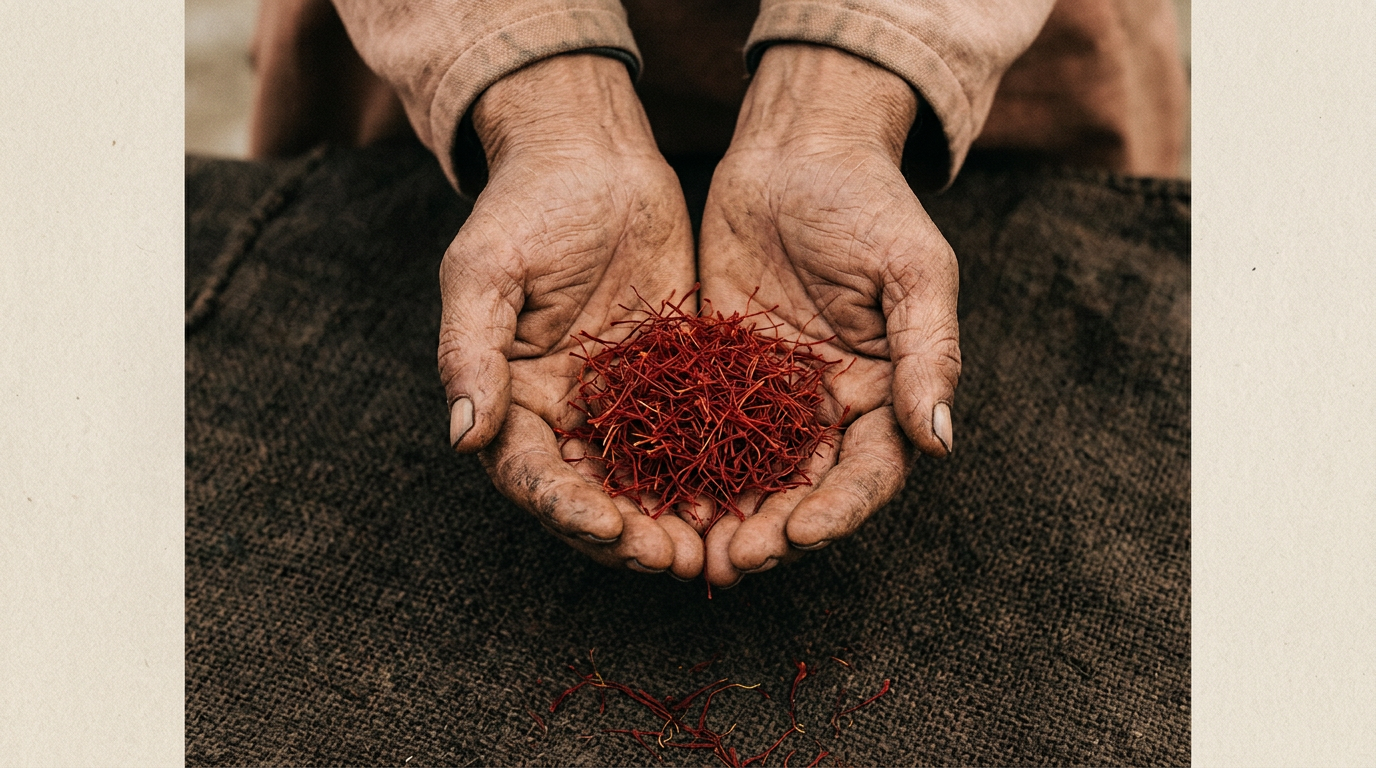
A higher Kashmir saffron farmer income is not a matter of simple charity, but a prerequisite for the survival of the world's finest saffron. This delicate spice, which can cost more per gram than gold, represents a profound economic paradox. While luxury retailers in London and New York showcase it in jewel-like jars, the farmers in Kashmir who cultivate it often struggle to make a sustainable living.
Deep in the Pampore plateaus of [India](/region/india), the saffron crocus (Crocus sativus) blooms for just a few weeks each autumn. Harvesting its three crimson stigmas is an act of intense manual labour, unchanged for centuries. It takes around 150,000 flowers, each picked by hand, to produce a single kilogram of dried saffron [1]. After the harvest, families gather to separate the fragile stigmas from the purple petals, another painstaking task done entirely by hand. This labour intensity is the beginning of saffron's story, but it's far from the whole picture of its final cost.
The Journey of a Single Gram
When you buy a gram of cheap saffron, you are often buying a story of exploitation. The price may seem like a bargain, but it has been achieved by squeezing the person at the very beginning of the chain: the farmer. To understand what a fair price looks like, we have to deconstruct the journey from the soil in Kashmir to your kitchen.
The market is flooded with lower-grade saffron, primarily from Iran (the world's largest producer), which is often sold with misleading labels. Worse, adulteration is rampant, with everything from corn silk to dyed horsehair being passed off as pure saffron [2]. The creation of a Geographical Indication (GI) tag for Kashmiri saffron in 2020 was a crucial step to protect its unique identity, but certification itself adds a layer of cost.
Let’s follow a hypothetical gram of authentic, GI-tagged Kashmiri saffron, priced fairly for everyone involved. The numbers shift, but the proportions tell a consistent story.
| Cost Component | Share of Final Price (Illustrative) | What It Covers |
| :--- | :--- | :--- |
| Farmer's Share | 50% | Labour for planting, harvesting, and stigma separation. This is the core of a dignified Kashmir saffron farmer income. |
| Processing & Certification | 15% | Professional drying to precise moisture levels, GI-tagging fees, and third-party lab testing for purity and potency (crocin, safranal levels). |
| Logistics & Export | 10% | Climate-controlled transport from Kashmir to our facility, export duties, and international freight. |
| Spiced with Science | 15% | Quality control, R&D, sustainable packaging, and telling these stories. We operate on slimmer margins than traditional brands. |
| Retail Partner | 10% | The cost of shelf space, whether physical or digital. Far less than the typical 50-60% markup in mainstream grocery. |
As the table shows, a fair system directs the majority of the value back to the source. When we pay a farmer a premium for their GI-tagged 'Kesar', we aren't just buying a spice. We are buying quality, traceability, and the preservation of a fragile agricultural heritage.
The Ripple Effect of a Fair Price
For a farmer in Kashmir, this model changes everything. It means they can afford to reject the low-ball offers from the opaque middlemen who dominate local markets like Delhi's Khari Baoli. It allows them to invest in better drying equipment, protect their crop from climate shocks, and send their children to school. A stable, predictable income incentivizes quality over quantity and protects the integrity of the Kashmiri saffron name.
In the UK, consumer awareness around provenance is slowly but surely growing. Shoppers are beginning to question why one jar of spice costs £2 while another, seemingly identical, costs £10. The answer is almost always hidden in the supply chain. Paying a fair price is an investment in a system that delivers unparalleled flavour and potency, verified by science. It ensures that the saffron you use is not just a colouring agent, but a complex, aromatic ingredient with measurable active compounds [3].
Building a supply chain on these principles takes years. It requires building trust village by village, season after season. It cannot be replicated overnight by a large corporation looking to enter the category. It is, in its own quiet way, a profound competitive advantage built on equity. The ultimate result is a more resilient supply chain and a vastly superior product for the discerning cook. It’s a quiet form of farmer-welfare that pays dividends in flavour.
---
### Frequently Asked Questions
1. What is Kashmiri Saffron GI?
The Geographical Indication (GI) tag is a legal designation that certifies a product as originating from a specific region and possessing qualities, a reputation, or characteristics attributable to that origin [4]. For saffron, it ensures the spice was grown in Kashmir and meets strict quality standards, protecting it from adulteration and mislabeling.
2. Why is authentic saffron so expensive?
The price comes from the extreme labour intensity of its harvest. It takes about 150,000 flowers to produce one kilogram. Each flower's three stigmas must be hand-picked and then carefully dried. When you add in costs for fair wages, certification, and quality testing, the price reflects its true value.
3. How can I tell if my saffron is real?
Authentic saffron threads are trumpet-shaped, a uniform crimson colour (not yellowish), and will turn water a bright yellow when steeped, while the threads themselves remain red. A quick test is to place a thread in warm water or milk; if the colour leeches out instantly and the thread loses its colour, it's likely fake. Real saffron releases its colour slowly [2].
4. How does fair pay for farmers affect saffron quality?
When farmers are paid fairly, they are incentivized to focus on quality over sheer volume. They can afford the time and resources for proper harvesting and drying techniques, and to participate in certification programs like the GI tag. This prevents them from being forced to sell to middlemen who may mix their high-quality crop with inferior grades.
Sources & citations
[1] Britannica, The Editors of Encyclopaedia. "Saffron". Encyclopedia Britannica, 18 Oct. 2023, https://www.britannica.com/plant/saffron.
[2] Ganaie, D. et al. "Saffron (Crocus sativus): A review of its processing, quality, and safety." Food Chemistry: Molecular Sciences, vol. 6, 2023, 100171. https://www.sciencedirect.com/journal/food-chemistry-molecular-sciences
[3] Board of Trustees of the Royal Botanic Gardens, Kew. "Crocus sativus L." Plants of the World Online, https://powo.science.kew.org/. Accessed 2024.
[4] World Intellectual Property Organization (WIPO). "Geographical Indications: An Introduction." WIPO, https://www.wipo.int/geo_indications/en/.