
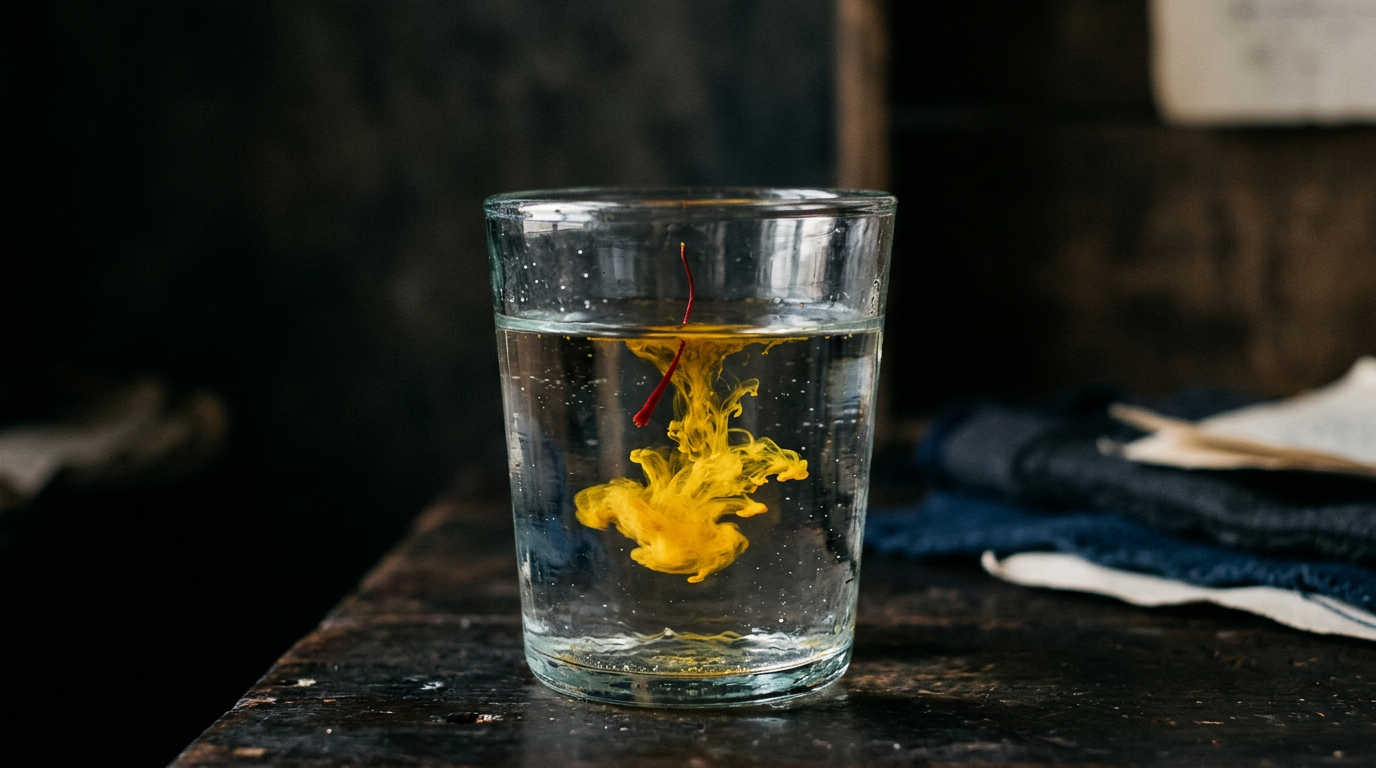
The easiest way to perform a real saffron vs fake saffron test is with a single thread in a glass of cool water. True saffron will release its golden color slowly, perfuming the water over minutes. Fake saffron, often dyed corn silk or safflower, will bleed an aggressive, cloudy red almost instantly. This simple observation reveals everything about a supply chain's integrity.
Every year, as the date for Ashura approaches—marked for July 25, 2026—my mind turns to saffron. Not just as an ingredient, but as a ritual. From my base in the /region/uae, I think of the fragrant, golden-hued rice puddings and shared dishes that will grace tables from Karbala to Mumbai. In Iraq, families might be preparing Qaymah Najafi, a rich chickpea stew where saffron’s aroma is as structural as any other component. It's a taste of reverence, of community, of memory. And it all hinges on the honesty of a few crimson threads.
The Anatomy of a Lie
The saffron trade is notoriously plagued by fraud. Some estimates suggest the majority of saffron sold globally is adulterated in some way [1]. The culprits are many: safflower (or 'bastard saffron'), corn silk, beet fibers, coconut filaments, or even low-grade saffron threads dyed and coated with honey or vegetable oil to add weight and sheen. The price tag, often seen as the ultimate signifier of quality, is a poor guide. A high price can simply be a mask for a well-marketed fake, while a price that's 'too good to be true' is invariably just that.
This isn't just about being cheated out of a few dirhams or rupees. It’s about the dissolution of trust. When a spice so deeply woven into our cultural and culinary rituals—from Saudi Qahwa to Indian biryanis—is a counterfeit, the ritual itself is hollowed out. The sensory experience we seek, that specific, almost medicinal perfume, is replaced by a chemical ghost.
The Test You Can Trust
Forget the confusing jargon and dubious claims on the packaging. The most reliable real saffron vs fake saffron test happens in your own kitchen. It's a quiet moment of observation that connects you directly to the farmer who harvested the stigma.
- Get a glass of cool or room-temperature water. Hot water can be misleading, as it will make even real saffron bleed color more quickly.
- Drop a single thread of saffron into the water. Don't stir.
- Watch closely.
Here’s what you’re looking for:
| Feature | Real Saffron (_Crocus sativus_) | Fake Saffron (Adulterants) |
| :--- | :--- | :--- |
| Color Release | Slow, elegant dispersion. A distinct golden-yellow plume unfurls from the thread. | Immediate, aggressive bleed. The water becomes cloudy and often turns red or orange, not gold. |
| Final Water Color | A uniform, brilliant, clear golden yellow. | Murky, often reddish or deep orange. |
| Thread Integrity | The thread itself remains red for a long time (10-15 minutes or more) after being steeped. | The thread quickly loses its color, turning pale or translucent. |
| Scent | As it steeps, it releases a complex aroma: honey, hay, slightly metallic. | May smell of chemicals, have no scent, or smell faintly sweet (from honey used to add weight). |
| Taste | If you taste the thread, it should be distinctly bitter. | It might taste sweet (a dead giveaway), metallic, or of nothing at all. |
This simple test cuts through thousands of miles of opaque supply chains. It is a moment of truth that a laboratory test for crocin levels can only confirm, not reveal with such elegance.
What a Single Thread Knows
But passing the water test is just the beginning. It tells you that you have real saffron. It doesn't tell you if you have great saffron. That's where provenance comes in. Saffron's quality is scientifically graded by the ISO 3632 standard, which measures the concentration of its three key compounds: crocin (color), picrocrocin (taste), and safranal (aroma) [2].
These concentrations aren't accidental. They are the direct result of terroir—the soil, altitude, and climate—and the painstaking harvest and drying methods of a specific place. Grade A saffron from Herat, Afghanistan, will have a different chemical and sensory signature than that from Kashmir, where it is still sold by the tola (a traditional Indian unit of mass, about 11.6 grams) in historic markets. This is the difference between a generic commodity and a true agricultural specialty. This is the story a single-origin saffron thread tells, a story you can explore further among our spices.
When you know the source, you can begin to understand the nuances. You know why one saffron is more floral and another is more earthy. You know the people whose hands picked the three delicate stigmas from each crocus flower before dawn. The simple real saffron vs fake saffron test is your first step. The next is asking not just if it’s real, but where it’s from. When you see how much a spice can vary, you start to compare everything differently.
It’s a shift from consuming a product to participating in a story. And for a ritual as meaningful as Ashura, that distinction is everything.
Frequently Asked Questions
What is the easiest real saffron vs fake saffron test?
The cold water test is the simplest and most reliable method. Place a thread in cool water. Real saffron will slowly release a golden-yellow color while the thread itself stays red. Fake saffron will instantly bleed a cloudy red or orange dye, and the thread will lose its color.
Why is real saffron so expensive?
Saffron's high cost comes from its labor-intensive harvest. Each saffron crocus flower produces only three tiny threads (stigmas), which must be hand-picked. It takes about 150,000 flowers to produce just one kilogram of saffron [3].
Can you eat the saffron threads after steeping?
Yes, absolutely. The threads contain flavor and aroma compounds. In many recipes, the threads are left in the dish to impart their full character and for visual appeal.
What does real saffron smell like?
The aroma of high-quality saffron is complex and unmistakable. It's not simply sweet. Instead, it has notes of honey, hay, and a distinct, slightly metallic scent due to the compound safranal [4].
Sources & citations
- Sasikumar, B. (2021). Saffron (Crocus Sativus): Adulteration, Quality Control and Standardization. In: Husen, B. (eds) Pharmacognosy - Recent Advances. IntechOpen. Available at: https://www.intechopen.com/
- International Organization for Standardization. (2017). ISO 3632:2011 Spices — Saffron (Crocus sativus L.). ISO. Available at: https://www.iso.org/
- Deo, B. (2003). Growing Saffron - The World's Most Expensive Spice. Crop & Food Research, No. 20. New Zealand Institute for Crop & Food Research. Available at: https://www.plantandfood.com/
- Tarantilis, P. A., & Polissiou, M. G. (1997). Isolation and Identification of the Aroma Components from Saffron (Crocus sativus). Journal of Agricultural and Food Chemistry, 45(2), 459–462. Available at: https://pubs.acs.org/