
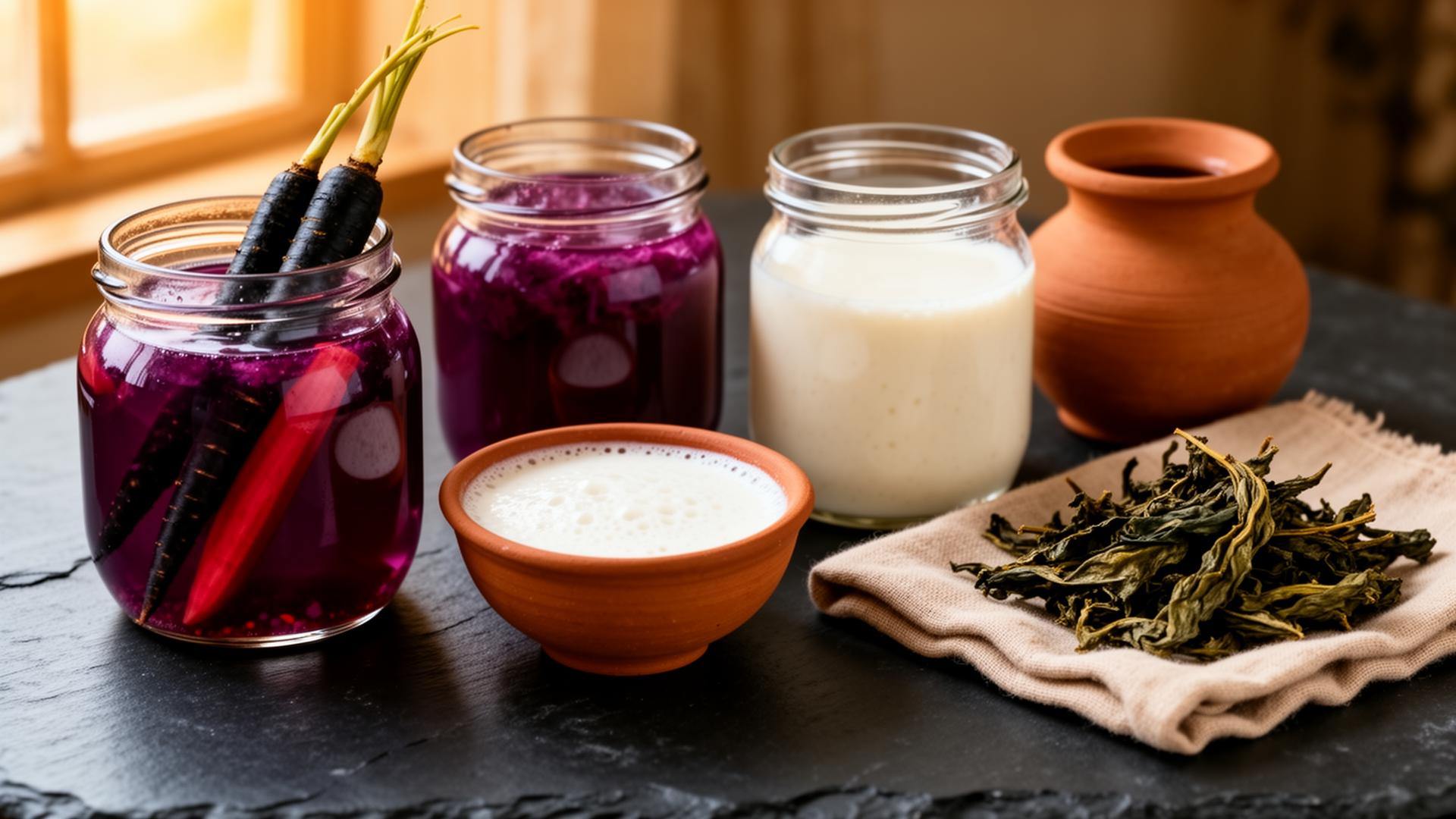
Long before "probiotic" became a label on the side of a yoghurt cup, the Indian kitchen was a quiet, year-round fermentation laboratory. Pots of kanji turning purple-black on a winter sill in Punjab. A clay matka of takra working through the afternoon in Gujarat. Idli batter bubbling overnight in a Tamil household. Gundruk pressed into a clay jar in the Eastern Himalayas. None of these were sold as functional foods. They were just dinner.
What modern microbiology has done is give us a vocabulary for what these kitchens always knew: that the right mix of salt, time, temperature, and starter culture turns ordinary vegetables, grains, and dairy into something quieter — softer on the gut, longer-lived on the shelf, and chemically richer than the raw ingredients it began with.
### Kanji — the Punjabi winter probiotic
A pot of mustard-purple kanji ferments black carrots, beetroot, mustard seeds, and salt for four to six days under indirect winter sun. The dominant organisms are Lactobacillus plantarum and Lactobacillus fermentum [1]. Studies of similar lacto-fermented vegetable brines show viable counts of 10⁷–10⁹ CFU per millilitre at peak — comparable to commercial probiotic drinks, without the marketing budget [2].
What kanji also delivers is the substrate fermentation makes more bioavailable: betalains from the beetroot, isothiocyanates from the mustard, anthocyanins from the black carrot. Acidification opens these compounds up. A clinical commercial capsule does not.
### Takra — buttermilk as a digestive
In the Ayurvedic pharmacopoeia, takra is its own category — distinct from milk, curd, or yoghurt. It is curd churned with water (and often roasted cumin and pink salt), thinned to a drinking consistency. The classical texts prescribe it after a heavy midday meal; modern lactose-intolerance literature now backs the intuition. Live Lactobacillus and Streptococcus cultures hydrolyse lactose in the cup before it reaches the gut [3]. The thinning with water reduces fat load while keeping the live organisms intact.
### Idli, dosa, dhokla — the wild-fermented batters
South India's idli batter, Gujarat's dhokla, Karnataka's neer dosa: all rely on a 8-to-16-hour spontaneous fermentation of rice and lentil slurry. The community is mixed — Leuconostoc mesenteroides starts the rise, Lactobacillus species drop the pH, and yeast strains contribute leavening [4]. The byproducts are clean: lactic acid, modest CO₂, B-vitamins (especially B12 from the bacterial culture, in foods that are otherwise plant-only) [5].
The phytate in raw lentils — the anti-nutrient that locks up iron and zinc — drops by 40-60% during the overnight ferment [6]. The dosa your grandmother made was a mineral-absorption upgrade over the same flour eaten unfermented.
### Gundruk — the Himalayan dry-fermented green
In the Eastern Himalayas, mustard, radish, and cauliflower leaves are wilted, pounded, packed tight in an earthen pot, and left to ferment for 15 to 30 days. The result is dried into long, smoky strips. Pediococcus pentosaceus and Lactobacillus plantarum dominate the community [7]. Gundruk preserves a winter vegetable into a year-round soup base, and it preserves the bioavailable iron from the leaves better than drying alone.
### What this means for the modern kitchen
A few practical moves that respect both tradition and the microbiology:
- Start with one ferment, not five. Kanji in winter or a small jar of cabbage-and-carrot lacto-pickle are the lowest-risk entry points. 2% salt by weight, room temperature, 4-7 days, taste daily.
- Trust your nose, not the calendar. Fermentation is a population, not a timer. Pleasantly sour and bright = ready. Off-smell, fuzzy mould, slimy texture = compost.
- Keep cooked grains separate from raw ferments. Batters like idli and dosa are cooked fermented foods — the live cultures are killed at the tava. The probiotic benefit there is from the pre-digested substrate, not live organisms. To get live cultures, you want the uncooked ferments: takra, kanji, fresh pickled greens.
- Pair with prebiotic fibre. Live cultures need substrate. The traditional South Indian thali — fermented batter, fresh chutney, leafy greens, takra to finish — is a coherent system, not a coincidence.
The Indian fermented kitchen is not catching up to gut-health science. It anticipated it by a few centuries, packaged it as dinner, and never asked anyone to buy a capsule.
---
Sources
- Tamang, J.P., et al. Diversity of Microorganisms in Global Fermented Foods and Beverages. Frontiers in Microbiology, 2016. link
- Marco, M.L., et al. Health benefits of fermented foods: microbiota and beyond. Current Opinion in Biotechnology, 2017.
- Savaiano, D.A. Lactose digestion from yogurt: mechanism and relevance. American Journal of Clinical Nutrition, 2014.
- Soni, S.K., Sandhu, D.K. Indian Fermented Foods: Microbiological and Biochemical Aspects. Indian Journal of Microbiology.
- Madhu, A.N., et al. Vitamin B12 production by fermented foods. Food Research International, 2010.
- Reddy, N.R., Pierson, M.D. Reduction in antinutritional and toxic components in plant foods by fermentation. Food Research International, 1994.
- Tamang, J.P., et al. Microorganisms in fermented foods of the Eastern Himalayas. International Journal of Food Microbiology, 2009.