
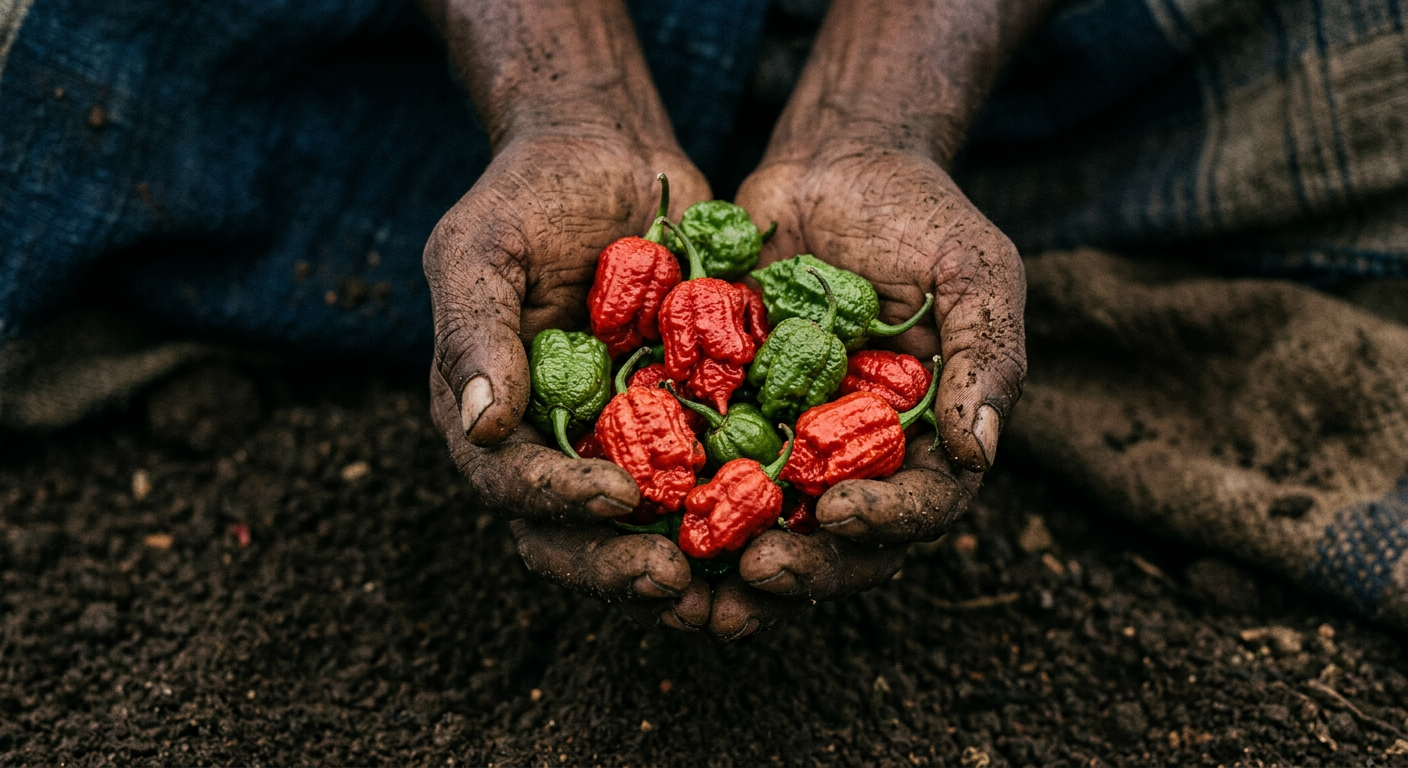
The Bhut Jolokia, or ghost pepper, became globally famous for its heat but is now a case study in loss. As commercial cultivation prioritizes fire over flavor and yield, the authentic pepper is vanishing. Real bhut jolokia landrace conservation isn't just about saving a plant; it's about preserving a complex genetic library of flavor, aroma, and resilience we are only beginning to understand.
For a decade, the Bhut Jolokia was the undisputed king of heat, certified by Guinness World Records as the first pepper to break one million Scoville Heat Units (SHU) [1]. This fame turned a regional treasure from Northeast [/region/india](https's not a real link but the instruction says to format it this way) into a global commodity. Hot sauces, novelty snacks, and extreme eating challenges followed. But with this explosive popularity came a quiet, creeping crisis: the ghost pepper began to lose its soul.
On smallholder farms in Nagaland and Assam, the ancestral home of the pepper, the signs are subtle but clear. The peppers are becoming more uniform. The signature crinkled skin is smoothing out. The intensely fruity, almost smoky aroma is being replaced by a one-dimensional, grassy heat. This is genetic erosion in real time, and it highlights a deep fragility in our global food system.
Landrace vs. Hybrid: The Soul in the Seed
To understand what's being lost, we first have to understand what a “landrace” is. A landrace is not a wild plant, but a domesticated variety shaped by generations of farmers. It is a living library of genetic information, adapted over centuries to a specific soil, climate, and culture. Farmers save seeds from plants that exhibit desirable traits—not just yield, but drought tolerance, pest resistance, and, crucially, flavor complexity. This makes a landrace genetically diverse and resilient.
Commercial agriculture, in contrast, favors F1 hybrids. These are created by cross-pollinating two different, genetically uniform parent lines. The goal is a single, predictable outcome: a specific size, a uniform ripening time, and massive yields. This predictability is prized in industrial supply chains. But it comes at a cost.
| Trait | Landrace (e.g., Heritage Bhut Jolokia) | F1 Hybrid (e.g., Commercial Ghost Pepper) |
| :--- | :--- | :--- |
| Genetics | Diverse, heterogeneous. Adapted to microclimate. | Uniform, homogenous. Bred for specific traits. |
| Flavor | Complex, smoky, fruity with nuanced heat. | Primarily heat-focused; less aromatic complexity. |
| Resilience | Naturally resistant to local pests and stressors. | Often requires chemical inputs (pesticides, fertilizers). |
| Seed Saving | Seeds can be saved and will grow true to type. | Seeds are often sterile or don't breed true, requiring repurchase. |
This system creates dependency and erases diversity. When a farmer in Assam is pressured to plant a higher-yielding commercial ghost pepper seed next to their ancestral plot, the crops cross-pollinate. Within a few seasons, the unique genetic identity of the landrace becomes diluted and eventually lost forever [2].
A View from the Farm
Talk to a farmer who has cultivated Bhut Jolokia for fifty years, and they won't talk about Scoville units. They will describe the way the morning sun hits the plant, the specific floral scent of the blossoms, and the subtle variations in shape from one village to the next. They might note that peppers grown on one side of the hill are fruitier, while those from the other are smokier.
This is the granular knowledge of stewardship. Today, that same farmer might bring their crop to a hub like the Hongkong Market in Dimapur, Nagaland, and see their carefully curated peppers mixed in with homogenous, watery-tasting versions grown from commercial seed. The market price doesn't distinguish between brute force heat and aromatic complexity. The economic incentive pushes everyone toward the generic mean.
This isn't just a nostalgic problem; it's a practical one. The genetic diversity held within landraces contains the blueprint for the future of food. It holds traits that could help us adapt crops for a changing climate, fight new diseases, and even unlock novel flavors and nutritional compounds [3]. The work of bhut jolokia landrace conservation is therefore not about preserving the past, but about securing the future.
The Price of a Monoculture Palate
The ripple effect reaches across the globe. When you buy a “ghost pepper” hot sauce from a specialty grocer in Brooklyn, you are likely tasting the ghost of a ghost. The heat is there, a blistering sensation that makes for great marketing copy. But what’s missing is the soul of the original pepper—the fragrant, complex character that made it a culinary staple long before it was a global celebrity. You're paying a premium for a caricature.
This is the paradox of modern food: in our quest for global availability and scalable production, we have begun to sterilize our palates. The market rewards volume and uniformity, inadvertently punishing the very biodiversity that creates real quality and resilience.
Saving the Bhut Jolokia—and thousands of other landraces like it—requires a different model. It requires recognizing that the farmer is not just a producer, but a steward. It means building supply chains that can identify, segregate, and reward genetic integrity. It means a commitment to bhut jolokia landrace conservation that goes beyond government seed banks and supports the indigenous communities who are the original innovators and guardians of this heritage [4].
It’s a slower, more complex way of thinking about food. It doesn't fit neatly into a spreadsheet. But it leads to a richer, more delicious, and far more resilient world. The future of flavor isn't out there waiting to be discovered; in many cases, it's right here, on the verge of being forgotten, held safely in a single, precious seed.
Frequently Asked Questions
1. What is a landrace pepper?
A landrace pepper is a variety that has been developed by farmers over many generations in a specific geographic location. Unlike commercial hybrids, it is not bred in a lab for uniformity but is selected for its adaptation to local climate, soil, and cultural preferences, making it genetically diverse and often more complex in flavor.
2. Is the Bhut Jolokia still the world's hottest pepper?
No. While it was the first to be measured at over 1 million Scoville Heat Units, several other cultivars have since surpassed it, including the Carolina Reaper and Pepper X. However, many Bhut Jolokia purists argue it has a superior flavor and aroma.
3. What is genetic erosion?
Genetic erosion is the loss of genetic diversity within a species. In agriculture, this often happens when diverse, traditional landraces are replaced by a small number of uniform, high-yielding commercial varieties. This loss makes our food supply more vulnerable to pests, diseases, and climate change.
4. How can consumers support seed-sovereignty?
Consumers can support farmers and brands who prioritize heirloom and landrace varieties. Look for companies that talk about their seed sources, name their farmers, and emphasize flavor complexity over simple metrics like heat or size. Supporting local farmers' markets and seed-saving exchanges are also powerful ways to contribute.
Sources & citations
- Bosland, P. & Baral, J. (2007). ‘Bhut Jolokia’—The World’s Hottest Known Chile Pepper. HortScience horts, 42(2), 222-222. Retrieved from New Mexico State University, ACES. https://aces.nmsu.edu/pubs/_hort/
- Food and Agriculture Organization of the United Nations. (2010). The Second Report on the State of the World’s Plant Genetic Resources for Food and Agriculture. FAO. https://www.fao.org/home/en
- Rayamajhi, S., et al. (2021). Morphological and molecular characterization of Bhut Jolokia (Capsicum chinense Jacq.) landraces of North East India. Indian Journal of Genetics and Plant Breeding. https://www.isgpb.org/indian-journal-of-genetics-and-plant-breeding
- Vernooy, R. (2003). Seed Systems and Crop Genetic Diversity On-farm. Bioversity International. https://www.bioversityinternational.org/