
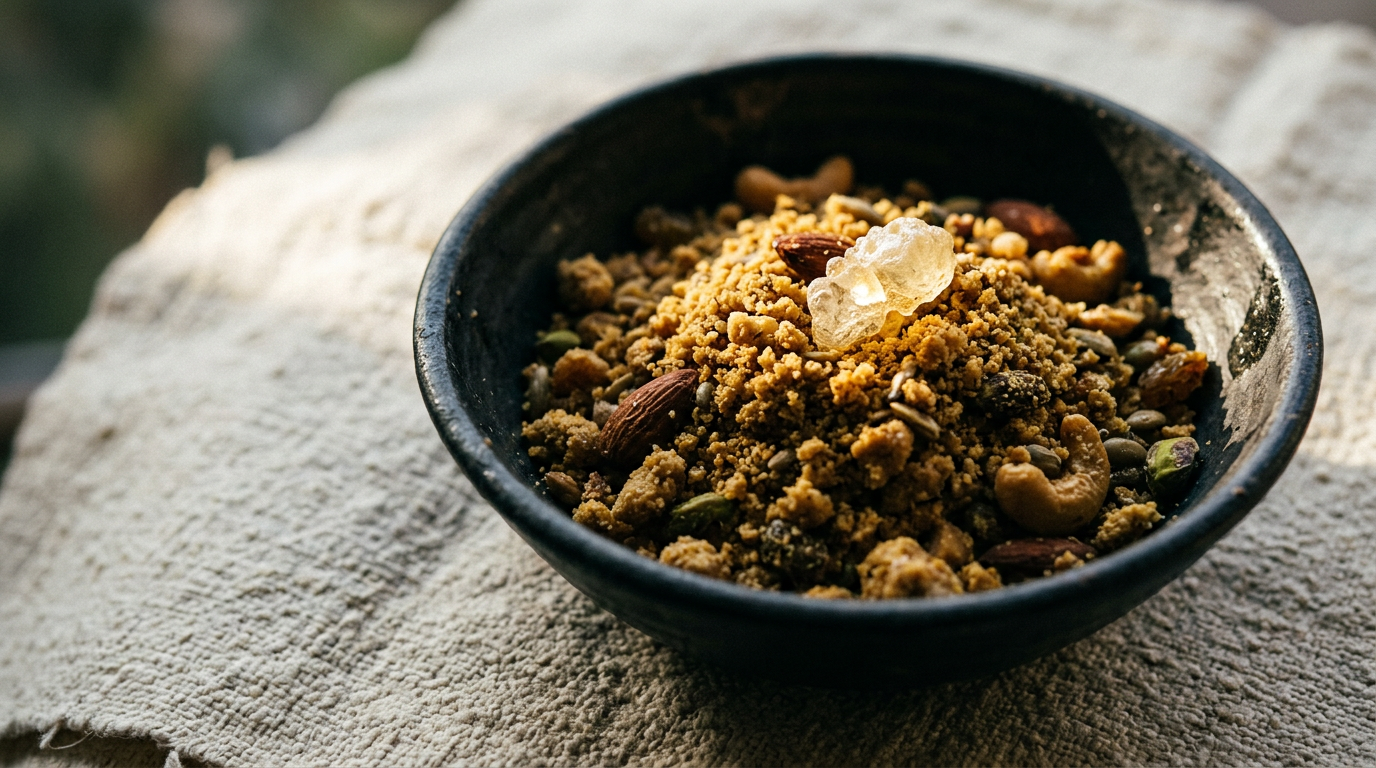
Our definitive panjiri recipe for Janmashtami is a study in precision, designed to nourish the body after a day of fasting. For generations, this blend of whole wheat flour, ghee, nuts, and spices has been a cornerstone of post-fast nutrition, but the method was always passed down in approximations. This year, for the festival on September 4, 2026, we’re writing it all down.
Panjiri is more than a sweet treat; it’s functional food. It marks the midnight birth of Krishna during [Janmashtami](/festival/janmashtami) and is traditionally given to new mothers to restore strength. The secret to its efficacy lies not just in the ingredients, but in the specific heat and time applied to them. It’s a quiet thermal science, practiced for centuries in kitchens across North [India](/region/ind).
The Alchemy of the Dry Roast
Ask for a family panjiri recipe and you’ll get a list of ingredients followed by the instruction to “roast until golden brown and fragrant.” This is true, but unhelpful. That crucial sensory cue is the result of a series of chemical reactions that are highly dependent on time and temperature.
When you roast whole wheat flour (atta), you are initiating dextrinization, a process where starches break down into smaller, sweeter-tasting dextrins. This not only creates a wonderfully nutty flavor but also makes the flour easier to digest—critical when reintroducing food after a fast [1]. Roasting too quickly on high heat will scorch the outside before the starches convert, resulting in a bitter taste. Roasting too slowly dries it out. Precision is not obsessive; it is the entire point.
Two ingredients in our version deserve special attention: gond (edible gum) and sonth (dried ginger).
- Gond (Acacia Gum): These crystalline tears of resin, when fried in ghee, puff up into ethereal, crunchy morsels. Traditionally revered for strengthening bones and aiding recovery, modern science understands gond as a powerful prebiotic. It’s a soluble fiber that nourishes beneficial gut bacteria, contributing to overall digestive health [2]. It is the textural magic and hidden wellness engine of a true panjiri.
- Sonth (Dried Ginger): We use ginger not just for its signature warmth, but for its well-documented role as a digestive aid and anti-inflammatory agent. The active compound, gingerol, helps soothe the digestive system, making panjiri a gentle yet potent way to break a fast [3].
The Recipe, by the Clock
This recipe is a blueprint. The quality of your ingredients—the freshness of your flour from the local chakki, the ghee you rendered at home, the nuts you sourced from a trusted vendor—is paramount. But this timetable provides the structural integrity that technique alone confers.
Yields: Approx. 750g
Prep time: 10 minutes
Cook time: 45-50 minutes
Ingredients:
- 250g Whole Wheat Flour (atta)
- 150g Ghee, divided
- 150g Unrefined Cane Sugar (bura) or Jaggery Powder
- 50g Edible Gum (gond)
- 50g Fox Nuts (makhana)
- 100g Mixed Nuts (almonds, cashews, pistachios), coarsely chopped
- 2 tbsp Dried Ginger Powder (sonth)
- 1 tsp Green Cardamom Powder (elaichi)
### Roasting Timetable & Method
Use a heavy-bottomed kadhai or pan. The timings are a guide; your stove, pan, and the humidity in the air will cause slight variations. Trust your nose as much as the clock.
| Ingredient(s) | Ghee | Heat | Time (minutes) | Sensory Cue & Notes |
| :--- | :--- | :--- | :--- | :--- |
| Edible Gum (gond) | 3 tbsp | Medium | 3-4 | Fry in batches. It will puff up like popcorn. Remove and set aside. |
| Fox Nuts (makhana) | 1 tbsp | Low-Medium | 8-10 | Roast until crisp enough to crush easily between your fingers. Remove. |
| Chopped Nuts | 1 tbsp | Low | 5-7 | Roast until lightly fragrant and just beginning to change color. Remove. |
| Whole Wheat Flour | 100g (remaining) | Low | 15-20 | Stir continuously. The color will change to a uniform sandy brown and emit a deeply nutty aroma. |
Instructions:
- Follow the roasting timetable above, removing each ingredient from the pan after it is roasted and setting it aside.
- In a bowl, lightly crush the fried gond and roasted makhana. You want a coarse, varied texture, not a fine powder.
- Once the flour is roasted, turn off the heat. Immediately add the sugar (bura), dried ginger (sonth), and cardamom powder to the hot flour. The residual heat will meld the flavors. Stir until thoroughly combined.
- Add the crushed gond and makhana, along with the roasted nuts. Mix everything together until evenly distributed.
- Let the panjiri cool completely before transferring it to an airtight container. It will become firmer as it cools.
This is more than a festival recipe. It’s a small act of preserving and documenting a piece of culinary wisdom, ensuring it nourishes for generations to come—with no more guesswork.
***
### Frequently Asked Questions
1. Can I make this panjiri recipe for Janmashtami without sugar?
Yes. You can substitute the unrefined cane sugar with an equal amount of finely powdered jaggery or date powder. Add it off the heat, just as you would the sugar, to prevent it from burning.
2. How long does homemade panjiri last?
Stored in a cool, dry place in an airtight container, panjiri will easily last for 4-6 weeks. The ghee acts as a natural preservative.
3. Is edible gum (gond) essential?
While gond is traditional and adds unique texture and health benefits, you can omit it if you can't find it. The recipe will still work, but you will miss the characteristic light crunch.
4. Why did my panjiri turn out bitter?
A bitter taste is almost always a sign that the flour was over-roasted or roasted on excessively high heat. The key is to use low, steady heat and stir constantly for an even, gentle roast.
Sources & citations
- Sands, D. C., & Miller, R. V. (1991). Dextrin. In Food Gels (pp. 37-67). Springer, Dordrecht. (Note: General food science principle, referencing a textbook concept on Dextrinization). Link to publisher: https://link.springer.com/
- Food and Agriculture Organization (FAO). "Acacia gum: Description and Specifications." FAO Corporate Document Repository. https://www.fao.org/ag/agn/jecfa-additives/specs/Monograph1/Additive-003.pdf
- Bode, A. M., & Dong, Z. (2011). The Amazing and Mighty Ginger. In Herbal Medicine: Biomolecular and Clinical Aspects. 2nd edition. CRC Press/Taylor & Francis. Available from: https://www.ncbi.nlm.nih.gov/books/NBK92775/
- The Editors of Encyclopaedia Britannica. (1998). "Janmashtami." Britannica. https://www.britannica.com/topic/Janmashtami