
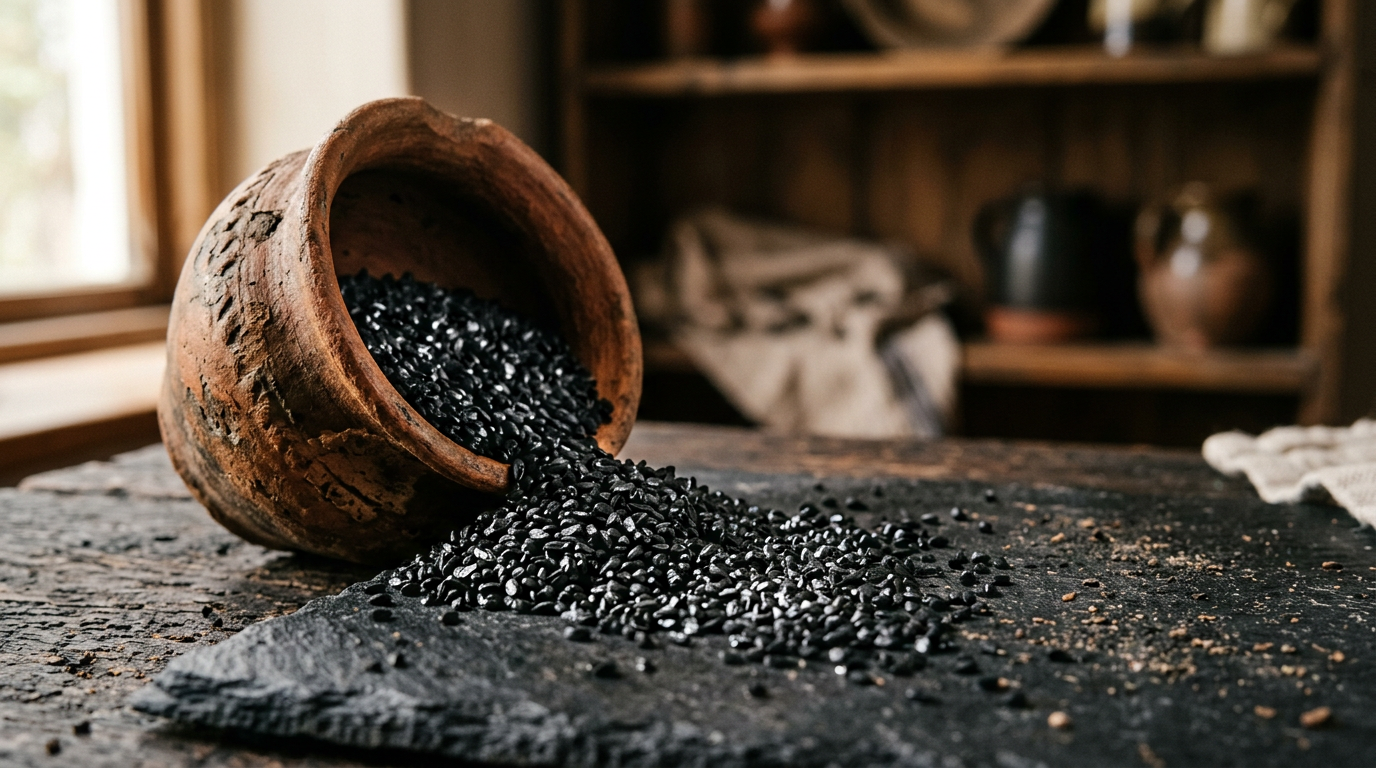
In 1922, when Howard Carter’s team finally breached the sealed door of Tutankhamun’s tomb, they uncovered a breathtaking inventory intended for the boy-king’s journey into the afterlife: gold, chariots, furniture, perfume. Among the spectacular treasures was something far more humble, yet just as telling: a stash of tiny, black, teardrop-shaped seeds [1].
These were seeds of Nigella sativa, known to many today as kalonji. Their presence in a pharaoh's 3,300-year-old grave goods poses a quiet question. In a chamber packed with the finest objects a kingdom could offer, why make room for a simple spice? The Egyptians clearly believed it was essential for the next world, a testament to its value in this one.
And they weren't alone. Kalonji threads its way through antiquity, a seasoning and a remedy prized by the world's great civilizations. The Old Testament mentions it as “ketzah” (Isaiah 28:25-27), a grain to be threshed with a staff, not a cartwheel—a nod to its delicate nature. The 1st-century Greek physician Dioscorides recommended it for headaches and toothaches. In Islamic tradition, it is revered, with a famous prophetic saying describing it as “a remedy for all diseases except death” [2].
Not Cumin, Not Sesame
Before we go further, a point of clarification. Kalonji is often mistakenly called black cumin, black caraway, or black sesame. It is none of these. Nigella sativa is a small flowering annual from the Ranunculaceae family, which makes it a relative of buttercups and columbines—not cumin (Apiaceae family) or sesame (Pedaliaceae family). The seeds have a unique flavor profile that sets them apart: a little peppery, a touch bitter, with intriguing notes of onion and oregano. Toasting them gently in a dry pan mellows the bitterness and amplifies their complexity, making them a cornerstone of Bengali panch phoron spice blends and an essential topping for Turkish breads and fluffy naan.
This long and cross-cultural history of reverence is what makes kalonji so fascinating. For millennia, across diverse cultures and geographies, people who had zero contact with one another all arrived at the same conclusion: this seed is important. They didn't have the tools of modern science, but they had observation, tradition, and a deep understanding of the plant world. They knew it worked.
From Pharaohs to Phytochemistry
Today, we are finally catching up, swapping folklore for phytochemistry. Modern science is beginning to map the mechanisms behind kalonji’s ancient reputation. The primary bioactive compound in these seeds is a potent molecule called thymoquinone (TQ), a subject of intense scientific interest [3].
A search of the National Library of Medicine’s database reveals thousands of papers on Nigella sativa and thymoquinone. Researchers are investigating its powerful antioxidant and anti-inflammatory properties, which may help explain its traditional use for such a wide array of ailments [4]. Studies have explored its effects on everything from metabolic health Markers to respiratory function and immune responses. While much of this research is preliminary, the sheer volume and direction of the findings suggest that ancient cultures were onto something profound.
What they understood through lived experience, we are now beginning to understand on a molecular level. The inflammatory response that Dioscorides sought to soothe, the general wellness that ancient Egyptians wished for their pharaoh—we can now see potential pathways for these effects within the seed's chemical makeup.
A Taste of Living History
This turn from history to the lab doesn’t mean kalonji belongs in a capsule. Its first and best use is where it began: in the kitchen. To use kalonji is to engage with this history directly. It’s to sprinkle the same seeds found in Tutankhamun’s tomb over your flatbread, to fold them into your lentil dal, to temper them in oil for a vegetable curry.
The seeds that accompanied a king on his eternal journey were not a relic. They were, and are, a living ingredient, a carrier of flavor and function that has never fallen out of use. We are not so much discovering something new as we are remembering something old. We are finally appreciating the depth of a knowledge system that saw a universe of potential in one tiny, black seed.
Sources & citations
- Zohary, D., Hopf, M., & Weiss, E. (2012). Domestication of Plants in the Old World: The origin and spread of domesticated plants in Southwest Asia, Europe, and the Mediterranean Basin. Oxford University Press.
- Britannica, The Editors of Encyclopaedia. "Black cumin". Encyclopedia Britannica, 23 Aug. 2023, https://www.britannica.com/plant/black-cumin.
- Ahmad, A., et al. (2021). A review on therapeutic potential of Nigella sativa: A miracle herb. Evidence-Based Complementary and Alternative Medicine, 2021, 5584924. https://www.ncbi.nlm.nih.gov/pmc/articles/PMC8426354/
- Tavakkoli, A., Mahdian, V., Razavi, B. M., & Hosseinzadeh, H. (2017). Review on Clinical Trials of Black Seed (Nigella sativa) and Its Active Constituent, Thymoquinone. Journal of Pharmacopuncture, 20(3), 179–193. https://www.ncbi.nlm.nih.gov/pmc/articles/PMC5635670/