
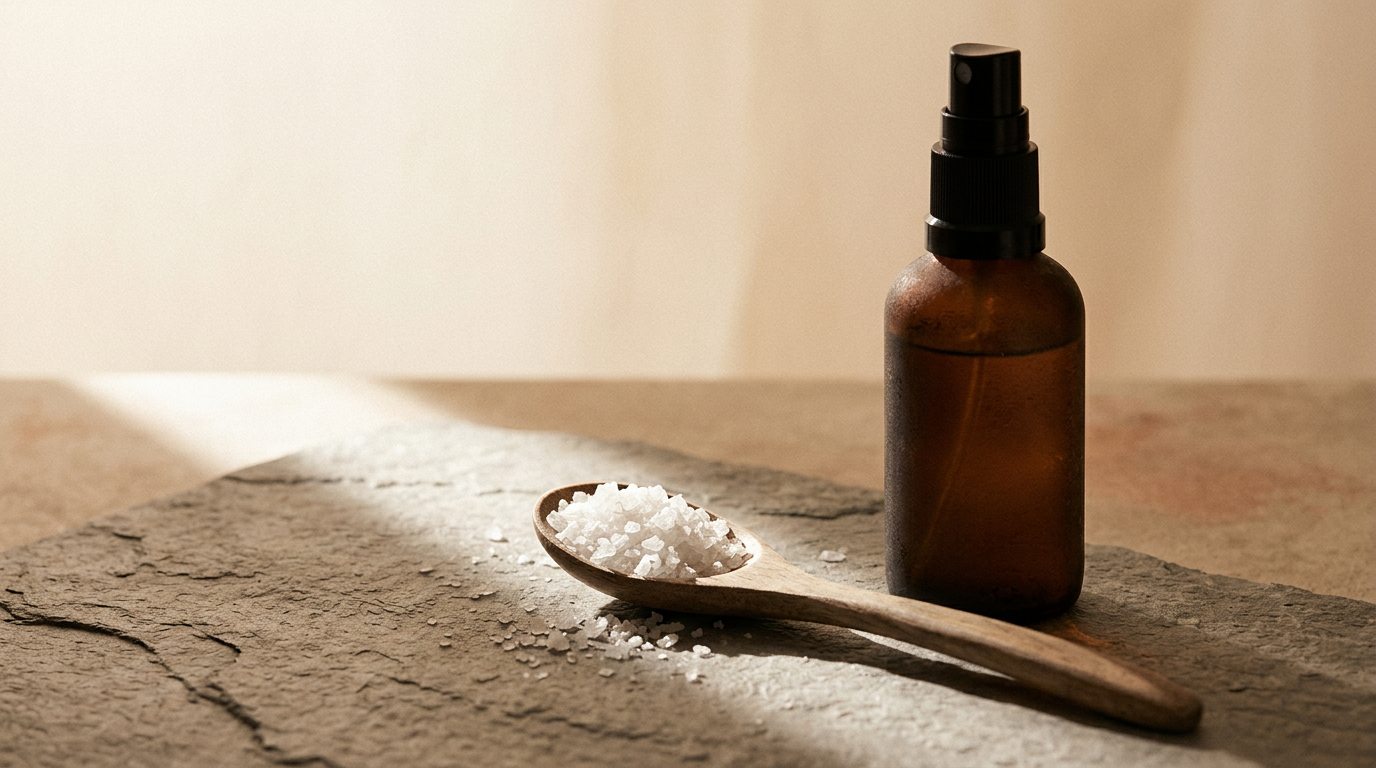
When it comes to a sore throat, the debate over a salt water gargle vs throat spray is a familiar one. A salt water gargle is a time-honored, globally recognized first-aid measure praised for its simplicity and accessibility. Yet, commercial throat sprays promise targeted, fast-acting relief. The effective choice depends on the mechanism: one offers temporary physical relief, while the other can deliver lasting, botanically-powered soothing.
The Honest Case for Salt Water
Let’s be clear: a salt water gargle works. It’s not just an old wives' tale; it’s a recommendation backed by health authorities like the NHS in the UK [1]. The science is simple and elegant: osmosis. When you gargle with a hypertonic saline solution (water that’s saltier than your own cells), it draws excess fluid out of the inflamed tissues in your throat, temporarily reducing swelling and the pain it causes.
From a kitchen in Indiana to a home in India, it’s the first line of defense. It’s practically free, the ingredients are always on hand, and it provides noticeable, if brief, relief. It’s the definition of a low-risk, accessible remedy. But its effectiveness is also its limitation. Salt water is a blunt instrument. It physically de-puffs tissue. It doesn't coat, soothe, or offer any antimicrobial action. The relief lasts only until your body’s fluid balance normalizes, and the inflammation reasserts itself.
Deconstructing the Throat Spray
This is where a thoughtfully formulated spray can offer something more. The question isn't whether to [compare](/compare) a gargle to a spray, but which spray.
Many over-the-counter options, particularly in the US market, rely on numbing agents like benzocaine or antiseptics like phenol. These work by deadening the nerve endings or killing surface microbes, but they do little to address the underlying inflammation or heal the irritated tissue. Others are mostly sugar, water, and “natural flavors,” offering minimal benefit beyond a momentary placebo effect. They are the ultra-processed food of throat care.
A superior [remedy](/remedy) leverages botanical science. Consider Mulethi, or licorice root. For centuries, this root has been a cornerstone of traditional medicine for respiratory ailments from Delhi's Khari Baoli spice market to ancient apothecaries. Modern science tells us why. Licorice root is a powerful demulcent, meaning it contains mucilage that forms a soothing, protective film over irritated mucous membranes [2]. This coat provides longer-lasting relief than salt water ever could.
Furthermore, its primary active compound, glycyrrhizin, has well-documented anti-inflammatory and even antiviral properties [3]. It doesn’t just distract you from the pain; it actively works to calm the irritation at a cellular level. This is the difference between turning down the volume on a smoke alarm and actually putting out the fire.
When we compare a salt water gargle vs throat spray, the real distinction is between temporary osmotic relief and targeted biochemical action. One is first-aid; the other is formulation. One is a quick fix; the other is a root-cause approach.
| Feature | Salt Water Gargle | Generic Throat Spray | Thoughtfully Formulated Spray |
| :--- | :--- | :--- | :--- |
| Mechanism | Osmosis (reduces swelling) | Numbing (benzocaine) or antiseptic (phenol) | Demulcent (coats tissue), Anti-inflammatory |
| Key Ingredient(s) | Salt (Sodium Chloride) | Chemicals, alcohol, sugar, artificial flavors | Whole plant extracts like Mulethi (Licorice Root) |
| Duration of Relief | Short (20–30 minutes) | Short to Medium (masks pain) | Long-lasting (soothes and protects) |
| Underlying Benefit | Temporary symptom relief | Masks symptoms | Addresses irritation and inflammation |
| Cost | Pennies | £5-£10 (UK) / $8-$15 (US) for a 1 fl oz bottle | A premium, but for a functional purpose |
Choosing a remedy shouldn't be about righteousness, but about receipts—the observable, evidence-backed results. Salt water is a good start. But for those seeking a solution that marries the wisdom of tradition with the rigor of science, the answer lies not in the salt shaker, but in the careful extraction and application of plants like mulethi.
### Frequently Asked Questions
1. Is a salt water gargle safe for everyone?
Generally, yes. However, individuals on sodium-restricted diets or with high blood pressure should consult their doctor, as some salt can be accidentally swallowed.
2. What should I look for in a good throat spray?
Look for a clean label with recognizable ingredients. Prioritize sprays featuring demulcent and anti-inflammatory botanicals like licorice root (mulethi), marshmallow root, or slippery elm. Avoid products heavy on sugar, alcohol, and numbing agents like benzocaine.
3. Why is mulethi (licorice) good for a sore throat?
Its benefits are twofold. First, as a demulcent, it creates a protective, soothing film over the raw tissues of your throat. Second, its active compound, glycyrrhizin, has been shown in clinical studies to have potent anti-inflammatory properties, helping to reduce the root cause of the pain [3].
4. Can I just chew on licorice root?
While chewing the raw root is a traditional practice, a properly formulated spray ensures a standardized dose of the active compounds and a better coating mechanism for the entire throat. People with high blood pressure or who are pregnant should consult a physician before consuming significant amounts of licorice due to the effects of glycyrrhizin.
Sources & citations
- National Health Service (NHS). "Sore Throat." NHS.uk, https://www.nhs.uk/conditions/sore-throat/.
- Naveed, M., et al. "A comprehensive review of the health-promoting effects of licorice (Glycyrrhiza glabra L.)." Phytotherapy Research, 2018. https://pubmed.ncbi.nlm.nih.gov/29178229/
- Wang, L., et al. "Glycyrrhizin and its derivatives as potential anti-inflammatory agents." Journal of Ethnopharmacology, 2023. https://www.sciencedirect.com/journal/journal-of-ethnopharmacology.
- Sinatra, S. T., et al. "The Salt Fix: The Health Benefits of Salt." Townsend Letter, 2018. https://www.townsendletter.com/