
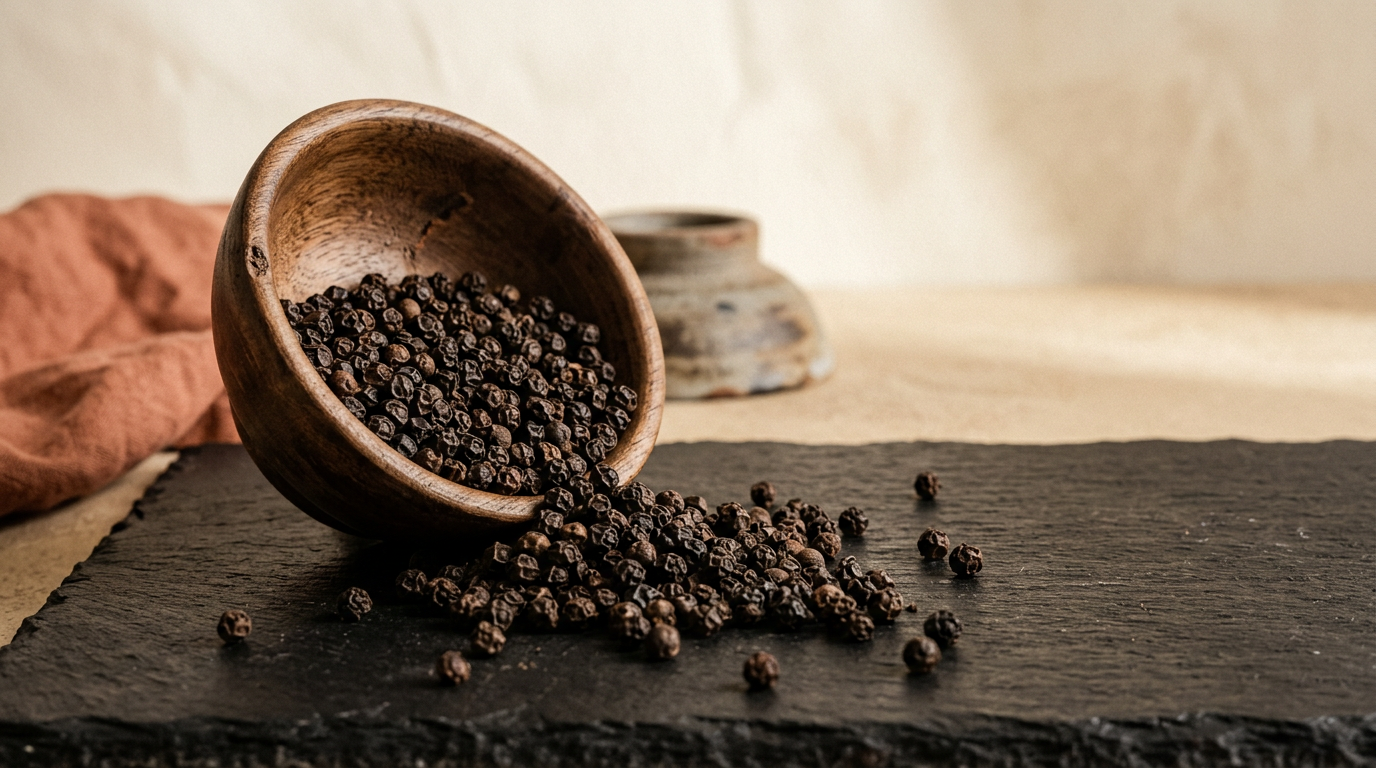
Another year, another scroll through the familiar Father's Day gift guide. The bluetooth-enabled grill tongs, the subscription box for esoteric hot sauces, the endless parade of mugs declaring him the 'World's Best Farter' (for the cheeky dad) or simply 'Dad Fuel' (for the tired one).
These gifts are fine. They are gestures. But they often speak more to novelty than to nourishment, offering a brief spark of amusement that quickly fades. What if we offered something different? A gift that doesn't just occupy a space on a shelf, but weaves itself into a daily ritual. A gift that carries the history of global exploration in each tiny sphere. A gift that makes every single meal, from a simple fried egg to a celebratory steak, taste more alive.
We’re talking about black pepper. Yes, pepper. That dusty shaker of grey powder sitting by the stove is a pale ghost of the real thing—and upgrading it is one of the most profound, and simple, improvements one can make in a kitchen.
The King in Exile
The story of modern pepper is a quiet tragedy. To meet mass-market demand, most of what we encounter is grown for yield, not character. It’s harvested prematurely, machine-dried too quickly at high temperatures, and then ground into a fine powder months or even years before it reaches your table. This process strips it of its soul. The volatile aromatic oils that give pepper its complex, floral, and citrusy notes evaporate, leaving behind only the brute, one-dimensional heat of its primary alkaloid, piperine.
It’s the aromatic equivalent of listening to a symphony through a broken speaker. You get the rhythm, but you miss the entire orchestra. Giving the gift of true, single-origin black pepper is like handing someone a front-row ticket.
From the Malabar Coast, a Different Story
To understand what pepper can be, you have to go to its ancestral home: the lush, monsoon-swept slopes of the Western Ghats in Southern India. This is the Malabar Coast, where Piper nigrum, a flowering vine, has been cultivated for millennia. For centuries, this was the only place on earth it grew, making its fruit—the peppercorn—one of the most sought-after commodities in history, driving men like Vasco da Gama to risk everything for a sea route to India.
This is where you find Tellicherry peppercorns. Tellicherry is not a variety, but a grade. It refers to the largest, most mature peppercorns from a given harvest, left on the vine longer to develop more complex sugars and aromatic compounds. By law, to be called Tellicherry, the berries must be a minimum of 4.25 millimeters in diameter. They are often picked by hand and sun-dried, a slower, gentler process that preserves their intricate chemistry.
Crack one open, and the difference is immediate. The aroma isn’t just sharp; it’s a layered perfume of citrus, pine, and sweet earth. This is a spice with terroir, a sense of place as distinct as a pinot noir from Burgundy or a coffee bean from Yirgacheffe.
The Science of Pungency (and a Secret Power)
The magic of that sensory explosion comes from a rich array of volatile compounds, but the star of the show remains piperine. Piperine is responsible for pepper’s signature pungency, but its role extends far beyond flavor. Modern science is only now catching up to what Ayurvedic practitioners have understood for ages: piperine is a remarkable bio-enhancer [1].
When consumed, piperine can significantly increase the bioavailability of other nutrients and compounds. The most famous example is its pairing with turmeric; piperine can boost the absorption of curcumin by up to 2,000% [1]. But its powers don't stop there. It enhances the uptake of beta-carotene, selenium, B vitamins, and numerous other plant compounds. It essentially acts as a key, unlocking the full potential of the other foods on the plate.
Beyond its role as a facilitator, piperine is a potent active compound in its own right. Studies suggest it has significant antioxidant and anti-inflammatory properties, helping to combat oxidative stress within the body [2]. The higher concentration of piperine in mature, well-grown peppercorns means you're not just getting more flavor; you're getting more function.
A Gift of Daily Ritual
A tin of whole Tellicherry peppercorns and a good grinder isn't just an ingredient. It's an invitation to a ritual. It’s the satisfying crunch, the release of aroma, the small moment of intention before finishing a dish. It’s a connection to the food, a nod to history, and a quiet application of nutritional science.
It’s a gift that says, “I want the things you do every day to be a little bit better.” Unlike the novelty mug, it won't be relegated to the back of the cupboard. It will be reached for daily, a constant, subtle reminder of a thoughtful gesture.
This Father’s Day, give a gift that deepens an experience, instead of just adding to the clutter. Explore our selection of heirloom, single-origin spices in our [Father's Day collection](/gifts/fathers-day) and our broader pantry of [heritage spices](/festivals).
Sources & citations
- Srinivasan, K. (2007). Black Pepper and Its Pungent Principle-Piperine: A Review of Diverse Physiological Effects. Critical Reviews in Food Science and Nutrition, 47(8), 735–748. [https://www.tandfonline.com/doi/abs/10.1080/10408390601062054]
- Chavarria, D., et al. (2016). The Pungent Principle of Black Pepper: A Review of the Pleiotropic Roles of Piperine. Mini Reviews in Medicinal Chemistry, 16(18), 1469-1482. [https://www.eurekaselect.com/article/77517]
- Britannica, The Editors of Encyclopaedia. (2024). Black pepper. In Encyclopædia Britannica. [https://www.britannica.com/plant/black-pepper-plant]
- Parry, John W. (2002). Spices, Volume 2: Morphology, Histology and Chemistry. Chemical Publishing Co.