
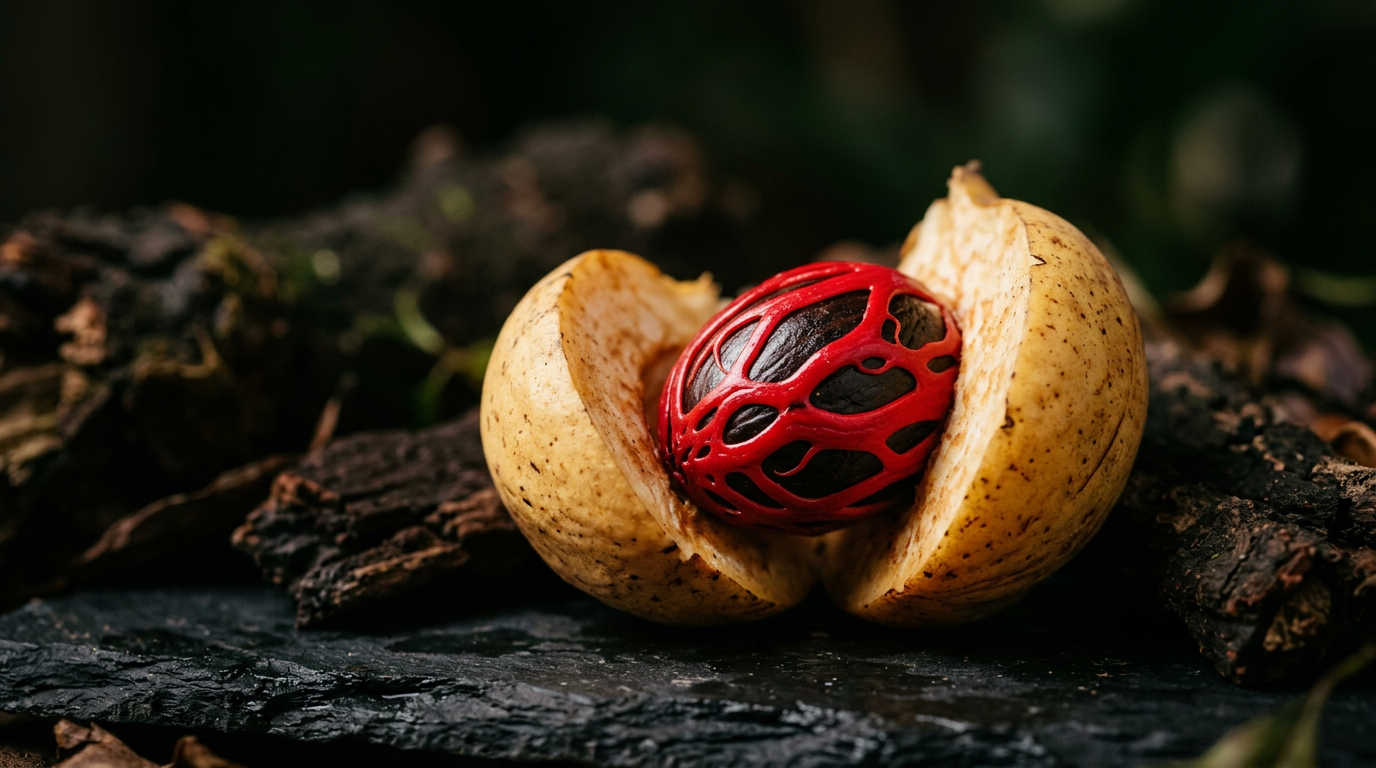
In the world of spices, there are no loners, only families, rivals, and forgotten twins. Consider nutmeg. We grate it into eggnog, dust it over béchamel, and welcome its deep, woody warmth in our autumn baking. It is a spice of comfort, a reliable background player. But nutmeg has a sibling—one born from the very same fruit, at the very same moment, yet with a wholly different character.
This is the story of mace.
A Single Fruit, A Double Life
To understand mace, you must first picture the fruit of the Myristica fragrans tree, an evergreen native to the Banda Islands of Indonesia, the fabled Spice Islands. When ripe, the fleshy, apricot-like fruit splits open. Inside is not one prize, but two. The hard, dark kernel is the nutmeg. But wrapped around it, like a brilliant crimson net, is a lacy, leathery membrane called an aril. This aril is mace [1].
Harvested by hand, the aril is carefully peeled from its seed, flattened, and dried. Its vibrant red slowly fades to a warm, sun-kissed orange-gold. For centuries, these two spices have grown together, been harvested together, and journeyed across oceans together. Yet, upon arrival, they part ways. Nutmeg marches confidently down the main aisle of global commerce, while mace is relegated to the specialty shelf, a secret handshake for chefs and devoted cooks.
This wasn't always the case. In the 17th and 18th centuries, during the brutal Dutch monopoly of the spice trade, mace was often more valuable than nutmeg by weight [2]. Its complex flavor was prized. What changed? Perhaps it was a simple matter of industrial convenience. Nutmeg, a robust and self-contained nut, is easier to handle, ship, and grind in bulk. Its flavor is bold and direct, easy to love. Mace is more fragile, its flavor more ethereal. In a world that began to prize consistency and volume over nuance, nutmeg was the logical winner.
The Chemistry of Character
Though born together, mace and nutmeg are not chemically identical. They share many aromatic compounds—myristicin, elemicin, safrole—but in distinctly different concentrations. Think of it as the same genetic blueprint expressed through a different developmental path.
Nutmeg’s flavor is dominated by terpenes like sabinene and pinene, giving it a warm, woody, and sweet profile [3]. It’s a deep, resonant cello note in a culinary composition.
Mace, on the other hand, has a higher concentration of other compounds which lend it a more complex and delicate aroma. While still warm, it is brighter, more peppery, with pronounced notes of citrus and pine, and a subtle floral finish like a whisper of clove. It doesn't shout; it converses. If nutmeg is the cello, mace is the viola—sharing a similar timbre but with a lighter, more agile, and arguably more intricate voice.
A Place in the Modern Pantry
The most common question is, “Can I substitute one for the other?” The answer is yes, but you shouldn’t. You lose the point. Using nutmeg where mace is called for is like using a permanent marker where a watercolor brush was intended.
Nutmeg’s strength is its ability to stand up, to infuse dairy, batters, and ground meats with its signature warmth. Its very boldness can be its limitation, as it can easily overpower a dish.
Mace excels where subtlety is key. Its brilliant color once made it a favorite for coloring and flavoring clear broths and consommés without muddying them. It's magical with seafood, particularly shellfish, and brings an unexpected brightness to creamed spinach or potato gratin. It’s the secret ingredient in many classic European sausages and pâtés, adding a savory depth that nutmeg alone cannot provide. Old-fashioned donut recipes frequently call for mace, a clue to its forgotten role in baking where it offers a sophisticated warmth without the cloying sweetness of the nutmeg-cinnamon-clove trinity [4].
To appreciate mace is to move beyond the obvious. It’s a quiet rebellion against the culinary monolith, an invitation to listen for the quieter notes. The preference for nutmeg over mace in the last few centuries says less about the spices themselves and more about our shift toward bolder, simpler, and sweeter flavor profiles. As our palates evolve and we begin to seek more complexity and nuance, mace is waiting patiently in the wings for its re-discovery. It’s not nutmeg’s understudy; it’s the other half of the story.
Sources & citations
- Harrison, P. A. (2022). "Nutmeg and mace". Encyclopædia Britannica. https://www.britannica.com/plant/nutmeg
- Le Couteur, P., & Burreson, J. (2003). Napoleon's Buttons: 17 Molecules That Changed History. TarcherPerigee. (Reference to Dutch East India Company trade; link to publisher homepage: https://www.penguinrandomhouse.com/)
- Parvin, B. (n.d.). "Nutmeg and Mace". Purdue University, College of Agriculture, Department of Horticulture and Landscape Architecture. https://www.hort.purdue.edu/newcrop/med-aro/factsheets/Nutmeg-Mace.html
- Shrivastav, P., George, K., & Balasubramanian, P. (2014). "Myristica fragrans (Nutmeg) and its pharmacological activities- a review". International Journal of Pharmaceutical Sciences and Research, 5(5), 1673-1678.