
Under U.S. Food and Drug Administration (FDA) regulations, “natural flavor” is a catch-all term for any substance derived from a plant, animal, or fermented source, whose primary function is flavoring, not nutrition. While this sounds reassuringly earthy, the definition is a regulatory gray zone, permitting a vast landscape of processing that divorces the final ingredient from its wholesome origin [1].
The Comfort of Cinnamon
Consider cinnamon. It’s the scent of cozy mornings and holiday baking, a spice cabinet staple we associate with warmth and wellness. When we see “cinnamon” on a label, we picture ground bark. But when we see “natural cinnamon flavor,” we are often getting something else entirely.
More often than not, this “flavor” is simply cinnamaldehyde—the single organic compound most responsible for cinnamon’s signature taste and aroma. This compound can be isolated from cinnamon or cassia bark, but it can also be produced through methods like microbial fermentation. Because the starting materials for the fermentation are natural, the resulting cinnamaldehyde can legally be labeled “natural flavor,” even if it was produced in a bioreactor by genetically engineered yeast.
Why go to all this trouble? The logic of the industrial food system prizes consistency, potency, and price above all else. Isolated flavor compounds are standardized, powerful, and cheap. A manufacturer can achieve the exact same flavor profile in every batch of breakfast cereal, from Toledo to Tallahassee, year after year. Real, ground cinnamon, on the other hand, is a raw agricultural product. Its flavor varies with terroir, weather, and harvest time. It's also bulkier and more expensive per unit of flavor.
The Whole Is Greater Than the Sum of Its Parts
The trade-off is a profound loss of complexity. Like a symphony reduced to a single note, “natural flavor” misses the point. Real cinnamon contains hundreds of aromatic compounds—eugenol, linalool, coumarin—that work in concert to create its rich, layered experience. Isolating cinnamaldehyde is like claiming a single brushstroke is the same as the entire painting.
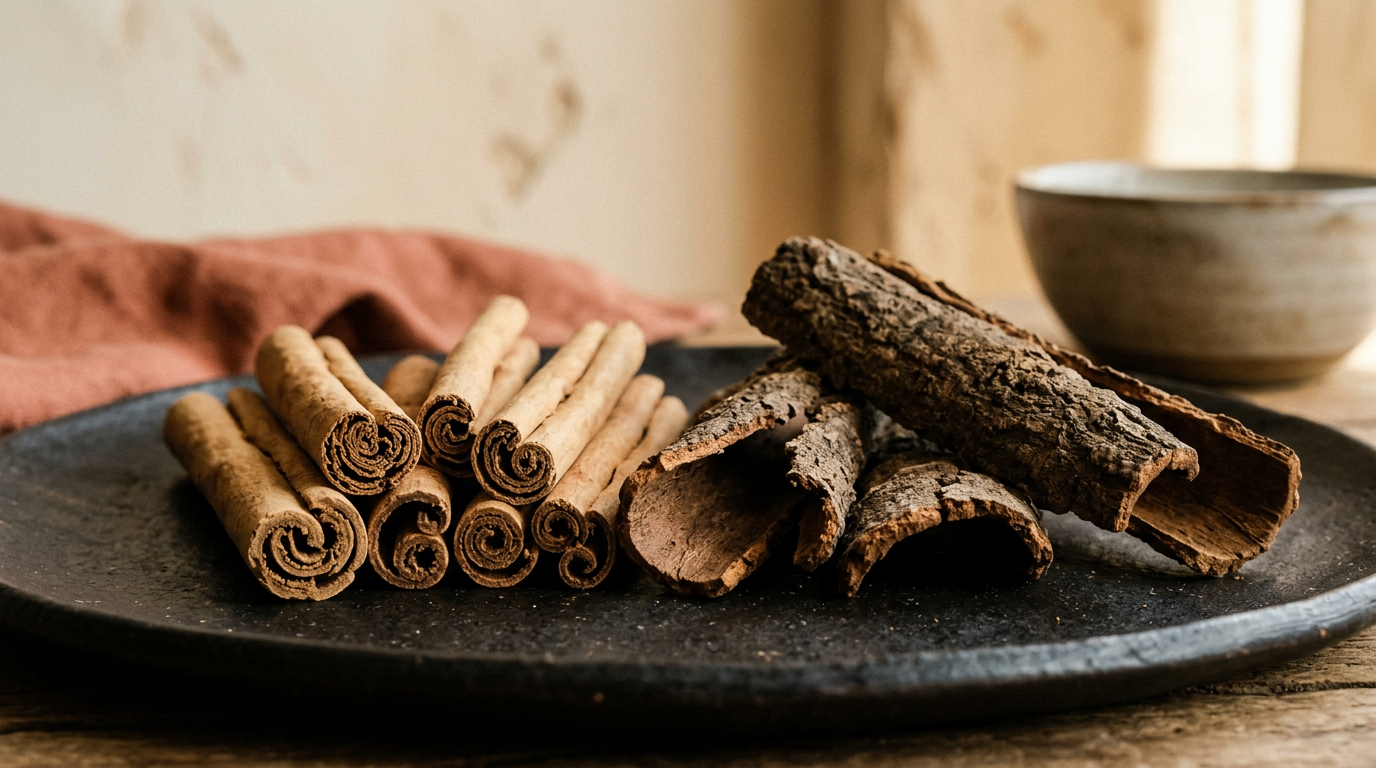
This distinction is especially critical when we look at the two major types of commercial cinnamon: Ceylon and Cassia [4].
| Feature | "Natural Cinnamon Flavor" | Cassia Cinnamon Powder | Ceylon Cinnamon Powder |
| -------------------- | ------------------------------- | ------------------------ | ------------------------- |
| Source | Isolated compound(s) | Cinnamomum cassia bark | Cinnamomum verum bark |
| Flavor Profile | Sharp, one-dimensional, sweet | Pungent, spicy, robust | Delicate, warm, complex |
| Key Compounds | Primarily cinnamaldehyde | Cinnamaldehyde + others | Cinnamaldehyde + others |
| Coumarin Content | Unknown / variable | High (0.31-6.97 g/kg) [2] | Negligible (<0.04 g/kg) [2] |
| Cost | Low | Moderate | High |
This brings us to a crucial point of science: coumarin. Cassia, the dominant “cinnamon” in the global market, contains significantly higher levels of a compound called coumarin, which can be toxic to the liver in sensitive individuals or at high doses [2, 3]. Ceylon cinnamon, or “true cinnamon,” contains only trace amounts. When you use “natural cinnamon flavor,” you have no way of knowing the source or its coumarin concentration. Is it a highly purified cinnamaldehyde with no coumarin? Is it a cheap, crude extract from cassia that concentrates it? The label doesn't say.
By choosing products made with traceable, whole-ground Ceylon cinnamon, you not only get a more nuanced and beautiful flavor, you also sidestep the coumarin issue entirely. You get the full spectrum of the spice's properties, not just a chemical echo.
A Question of Trust
The ambiguity of “natural flavor” is not an accident; it’s a feature of a system that prioritizes industrial efficiency over transparency. The term creates a halo of health and simplicity for products that are often highly processed. It allows a brand to evoke the idea of a strawberry field or a vanilla bean while using a derivative concocted in a lab.
Reading an ingredient panel has become an exercise in decoding. When a label lists “ground cinnamon,” you know what you are eating. When it lists “natural flavors,” you are buying a story, not a spice. It’s a quiet acknowledgment that the real thing was too expensive, too variable, or too inconvenient. For us, that’s a compromise we’re unwilling to make.
### Frequently Asked Questions
1. Are 'natural flavors' bad for you?
Not necessarily. The chemicals themselves are generally recognized as safe by regulatory bodies. However, their presence is often a marker of a highly processed food that lacks the nutritional and synergistic benefits of the whole food source.
2. Why are 'natural flavors' so common?
They are used to add potent, standardized flavor back into processed foods at a very low cost. They create a consistent product and can make bland ingredients more palatable, increasing a product's appeal.
3. What is the difference between 'natural' and 'artificial' flavors?
The legal distinction lies in the origin of the source material. A natural flavor must be derived from a plant, animal, or other natural source. An artificial flavor is derived from a synthetic source, like petroleum. The final chemical molecule, however, can be identical.
4. How can I avoid 'natural flavors'?
Read ingredient lists carefully. Choose products that use whole food ingredients, like “ground ginger,” “vanilla extract,” or “clove,” instead of the generic “natural flavors” catch-all. This is most common in less-processed foods.
Sources & citations
[1] U.S. Food & Drug Administration. (2024). CFR - Code of Federal Regulations Title 21, Part 101.22: Spices, flavorings, colorings and chemical preservatives. https://www.accessdata.fda.gov/scripts/cdrh/cfdocs/cfcfr/CFRSearch.cfm?fr=101.22
[2] Wang, Y. H., Avula, B., Nanayakkara, N. P., Zhao, J., & Khan, I. A. (2013). Cassia cinnamon as a source of coumarin in cinnamon-flavored food and food supplements in the United States. Journal of Agricultural and Food Chemistry, 61(18), 4470–4476. https://pubmed.ncbi.nlm.nih.gov/23627682/
[3] German Federal Institute for Risk Assessment (BfR). (2012). Frequently Asked Questions about coumarin in cinnamon and other foods. https://www.bfr.bund.de/en/home.html
[4] The Editors of Encyclopaedia Britannica. (2024). Cinnamon. Britannica. https://www.britannica.com/plant/cinnamon