
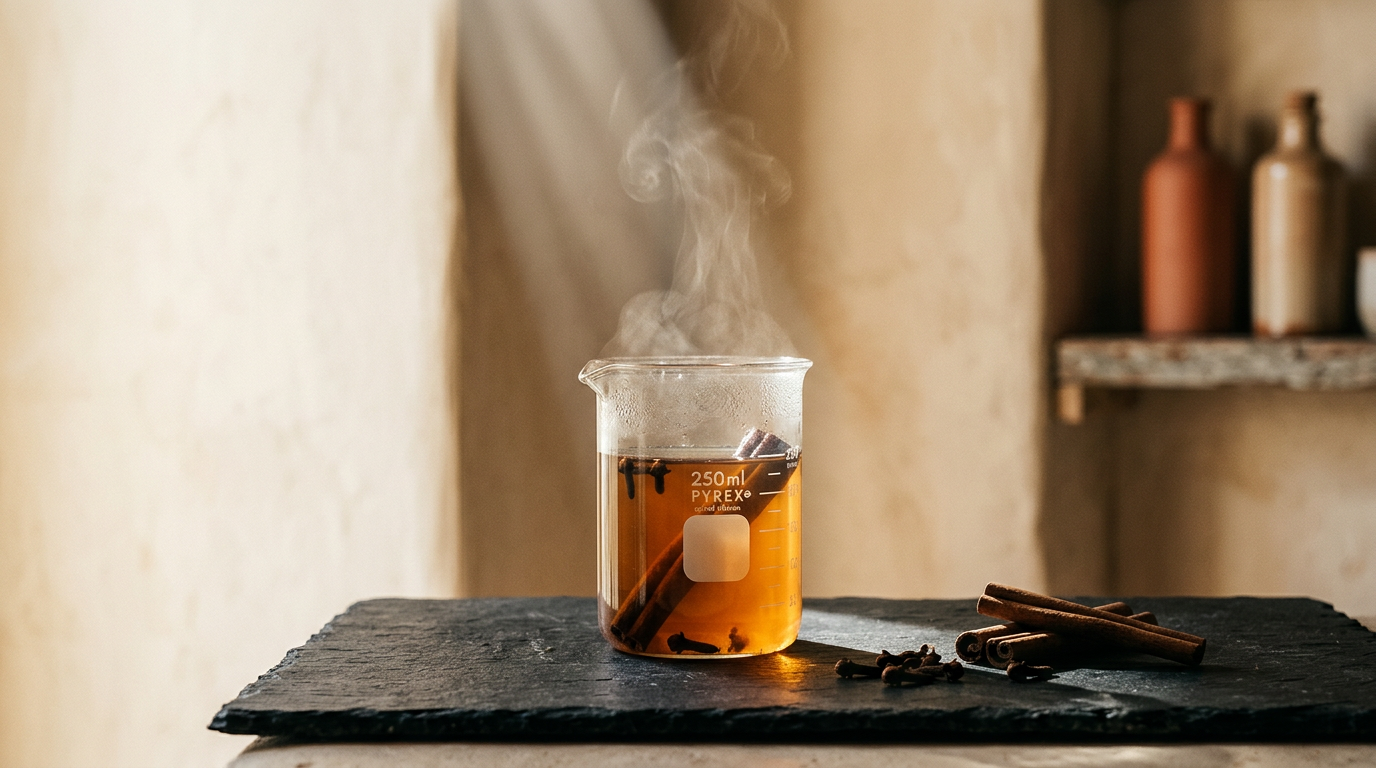
A kadha is a traditional South Asian decoction of herbs and spices, simmered in water to extract their active compounds. Often used for seasonal wellness, its efficacy traditionally relies on family wisdom and ingredient feel. But the bioactive content of these natural ingredients can vary, meaning consistency—the reliable delivery of their benefits—is the real challenge for anyone making it today.
A simmering pot of kadha is a core memory for many of us. That aromatic steam—a blend of cinnamon, clove, and maybe the sharp kick of long pepper (pippali)—was the scent of being cared for. It was a promise of comfort, a functional brew long before the term was coined. When you felt a cold coming on, a grandmother or parent would head to the spice box, not the pharmacy. Their knowledge wasn't written down; it was embodied. They knew the feel of the right cinnamon bark, the plumpness of a good clove.
But here’s a question only a modern maker would ask: was every pot of kadha the same? The honest answer is no. It couldn’t have been.
Nature is not a factory. The cinnamaldehyde that gives cinnamon its warmth and well-studied biological activity [1] varies dramatically depending on the tree’s age, the soil it grew in, and the year’s rainfall. The same is true for the eugenol in cloves, a potent compound with a history of use in both kitchens and apothecaries [2]. A spice is a living archive of its environment. That beautiful, organic variation is also a challenge when you move from a single pot in a home kitchen to producing something people can rely on, time and again.
An act of love doesn't require a certificate of analysis. A trusted product does.
From Kitchen Art to Lab Science
This is where our work begins. We start with the wisdom—the classic blend of warming spices known for their synergistic power. But we don't stop at the recipe. We take it apart, molecule by molecule.
Every batch of cinnamon, clove, and long pepper that arrives at our facility is quarantined. It doesn’t enter our pantry until it passes through the lab. Using tools like High-Performance Liquid Chromatography (HPLC), we measure the precise percentage of key bioactive compounds—the cinnamaldehyde in the cinnamon, the eugenol in the clove, the piperine in the long pepper. We are, in effect, counting the molecules that matter.
Why? Because a 'pinch' is not a unit of measurement. A 2021 harvest of cloves from the Western Ghats might have a higher eugenol content than the 2022 harvest, which got more monsoon rain. Ignoring this reality means the kadha you make in January will not have the same potency as the one you make in March. The consumer might not know why it feels different, but they'll feel it. And trust, once lost, is hard to regain.
Our process allows us to smooth out nature’s beautiful variability. If a batch of Sri Lankan 'true' cinnamon (Cinnamomum verum) comes in with a slightly lower cinnamaldehyde reading, we can precisely adjust the formulation to match our standardized target. It's a meticulous process of blending and calculating that ensures the final product delivers a consistent, measurable level of polyphenols in every single serving.
This isn't about creating something artificial. It’s the opposite. It is a profound act of respect for the source material, ensuring the promise of these ancient ingredients is not left to chance.
Consistency as a Form of Trust
Here’s a way to visualize the difference between the kadha we grew up with and the one we’re trying to perfect:
| Feature | The Heritage Kadha | The Standardized Kadha |
| :--- | :--- | :--- |
| Potency | Variable; depends on the 'luck' of the draw from the spice box. | Specified; a target polyphenol level is met in every batch. |
| Consistency | Low. Each pot is a unique event. | High. The 100th cup is as effective as the first. |
| Source Knowledge | Intuitive, anecdotal, and passed down through generations. | Indigenous wisdom validated and refined with analytical chemistry. |
| Trust Signal | The love of the person who made it for you. | Verifiable data, batch-level testing, and transparent sourcing. |
We are not replacing the love. We are fortifying it with certainty. When you’re building something for a community, you owe them a standard. You owe them the unglamorous, behind-the-scenes work of lab reports and batch records. You owe them the peace of mind that what they are using is not just rooted in tradition, but proven by measurement.
It’s the quiet fusion of a 5,000-year-old idea with the tools of the 21st century. The goal remains what it has always been: to offer comfort, to provide relief, and to harness the deep intelligence of the plant world. We’re just adding a layer of certainty that was never before possible.
### Frequently Asked Questions
1. What exactly is a kadha?
A kadha, also known as a kashayam, is an Ayurvedic water-based decoction or herbal tea. It involves simmering specific herbs and spices in water for an extended period to extract their soluble medicinal compounds. It's a traditional method for concentrating the bioactive benefits of plants into a drinkable form.
2. What are polyphenols and why do they matter?
Polyphenols are a large category of naturally occurring compounds in plants. They act as antioxidants and are believed to offer various health benefits. In spices like cinnamon and cloves, specific polyphenols like cinnamaldehyde and eugenol are responsible for much of their distinctive aroma, flavor, and functional properties [3]. Measuring them is a reliable way to measure the potency of an ingredient.
3. Doesn't standardizing a kadha make it less 'natural'?
Not at all. The ingredients remain 100% natural, sourced directly from farms. Standardization is a quality assurance step. It ensures that the natural potency you expect is actually present in every serving. We see it as delivering on the promise of 'natural' by ensuring the plant’s inherent benefits are consistently present, not lost to agricultural variability.
4. Is there a big difference between types of cinnamon?
Yes, a significant one. Most of what is sold as cinnamon in global markets is Cassia (Cinnamomum cassia), which has high levels of coumarin, a compound that can be harmful in large doses. 'True' cinnamon (Cinnamomum verum), primarily from Sri Lanka, has much lower coumarin levels and a more nuanced flavor and aroma profile [4]. This distinction is critical for a product intended for wellness.
Sources & citations
- Rao, Pasupuleti Visweswara, and Siew Hua Gan. "Cinnamon: a multifaceted medicinal plant." Evidence-based complementary and alternative medicine 2014 (2014). https://www.hindawi.com/journals/ecam/2014/642942/
- Cortés-Rojas, Diego Francisco, Claudia Regina Fernandes de Souza, and Wanderley Pereira Oliveira. "Clove (Syzygium aromaticum): a precious spice." Asian Pacific journal of tropical biomedicine 4.2 (2014): 90-96. https://www.ncbi.nlm.nih.gov/pmc/articles/PMC3819475/
- Pandey, K. B., & Rizvi, S. I. (2009). Plant polyphenols as dietary antioxidants in human health and disease. Oxidative medicine and cellular longevity, 2(5), 270–278. https://www.ncbi.nlm.nih.gov/pmc/articles/PMC2835915/
- U.S. National Library of Medicine. "Cinnamon." MedlinePlus. https://medlineplus.gov/druginfo/natural/992.html