
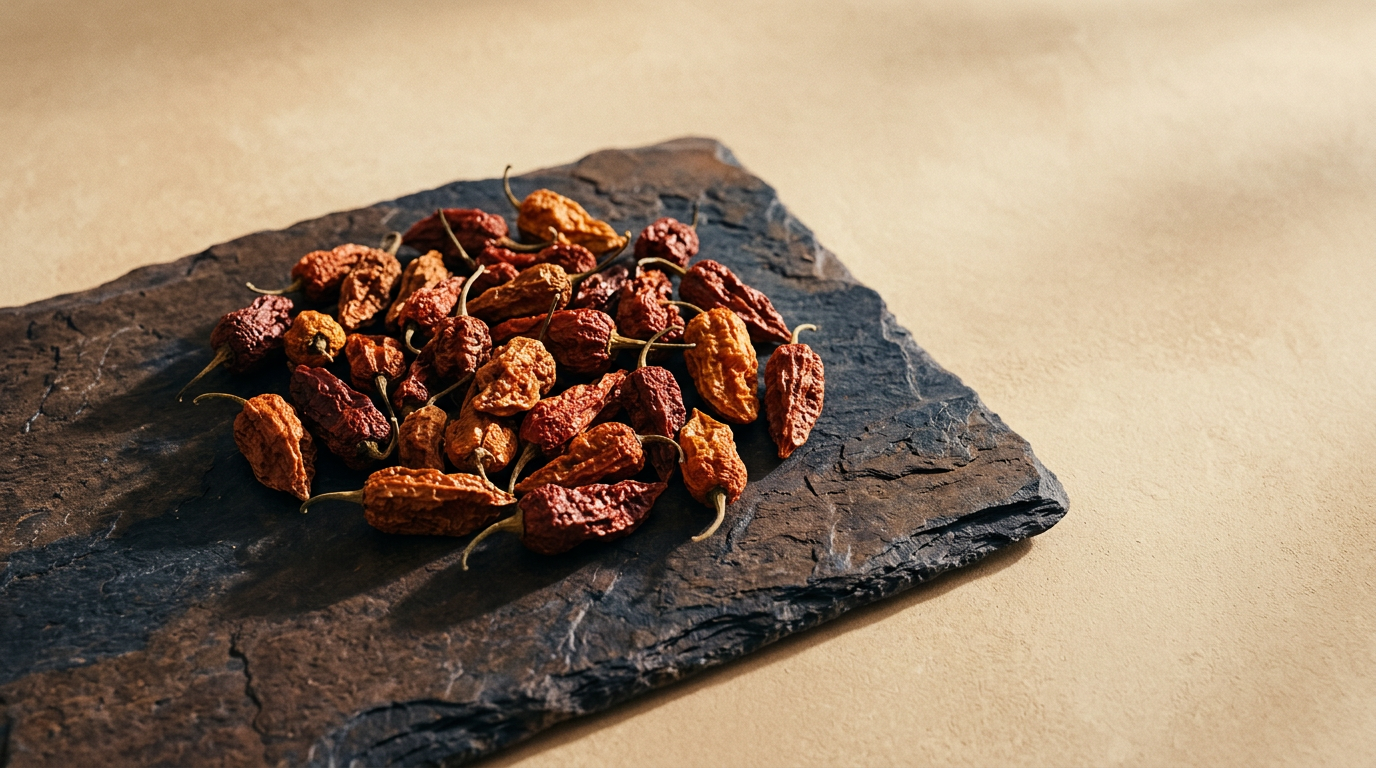
In the hills of Nagaland, the Bhut Jolokia chili is more than a crop; it's a cultural heirloom. Known locally as Raja Mircha, or 'King Chili,' this celebrated landrace is protected by a Geographical Indication tag and, more importantly, by the hands of women who have curated its genetic legacy for centuries, ensuring its survival against the tide of commercial agriculture [1].
A Living Library in a Single Seed
A landrace is not a hybrid engineered in a lab for uniformity. It is a domestic-adapted variety of a plant that has been shaped by the local environment and perfected by generations of farmers through careful selection. In a world chasing standardized yields, a landrace like the Raja Mircha is a repository of genetic diversity—a living library of resilience, flavor, and history [2]. Preserving it is not an act of nostalgia; it is a critical strategy for a secure food future.
In the village of Mima, this responsibility rests largely with women. We see it in figures like Neikha, a village elder in her seventies. For her, the harvest is a conversation with her ancestors. She walks the rows of two-acre plot, her eyes scanning for the “king” of the crop—the one chili on each plant with the ideal shape, color, and texture. These are not for selling. They are the seeds for next year’s planting. Her knowledge, passed down orally, dictates that the seeds from the very tip and very bottom of the pod are discarded; only the potent middle section is saved, ensuring the chili’s signature delayed, blooming heat is passed on.
Her daughter, Visenno, stands as the bridge between this ancient practice and the modern market. Armed with a higher secondary education and a smartphone, she helped organize a small cooperative of ten women farmers. For years, they were at the mercy of middlemen from Dimapur who would buy their entire harvest at a flat, non-negotiable rate. By pooling their resources, Visenno and the others managed to fund the organic certification process and, eventually, connect with buyers who understood the value of their GI-tagged chili. “The price is better,” she admits, “but the respect is what matters. They ask about the drying process. They don’t treat our chili like a simple commodity.”
Tradition and Hybrid Vigor
The contrast between a landrace and its commercial counterparts is stark, revealing what is lost when we optimize for shipping and shelf life alone.
| Feature | Raja Mircha (Landrace Bhut Jolokia) | Commercial Hybrid Chili |
|---|---|---|
| Genetic Makeup | Diverse, locally adapted | Uniform, genetically narrow |
| Cultivation Method | Polyculture, traditional inputs | Monoculture, synthetic inputs |
| Flavor Profile | Complex: smoky, fruity, delayed heat | One-dimensional: immediate, sharp heat |
| Seed Saving | Viable, saved from each harvest | Often sterile or not true-to-type |
| Climate Resilience | High; adapted to local fluctuations | Low; requires controlled conditions |
This table isn’t an academic exercise. It’s the lived reality for farmers navigating a changing climate and a demanding market. The Raja Mircha’s genetic diversity makes it naturally more resistant to the specific pests and unpredictable monsoons of the Naga hills. A commercial hybrid, while potentially offering a higher yield in a perfect year, is a fragile gamble.
The Next Custodian
That brings us to Petekhrieno, Visenno’s daughter, who is home from college in Kohima. She embodies the synthesis of deep-rooted wisdom and modern science. She watches her grandmother select seeds with practiced intuition, then records the day’s humidity levels in a weather app on her phone. She understands that the traditional sun-drying method, while effective, can lead to inconsistencies. She’s experimenting with a small, solar-powered dryer—a simple, elegant piece of technology—to see if it can produce a more evenly dried chili with better color retention and a lower risk of mold, all without using a single watt from the grid [3].
She isn’t trying to replace her grandmother’s knowledge, but to augment it. She’s documenting the community's companion planting traditions—which beans grow best beside the chilis, which marigolds deter which nematodes—and cross-referencing them with agricultural extension papers online. This is the future: a respectful fusion where data validates, rather than supplants, tradition.
The story of these three women is the story of a single chili, but it’s also a blueprint. The future of flavorful, resilient food doesn’t lie in ever-larger monocultures, but in protecting and honoring the thousands of Neikhas, Visennos, and Petekhrienos who are the quiet custodians of the world’s most precious culinary assets.
***
### Frequently Asked Questions
1. What exactly is a landrace?
A landrace is a domesticated plant variety that has adapted over a long period to a specific natural and cultural environment. Unlike commercial cultivars, which are bred for uniformity, landraces have a high degree of genetic diversity, which makes them more resilient to local pests and climate change.
2. Is the Bhut Jolokia still the world's hottest pepper?
It held the Guinness World Record from 2007 until 2011. While several other peppers have since surpassed its peak heat (which can exceed 1 million Scoville Heat Units), the Bhut Jolokia remains famous for its unique combination of intense heat and a distinctively fruity, smoky flavor profile [4].
3. How does a Geographical Indication (GI) tag help farmers?
A GI tag, like the one for 'Nagaland Raja Mircha,' acts as a certification that the product possesses certain qualities and a reputation due to its origin in a specific geographical territory. It prevents unauthorized producers from using the name, protecting the farmers' livelihood and guaranteeing authenticity for the consumer [5].
4. What's the best way to cook with Bhut Jolokia?
Respectfully and sparingly. A tiny amount is enough to flavor a large pot of stew or curry. It’s often used in pickles (achar) or smoked and dried, then ground into a powder. The key is to see it as a powerful flavoring agent that provides deep, smoky notes, not just brute force heat. Always handle with gloves.
Sources & citations
[1] Sanatombay, D., & Sharma, G. J. (2008). Capsaicin and Oleoresin in a Hot Chilli Variety (Capsicum Chinense Jacq.) Bhut Jolokia. Journal of Food Science and Technology, 45(5), 447-449. (Available via research portals).
[2] Food and Agriculture Organization (FAO). (n.d.). Coping with climate change: The roles of genetic resources for food and agriculture. Retrieved from https://www.fao.org/home/en
[3] Tiwari, G.N. (2016). Solar drying: A sustainable way of food processing. Journal of the Indian Institute of Science. Retrieved from https://journal.iisc.ac.in/index.php/iisc/article/view/15
[4] Bosland, P. W., & Baral, J. B. (2007). 'Bhut Jolokia'—The world's hottest known chile pepper. HortScience, 42(2), 222-224. Retrieved from https://journals.ashs.org/hortsci/view/journals/hortsci/42/2/article-p222.xml
[5] World Intellectual Property Organization (WIPO). (n.d.). Geographical Indications. Retrieved from https://www.wipo.int/geo_indications/en/