
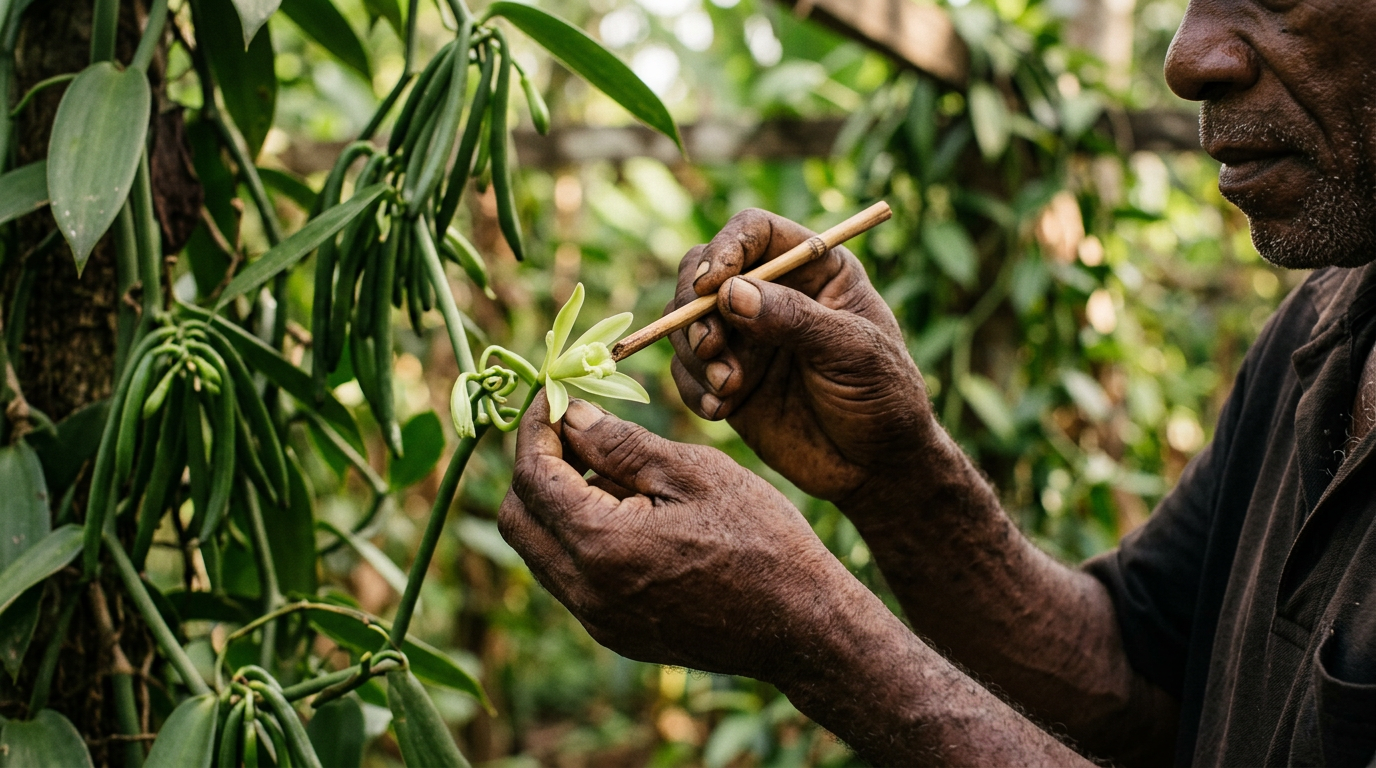
On Nelson Mandela International Day, honouring his 67 years of public service, many look for a meaningful way to act. For us, the most powerful solidarity lies in understanding Mandela Day fair trade food not as a one-off purchase, but as a commitment to dismantling inequitable systems from the ground up, starting with the price paid at the farm gate. It’s about more than a sticker; it’s about a structural shift.
Every year on [July 18th](/festival/mandela-day), the world is invited to dedicate 67 minutes to public service. It’s a beautiful gesture. But what happens in the minutes, hours, and days that follow? The logic of Mandela Day isn't just about charity; it's about justice. And for us in the food world, justice begins where the soil does.
The Sticker and the System
The idea of “fair trade” has become a familiar, comforting presence in our grocery aisles. It promises that a product was made with certain ethical standards. And that promise is a good start. But over time, it has also become a blunt instrument, a shortcut that can obscure more than it reveals.
Certification is expensive. The fees and bureaucratic hurdles can unintentionally sideline the smallest-scale farmers—the very people the system was designed to help. It often enforces a price floor, a safety net, which is crucial. But it rarely creates a mechanism for true wealth creation. It prevents the worst-case scenario, but doesn't always enable the best-case one. There’s a disconnect as stark as the price difference between a high-street grocer in Johannesburg and the farm gate in Limpopo province for the same chilies. It’s the hidden story behind the vibrant piles of ginger or uziza seeds at Lagos’s Balogun Market—the long chain of middlemen that whittles down a farmer’s earnings to a fraction of the final price [1].
This is why a simple sticker is not enough. True equity requires participation, not just certification.
The Story of a Single Vanilla Pod
Consider the vanilla bean. It is the fruit of an orchid, and one of the most labour-intensive agricultural products in the world. Each flower opens for just one day, sometimes only a few hours, and must be pollinated by hand [2]. This delicate, skilled work is often done by smallholder farmers across [Africa](/region/africa) and Asia.
After a nine-month wait for the bean to mature, it then undergoes a complex, months-long curing process of sweating and drying to develop its distinct aroma and flavour. The finished product is one of the world's most prized spices. Yet, the person who performed that patient, precise pollination often sees the smallest fraction of the final value.
Ask a farmer outside Nairobi what they receive for a kilogram of hand-pollinated vanilla pods versus the price you see at City Market, and the gap is often staggering. The market price fluctuates wildly, but the farmer’s share remains stubbornly, unjustly low. This isn't a market failure; it's the market working as designed, optimized for extraction, not for partnership.
Beyond a Fair Price: A Fair Partnership
Solving this requires moving beyond the transactional nature of most fair-trade models and toward a relational one. We believe in a direct partnership model that re-writes the terms of engagement.
| Feature | Standard Fair-Trade | Direct Partnership |
| :--- | :--- | :--- |
| Pricing | A minimum floor price | A premium based on farmer expertise + a share of the final value |
| Relationship | Transactional, mediated by auditors | Long-term, multi-year contracts built on mutual trust |
| Knowledge Flow | One-way: certification standards imposed on farmers | Two-way: farmers teach us terroir; we share market data and science |
| Impact | Acts as a safety net | Acts as a growth engine and wealth creator |
This approach isn't a marketing slogan; it's a completely different way of building a supply chain. It means knowing your farmers by name. It means co-investing in soil health and regenerative practices. It means agreeing on a price that reflects the immense skill and labour involved, not just the lowest possible number a commodity market will bear. It means understanding [why we do this](/why).
This is the real work of Mandela Day fair trade food. It's less about 67 minutes of aid and more about 365 days of equitable trade. It’s the belief that the farmer who pollinated the vanilla orchid deserves to participate in the value she created. That her deep, generational knowledge of the land is an asset to be treasured, not a resource to be extracted.
So this July 18th, by all means, give your 67 minutes. But maybe also take a 68th minute to ask who grew your food, and on what terms. That question, followed by action, is how we truly honour a legacy of justice.
***
### Frequently Asked Questions
1. What is Nelson Mandela International Day?
Celebrated annually on July 18th, Nelson Mandela's birthday, it's a day of global action recognized by the UN. People are encouraged to spend 67 minutes doing community service, symbolizing the 67 years Mandela spent fighting for social justice [3].
2. Is standard "fair trade" certification a bad thing?
Not at all. It was a pioneering movement that raised global consciousness and established a crucial safety net for many producers. Our view is simply that it's a floor, not a ceiling, and there are more direct, partnership-based models that can create even greater value for farmers.
3. How does a direct partnership create more value for farmers?
By cutting out multiple layers of intermediaries, more of the final price goes directly to the grower. Furthermore, long-term contracts provide financial stability, while sharing quality metrics and market data empowers farmers to improve their product and negotiating position over time.
4. What's an example of a spice with a complex, labor-intensive supply chain?
Vanilla is a prime example. Each flower must be hand-pollinated on the single day it blooms. The subsequent curing process is also an art form, taking months of skilled work. This is why direct, transparent sourcing is so critical for vanilla farmers [4].
Sources & citations
- Bymolt, R., Laven, A., & Post, D. (2018). Demystifying the Cocoa Sector in Ghana and Côte d'Ivoire. The Royal Tropical Institute (KIT). https://www.kit.nl/
- Food and Agriculture Organization of the United Nations (FAO). Vanilla: An essential ingredient for sustainable livelihoods. https://www.fao.org/
- United Nations. Nelson Mandela International Day. https://www.un.org/en/events/mandeladay/
- Havkin-Frenkel, D., & Belanger, F. C. (Eds.). (2018). Handbook of Vanilla Science and Technology. John Wiley & Sons.