
Take a look inside your spice cabinet. Go on, we’ll wait.
Chances are you’ll find a small legion of neatly labeled jars from a handful of familiar brands. Many were likely purchased for a single recipe, used once, and then consigned to the back of the shelf. There’s the turmeric from two years ago, the paprika that’s lost its vibrant hue, the ground cumin that smells more like dust than dinner. The “Best By” date printed on the bottom assures you they are still technically food. But are they?
This is the quiet contradiction of the modern spice rack. We’ve been taught to see spices as shelf-stable commodities—like salt or flour—that are “good” as long as they don’t spoil. But this view misses the point of a spice entirely. The true value of a spice lies not in its eternal shelf-life, but in its ephemeral essence: the complex, volatile compounds that provide its aroma, flavor, and potent biological activity.
The Logic of the Long Haul
The industrial spice supply chain is a modern marvel of logistics. It’s designed to move massive quantities of product from thousands of small farms across the globe, consolidate them, process them for uniformity, and distribute them to supermarkets, where they might sit for months or even years. To manage this complexity, the system is optimized for stability and safety, not peak expression.
Spices are often harvested, dried, and then stored for long periods in warehouses. When needed, they are ground into a fine powder. This grinding dramatically increases the surface area, which is great for instant flavor release in a dish, but terrible for preservation. To ensure they are free of microbes, these ground powders are often treated with either ethylene oxide gas or irradiation [1]. This is an effective food safety measure, but it can also be a final, harsh blow to the delicate molecules that make a spice special.
The resulting product is consistent, safe, and predictable. Its color might be stabilized with anti-caking agents or other additives. It will perform its role as a generic coloring or background flavor. But the vibrant, distinct soul of the plant, the very reason it was revered for millennia, has been systematically engineered out of it.
The Science of Stale
What we perceive as the aroma and flavor of a spice is a cloud of tiny molecules called volatile oils, or essential oils. These are the plant’s secondary metabolites—compounds like cinnamaldehyde in cinnamon, eugenol in cloves, or limonene in coriander. They are called “volatile” for a reason: they are eager to escape into the air. This is why you can smell fresh cinnamon from across the room.
These compounds are also responsible for many of the health-supportive properties that have made spices central to traditional medicine systems for 5,000 years [2]. Curcumin in turmeric isn’t just yellow; it’s a powerful anti-inflammatory. Eugenol isn't just spicy; it's a potent antioxidant.
Unfortunately, these delicate compounds are highly susceptible to degradation from oxygen, light, and heat. The moment a spice is ground, the clock starts ticking, fast. The massive increase in surface area exposes these oils to oxygen, which begins to break them down through oxidation. A study on ground black pepper, for example, found that its primary aromatic compound, piperine, degrades significantly after just a few months of storage, with a corresponding loss of its signature pungency and aroma [3].
What’s left in that three-year-old jar is the ghost of a spice. The basic cellular structure of the plant remains, but the living chemistry—the flavor and function—has dissipated. This is why old spices taste flat, dusty, and one-dimensional.
The Case for Grinding Fresh
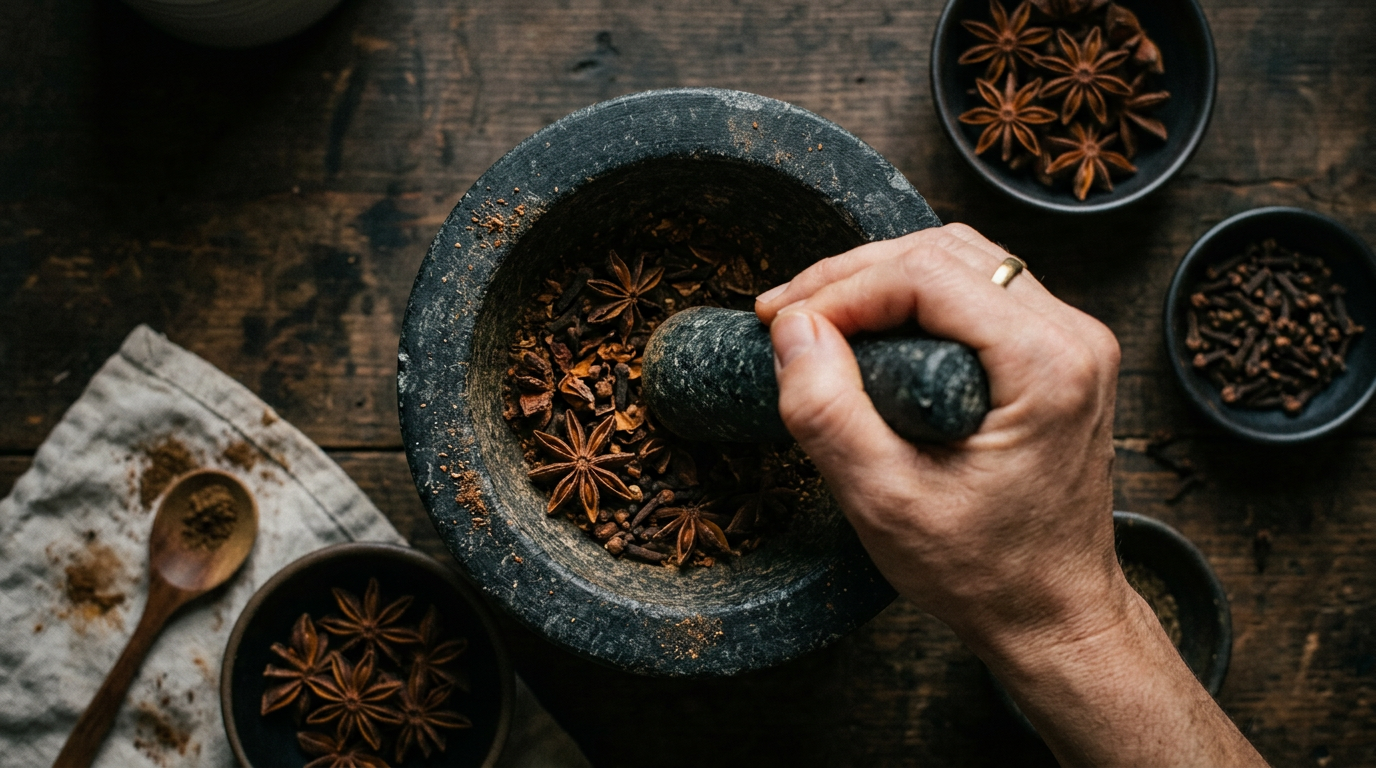
For generations, before the advent of industrial grinders and plastic jars, this was intuitively understood. Cooks used whole spices. They were easier to store, transport, and trade, and their flavor was locked safely inside their fibrous matrix. Only when it was time to cook would a small amount be ground by hand with a mortar and pestle or a simple grater. This wasn't a quaint, romantic affectation; it was a pragmatic act of preservation. It ensured that every bit of the spice’s precious essence made it into the meal, not into the air of a distant factory.
The act of grinding spices just before use transforms them. The kitchen fills with a fragrance that a pre-ground powder simply cannot replicate. The flavor is not just stronger; it’s more complex, with high, bright notes and deep, resonant bass notes that have long since vanished from their shelf-stable counterparts.
This isn’t about being nostalgic. It’s about respecting the ingredients. It’s about shifting our definition of freshness from “not spoiled” to “fully expressed.” A new standard for quality would mean transparent sourcing, celebrating the terroir of a specific harvest, and above all, minimizing the time between grinding and cooking. It might mean a “Ground On” date is more important than a “Best By” date. It means we should be asking not just where our spices are from, but when they were.
Try it yourself. Buy a handful of whole cumin seeds and a jar of the pre-ground stuff. Toast the whole seeds for 30 seconds in a dry pan until they smell nutty, then give them a quick grind. Now taste them side-by-side. One is a spice. The other is a memory.
Sources & citations
- Food and Drug Administration (FDA). "Spices and Food Irradiation." https://www.fda.gov/food/irradiation-food-packaging/food-irradiation-what-you-need-know
- Tapsell, L. C., et al. "Health benefits of herbs and spices: the past, the present, the future." The Medical Journal of Australia, 2006. https://pubmed.ncbi.nlm.nih.gov/17022438/
- Zachariah, T. J., et al. "Chemistry of Spices." CABI, 2008. (This is a comprehensive book, but for a similar idea online, see:) Singh, G., et al. "A comparison of chemical, antioxidant and antimicrobial studies of cinnamon leaf and bark volatile oils, oleoresins and their constituents." Food and Chemical Toxicology, 2007. https://pubmed.ncbi.nlm.nih.gov/17101235/
- Britannica. "Spice and herb." https://www.britannica.com/topic/spice-and-herb