
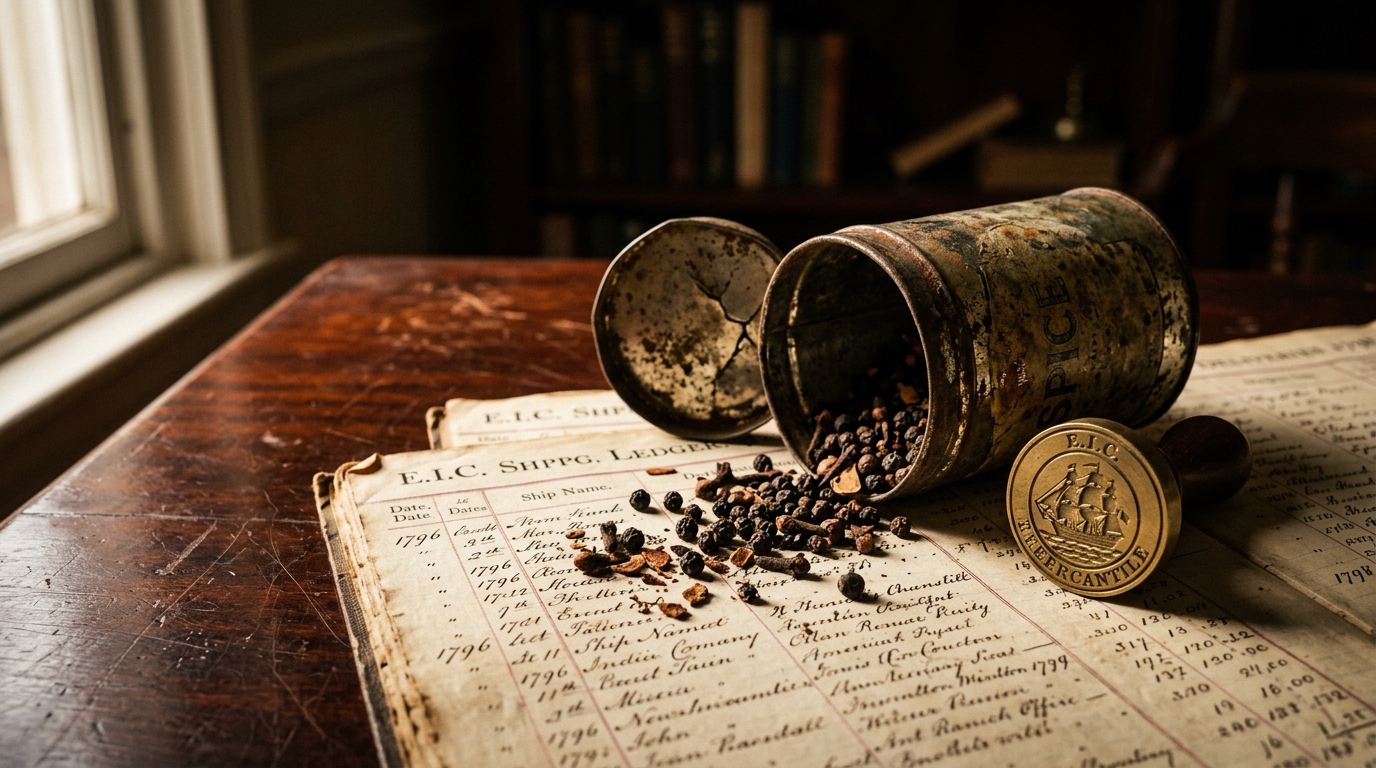
Open your pantry. Pick up a jar of cloves, black pepper, or cinnamon. Look at the label. You’ll likely find a brand name, an expiration date, and maybe a vague “product of” country. But where is its story? Where was it grown? Who harvested it? When was it picked?
We don’t ask these questions of spices, yet we obsess over them for coffee, chocolate, and wine. We celebrate the terroir of a Napa Cabernet or a single-origin Ethiopian coffee bean. Meanwhile, our spices—once the most precious commodities on earth, launching fleets and building empires—sit silently in our kitchens, their identities stripped, their histories anonymized.
This isn’t an accident. It’s the result of a deliberate, centuries-long rewiring of global trade. The story of why your spices have no story is the story of one of the world's most powerful early multinational corporations: The British East India Company.
A World of Flavor, Before the Company
Before the 17th century, the spice trade was a vibrant, sprawling network connecting the Maluku Islands (the Spice Islands) of Indonesia, India, and Sri Lanka with markets in the Middle East and Europe. For millennia, a succession of groups—from Indonesian sailors to Arab traders to Venetian merchants—controlled these lucrative routes [1].
Spices were luxury goods, used not just for flavor, but as medicine and perfume. Nutmeg was fantastically expensive, and black pepper was so valuable it was historically used to pay rent [1]. The journey from farm to European kitchen was long and perilous, its details often deliberately obscured by traders to protect their sources and inflate prices. The very mystery was part of the value.
Enter the East India Company
On the last day of 1600, Queen Elizabeth I granted a royal charter to a group of London merchants for a new joint-stock company. The charter granted “The Governor and Company of Merchants of London Trading into the East Indies” a monopoly on all English trade east of the Cape of Good Hope and, crucially, the authority to “make peace or war” with non-Christian rulers [2].
The East India Company (EIC) arrived in Asia not as humble merchants, but as armed disruptors, soon followed by their rivals, the Dutch East India Company (VOC). Reporting on the EIC's history suggests their goal wasn't to join the existing trade network, but to dismantle and dominate it, often through military force [3]. They understood that the greatest power came not from buying spices, but from controlling the land and labor that produced them.
Over the next century, the EIC established fortified trading posts along the Indian coast. They used their private armies to intimidate local rulers, enforce exclusive contracts, and eventually seize territory. The company transformed from traders into governors, ruling vast swathes of India. Profit, enforced by military might, was the primary guiding principle [3].
The Great Flattening
Here lies the origin of your anonymous spice jar. The EIC’s business model was built on volume, standardization, and extraction—a template for modern corporate supply chains.
First, they de-emphasized provenance. Once the EIC controlled production, spices from numerous farms, villages, and regions were bulked together at collection centers to create a standardized, shippable commodity [2]. A peppercorn from a specific coastal farm in Kerala might be mixed with one from a hillside plot miles away. Any nuance was lost as the product became a generic commodity ready for export.
Second, they prioritized shelf-life over character. To supply the mass market in Europe, spices had to survive a long sea voyage and sit in warehouses. This often meant grinding them into powder long before they reached a kitchen. Food science confirms that grinding dramatically increases a spice's surface area, causing the volatile aromatic compounds that provide flavor to rapidly degrade [4]. A vibrant bud or piece of bark became a more predictable powder.
Finally, this system was built on inequity. Historical analysis shows that farmers were often pushed into monoculture, planting only the cash crops the Company demanded at fixed prices. The immense value of spices, once distributed among a complex network of local stakeholders, was systematically funneled into the pockets of the EIC’s shareholders [3].
The Ghost in the Modern Pantry
The East India Company was dissolved in 1874, but its ghost lives on. The commodity-driven system it pioneered became a global standard. Spices are traded on international exchanges, their prices fluctuating based on speculation far removed from the realities of the harvest. This system rewards volume, not always quality, sustainability, or the stories of the people who grow them.
At Spiced with Science, we believe another way is possible. We believe that, like wine, spices have terroir. The volcanic soil of one island gives its nutmeg a different profile than another. A peppercorn’s flavor tells the story of its soil, its climate, and the hands that harvested it.
Reclaiming this lost provenance isn’t just about enjoying better flavor. It’s an act of awareness. When we ask where our spices come from, we are asking to see the people and places that a centuries-old corporate model helped to obscure. We are voting for a more transparent supply chain, one where value can be more equitably shared.
So next time you reach for that jar, pause. Ask for its story. You might be surprised by the world of flavor you find.
Sources & citations
- R.A. Donkin, "The Spice Trade of the Ancient World," National Geographic, accessed November 15, 2023, see National Geographic reporting on the history of the spice trade, for instance: https://www.nationalgeographic.com/history/article/how-spice-trade-changed-the-world
- The Editors of Encyclopaedia Britannica, "East India Company," Encyclopaedia Britannica, last modified September 20, 2024, https://www.britannica.com/topic/East-India-Company
- William Dalrymple, as reviewed by Tom Holland, "The Anarchy: The Relentless Rise of the East India Company by William Dalrymple review – the shameless looting of India," The Guardian, September 11, 2019, https://www.theguardian.com/books/2019/sep/11/the-anarchy-the-relentless-rise-of-the-east-india-company-by-william-dalrymple-review
- Nancy E. Flores and Ann A. Hertzler, "Storing Herbs and Spices," Penn State Extension, May 3, 2023, https://extension.psu.edu/storing-herbs-and-spices