
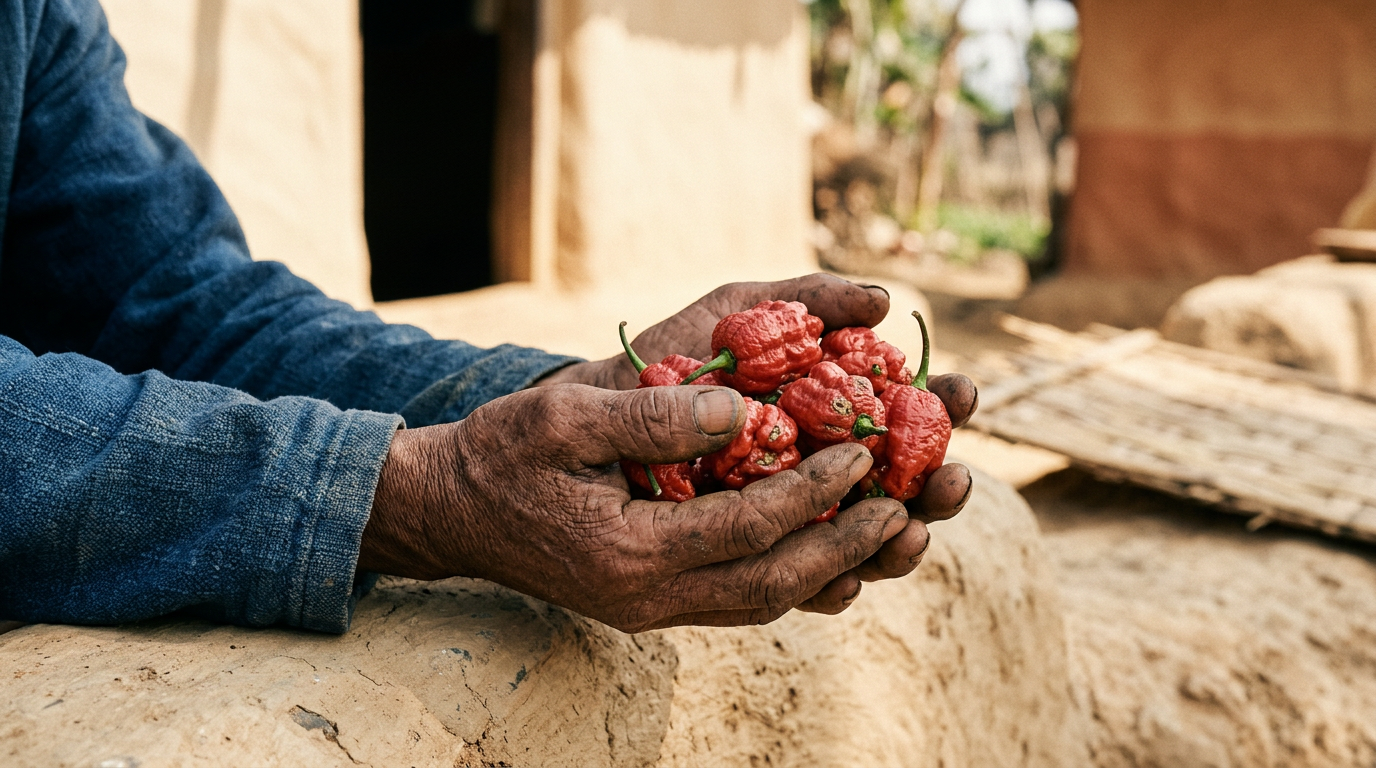
The world’s chili diversity is contracting. A handful of commercial hybrids are displacing thousands of indigenous landraces—locally adapted varieties with unique flavors, heat profiles, and cultural histories. This genetic erosion, driven by market pressures for uniformity and yield, threatens the resilience of our food system and erases centuries of agricultural wisdom, from the Andean highlands to the hills of Nagaland.
The Illusion of Choice
Walk into any major supermarket. You’ll see chilis labeled simply “red,” “green,” or perhaps “jalapeño.” Even in specialty stores, the selection represents a tiny fraction of what exists. The world is home to thousands of distinct chili pepper varieties, yet our global food system is narrowing its focus to a dangerously small number. The culprit? The quiet replacement of landraces with commercial F1 hybrids.
Landraces are the original heirlooms. They are traditional varieties developed by farmers over generations, selected by hand for traits that make them thrive in a very specific place. They are genetically diverse, resilient, and packed with the complex flavors of their terroir.
Hybrids, on the other hand, are bred in labs for industrial agriculture. Their primary virtues are uniformity, high yield, and shipping durability. They are a marvel of a certain kind of efficiency, but they come at a steep cost. Farmers often cannot save the seeds from hybrid plants, as they won't grow true to type in the next generation, creating dependency on seed companies. And in the quest for a standardized product, the nuance, complexity, and genetic richness that make landraces so valuable are often lost [1].
It’s like reducing the world’s vast library of literature to a single shelf of bestsellers. We lose the poetry, the history, the weird, brilliant, and challenging stories that make the whole ecosystem so rich.
A View from Nagaland
Let’s travel to the hills of Nagaland in Northeast India, the home of the legendary Bhut Jolokia, or ghost pepper. For generations, Naga families have been the custodians of this chili. A farmer we know, Atsu, cultivates his family's Bhut Jolokia on a small, terraced plot. His seeds have been passed down for as long as anyone can remember. They are perfectly adapted to his village’s specific soil, rainfall patterns, and pests. The peppers they produce have a signature smoky flavor under their blistering heat—a flavor unique to his patch of land.
But Atsu is under pressure. Buyers from big cities want a standardized product. They want peppers of a consistent size, shape, and—most importantly—a guaranteed Scoville Heat Unit (SHU) measurement. To meet this demand, seed companies have developed hybrid Bhut Jolokia seeds. These seeds promise a more uniform, predictable crop. For farmers facing economic uncertainty, the temptation is immense.
Each time a farmer like Atsu decides to plant commercial seeds instead of saving his own, a unique genetic line that has evolved for centuries is at risk of blinking out of existence. This isn't a hypothetical; it's happening across India and the world [2]. These farmers aren't just growers; they are living archivists, and their libraries are being shuttered.
### Landrace vs. Hybrid: The Real Difference
| Feature | Indigenous Landrace (Atsu's Bhut Jolokia) | Commercial Hybrid |
| :--- | :--- | :--- |
| Genetic Pool | Diverse, varies from farm to farm | Uniform, genetically narrow |
| Seed Saving | Seeds can be saved and will breed true | Often sterile or do not breed true (F1) |
| Adaptation | Hyper-local to specific soil and climate | Broadly adapted, often requires more inputs |
| Flavor Profile | Complex, nuanced, expresses terroir | Standardized, often bred for a single trait (e.g., heat) |
| Resilience | High natural resistance to local pests/diseases | Vulnerable to new pests; may rely on pesticides |
| Market Incentive | Low; often seen as non-standard | High; rewards uniformity and shelf-life |
Why We Can’t Afford to Lose These Seeds
This isn't just a matter of nostalgia for old-time peppers. The loss of genetic diversity, known as genetic erosion, is a clear and present threat to our food security [3]. Landraces hold the genetic keys to resilience. Within their diverse DNA are the traits that could help our crops adapt to climate change, resist new diseases, or thrive with less water. When we lose a landrace, we lose potential solutions to problems we haven't even encountered yet.
For eaters, the loss is more immediate. We lose flavor. The fruity tang of one chili, the smoky depth of another, the bright citrus note of a third—these are expressions of genetic diversity. A food system that prizes uniformity above all else is a food system that is making our world less delicious.
But there is a counter-current. A growing number of chefs, scientists, and eaters are beginning to understand what's at stake. By seeking out and creating a market for these unique landraces, we can provide farmers like Atsu with a powerful incentive to continue their work as custodians. We can vote with our pantries for a more diverse, resilient, and flavorful future. It starts with recognizing that a pepper is not just a pepper. It’s a story, an ecosystem, and a library of genetic wisdom. We must ensure it's a library that stays open.
### Frequently Asked Questions
1. What exactly is a landrace?
A landrace is a domesticated, locally adapted, traditional variety of a plant or animal that has developed over time through adaptation to its natural and cultural environment. Unlike commercial breeds, they are genetically diverse and are often part of the intangible cultural heritage of a region.
2. What is genetic erosion?
Genetic erosion is the loss of genetic diversity within a species. In agriculture, it most often refers to the disappearance of traditional landraces as they are replaced by a smaller number of modern, uniform commercial varieties.
3. Are hybrid seeds bad?
Not inherently. Hybrids have played a major role in increasing food production globally. The issue arises from over-reliance. When hybrids lead to vast monocultures and displace the genetic diversity of landraces, the entire food system becomes more vulnerable to shocks like climate change or new diseases.
4. How can I support seed diversity?
Support producers and brands who name their farmers and the specific varieties they source. Visit farmers' markets and ask about heirloom varieties. If you have a garden, consider planting heirloom or open-pollinated seeds from companies that specialize in preserving them.
Sources & citations
- Bosland, P.W. and Votava, E.J. (2012). Peppers: Vegetable and Spice Capsicums. CABI. https://www.cabi.org/bookshop/book/9781845938210/
- Yumnam, D, et al. (2018). Naga King Chilli (Capsicum chinense Jacq.): A Short Review. Journal of Pharmacognosy and Phytochemistry. https://www.phytojournal.com
- FAO. (2019). The State of the World's Biodiversity for Food and Agriculture. Food and Agriculture Organization of the United Nations. https://www.fao.org/state-of-biodiversity-for-food-agriculture/en
- Vernooy, R., Sthapit, B. R., and Bessette, G. (2020). The roles of community seedbanks in climate change adaptation. Bioversity International. https://www.bioversityinternational.org