
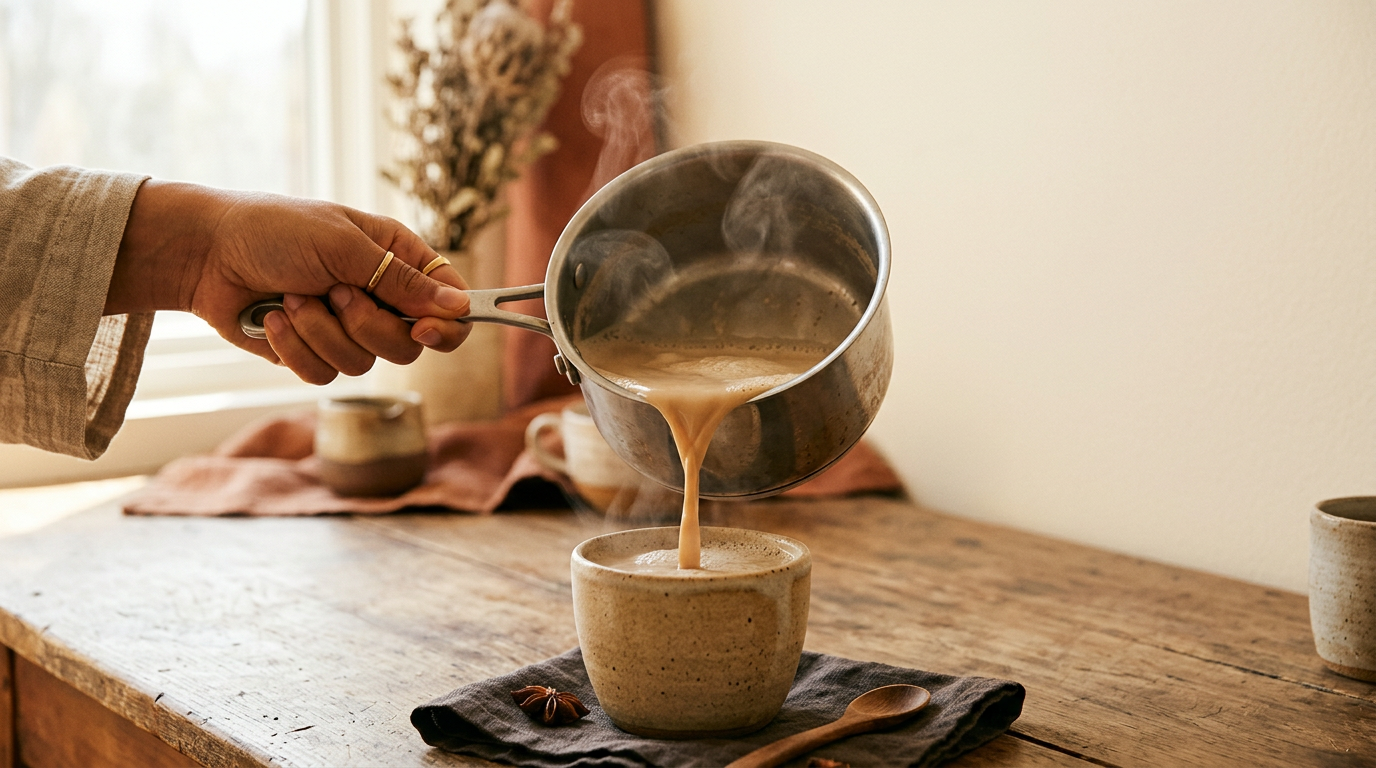
The world is full of well-intentioned but disappointing gifts. This Father’s Day, consider an alternative: a gesture so full of warmth and craft it eclipses anything you can put in a box. We're talking about a proper cup of chai, made from scratch.
Not the cloyingly sweet, cinnamon-dusted latte from a corporate coffee chain, which bears as much resemblance to real chai as a powdered soup mix does to a slow-simmered bone broth. We mean the real thing: a potent, restorative decoction of tea, spices, and milk, perfected over centuries in countless South Asian kitchens.
Making one is an act of care. But it’s also an act of applied chemistry. Understanding the science behind the ritual is what separates a mediocre cup from a truly memorable one.
The Backbone: Taming the Tannins
The fundamental error in most Western chai preparations is treating it like a delicate English tea. The method is often to steep a sad little teabag in hot water, remove it, and then add a splash of milk. This produces a watery, underwhelming brew.
A true chai is a decoction, not an infusion. You boil the tea, often for several minutes. This feels wrong to anyone trained in the ‘never boil tea’ school of thought, but it’s essential. The goal is to extract the polyphenols, specifically the tannins, from the black tea leaves. These compounds provide the powerful, astringent backbone that gives chai its structure and bracing quality.
But there’s a fine line. Boil it too long, and you over-extract the tannins, leading to a harsh, mouth-puckering bitterness. Don’t boil it long enough, and the tea is too weak to stand up to the milk and spices. The traditional method of a rolling boil for a few minutes is a time-tested protocol for hitting that perfect balance of strength and structure [1].
The Soul: Volatile Oils and Whole Spices
Chai is a symphony, and the spices are the lead soloists. While recipes vary by household, the queen of the blend is often green [cardamom](/spice/cardamom). Its unique fragrance comes from a complex mixture of volatile oils, primarily cineole (which gives a eucalyptus-like vigor) and terpinyl acetate (responsible for its sweet, floral, and citrusy notes) [2].
These compounds are, as the name suggests, volatile. They evaporate quickly when exposed to air and heat. This is why using pre-ground cardamom powder is a cardinal sin in a proper chai. By the time it reaches your kitchen, most of its aromatic soul has vanished. The magic happens when you lightly crush a few whole pods just before they go into the pot. This act ruptures the cell walls, releasing the full spectrum of oils directly into the water, where they can be captured and savored.
Other key players add depth and complexity. Freshly grated ginger provides a pungent kick from gingerols. A few whole cloves add a warm, medicinal sweetness thanks to eugenol. And a crack of [black pepper](/spice/black-pepper) contributes not just heat, but a woody aroma and the distinct bite of piperine. Each spice is a chemical library, and boiling them together creates a unified, layered aromatic profile that powder simply cannot replicate.
The Alchemy: How Milk Transforms Everything
Here is where the real transformation occurs. After you’ve created your dark, spicy, astringent tea decoction, you add whole milk and bring it all back to a boil. This isn’t just for color or creaminess; it is a critical chemical step that changes the very nature of the drink.
The key interaction is between the casein—the main protein in milk—and the tannins from the tea. Tannins are polyphenols that readily bind to proteins. When you add milk, the casein molecules essentially seek out and latch onto the tannin molecules [3]. This binding action dramatically softens the tea's astringency, mellowing its harsh edges and transforming the texture from rough to velvety smooth. It is a perfect marriage of chemistry and flavor.
Milk fat also plays a vital role. The aromatic compounds in spices like cardamom and ginger are fat-soluble. This means they dissolve more readily in fat than in water. The fat globules in whole milk act as vehicles, capturing these volatile oils and distributing them evenly throughout the chai. This helps to create a richer, more rounded flavor profile and a more lingering, satisfying aroma [4]. Using skim milk is a false economy; you rob the chai of its ability to carry flavor and its luxurious mouthfeel.
A Ritual of Care
So, this Father’s Day, put the science into practice. Crush a few pods of cardamom and some black peppercorns. Grate some fresh ginger. Bring them to a boil in water. Add a robust black tea and let it bubble for a minute or two. Then, pour in whole milk and watch as the color changes from dark brown to a warm, inviting café au lait. Bring it to a final boil before straining it into a favorite cup.
It takes ten minutes. But in those ten minutes, you are conducting a small orchestra of chemical reactions honed over generations. It's more than a drink; it’s a demonstration that the best things are a blend of ancient wisdom, a little bit of science, and a great deal of care.
Sources & citations
- Samaniego-Sánchez, C., et al. (2011). "Influence of infusion time on the polyphenol content and antioxidant capacity of black, green, and white tea infusions." Journal of Food Composition and Analysis.
- Ashokkumar, K., et al. (2020). "Botany, traditional uses, phytochemistry and biological activities of cardamom [Elettaria cardamomum (L.) Maton] – A critical review." Journal of Ethnopharmacology.
- O’Connell, J. E., & Fox, P. F. (2001). "Significance and applications of phenolic compounds in the production and quality of milk and dairy products: a review." International Dairy Journal.
- McGee, H. (2004). On Food and Cooking: The Science and Lore of the Kitchen. Scribner. p. 445.