
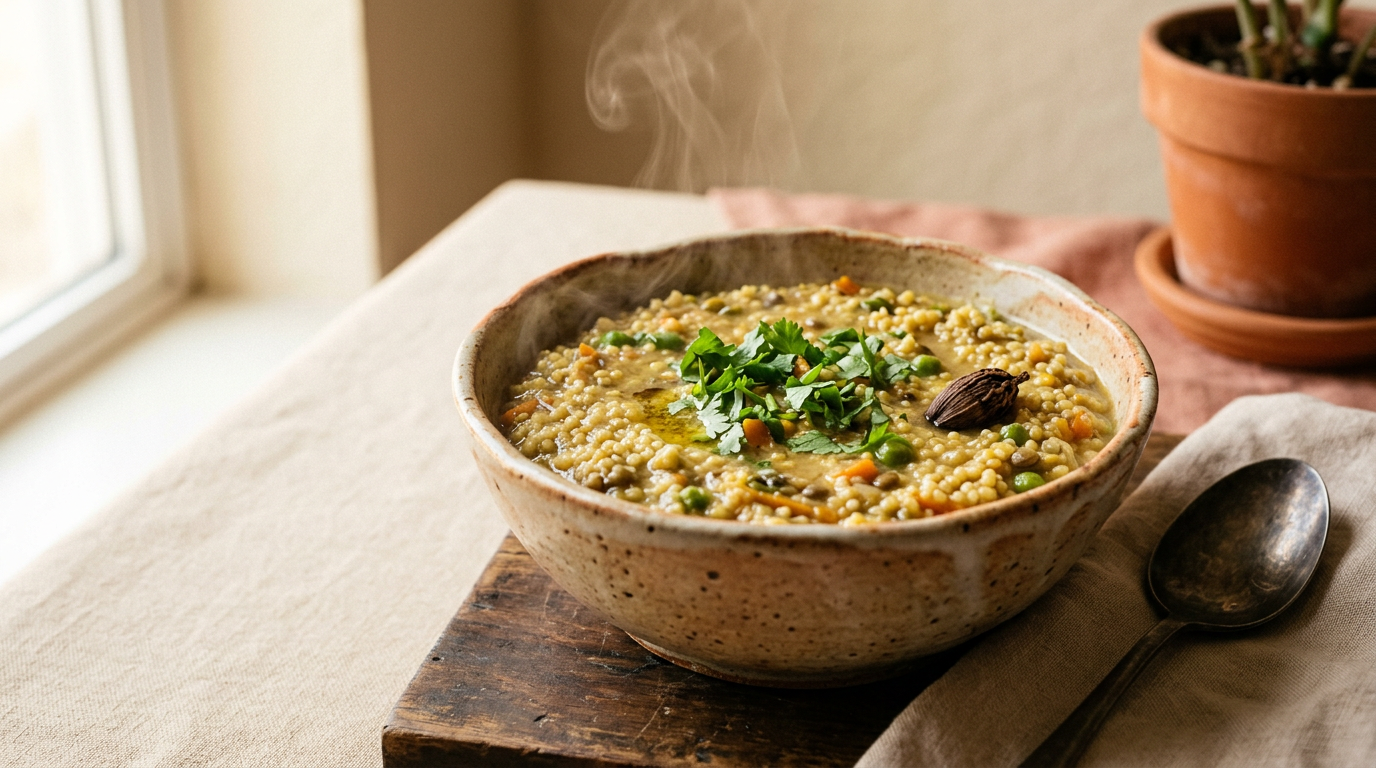
A well-crafted foxtail millet breakfast recipe offers more sustained energy and balanced nutrition than many trendy 'high-protein' bowls that dominate the wellness conversation. This ancient grain, prepared traditionally, challenges our assumptions about what constitutes a performance breakfast. It’s not about packing in isolated protein; it’s about slow-release fuel from a whole, synergistic system that has nourished populations for centuries.
Walk down any breakfast aisle, or scroll through any wellness feed, and you're met with a barrage of claims. '20g of protein!' screams a tub of powder. 'Keto-friendly!' whispers a box of granola. The modern breakfast has become a battlefield of macronutrient ratios, often assembled from processed powders, sugary fruit purees, and isolated fibers. The result is frequently a meal that delivers a quick energy spike followed by an equally precipitous crash, leaving you hungry and unfocused by 11 a.m.
Now, consider khichdi. For too long, it’s been typecast in the West as simple, convalescent food. But in its traditional form, especially when made with ancient grains, it's a masterpiece of nutritional engineering. We're not talking about just any khichdi, but one built on foxtail millet (Setaria italica).
The Grain That Endures
Foxtail millet is one of humanity’s oldest cultivated grains, a resilient crop that thrives in arid conditions where rice and wheat falter. In regions across <a href="/region/ind">India</a>, it’s known by names like kangni or thinai, a testament to its deep cultural roots. Unlike the highly processed grains that form the base of many Western breakfast products, foxtail millet is a nutritional powerhouse in its whole form. It's rich in complex carbohydrates, boasts a significant amount of dietary fiber, and is notably high in protein for a grain [2].
You can find it in the bulk bins of a California co-op, priced by the pound (lb), or in specialty food stores. When paired with split moong dal—a staple you can find in any South Asian grocer in Birmingham, usually sold in 500g bags—it creates a complete protein, providing all the essential amino acids your body needs to build and repair tissue.
The Quiet Power of Spice
What elevates this breakfast from merely nutritious to truly functional is the spice. We’re not adding a dusting of cinnamon for flavor; we’re using spices for their specific physiological benefits. Instead of the usual suspects, consider the pairing of green cardamom and ajwain (carom seeds).
Cardamom is often relegated to sweets and chai, but it has a rich history as a digestive aid, helping to soothe the stomach and improve nutrient absorption [3]. Ajwain is even more of a digestive specialist. Its active compound, thymol, is a potent carminative, known to relieve indigestion and bloating [4]. Together, they ensure your breakfast doesn't just fuel you, but that your body can process it with maximum efficiency and comfort. This is the difference between food as a pile of numbers and food as a living system.
The Showdown: Bowl vs. Khichdi
Let's put them side-by-side. The comparison isn't about which is 'good' or 'bad,' but about which is built on a more sophisticated nutritional architecture.
| Feature | The 'High-Protein' Smoothie Bowl | Spiced Foxtail Millet Khichdi |
|---|---|---|
| Protein Source | Processed whey/soy/pea isolates | Whole moong dal + millet (a complete protein) |
| Carbohydrate Quality | Often simple sugars (fruit purees, agave) | Complex carbohydrates from a whole grain |
| Intrinsic Fiber | Low, or added as processed powders | High, from whole grains and lentils |
| Functional Spices | Flavorings, 'superfood' dusts | Cardamom, Ajwain (targeted digestive aids) |
| Energy Profile | Potential spike and crash | Sustained release, stable blood sugar [1] |
| Satiety Index | Variable; can be fleeting | High, due to protein quality and fiber structure |
The data points to a clear winner for sustained performance. The slow-digesting nature of the millet and dal provides a gentle, prolonged release of energy, keeping blood sugar stable and focus sharp—a stark contrast to the rollercoaster induced by many sugar-heavy breakfast bowls [1].
This isn't a call to abandon your current breakfast, but an invitation to reconsider it. Building your morning meal around an ancient, climate-resilient grain and whole spices isn’t about nostalgia. It’s a modern, evidence-backed strategy for better energy, better digestion, and a more resilient food system. It’s a quiet rebellion against the noise of the wellness-industrial complex, and you can start with this simple, profoundly effective [foxtail millet breakfast recipe](/recipe).
Frequently Asked Questions
1. Is foxtail millet gluten-free?
Yes, foxtail millet is naturally gluten-free, making it an excellent choice for individuals with celiac disease or gluten sensitivity.
2. What does foxtail millet taste like?
It has a mild, nutty flavor and a texture slightly chewier than couscous. It absorbs the flavors of spices and other ingredients beautifully, making it very versatile.
3. Can I make this khichdi ahead of time?
Absolutely. Khichdi stores well in the refrigerator for 2-3 days. The flavors often meld and deepen overnight. You may need to add a splash of water when reheating to restore its creamy consistency.
4. Why is this better than an oatmeal-based breakfast?
While oatmeal is a healthy choice, foxtail millet has a lower glycemic index, meaning a slower impact on blood sugar. When combined with moong dal, it also provides a complete protein profile, which is not the case for oatmeal eaten on its own.
Sources & citations
- Kam, J., Puranik, S., Yadav, R. et al. (2016). Dietary interventions for type 2 diabetes: how millet comes to help. Frontiers in Plant Science. Available at: https://www.frontiersin.org/journals/plant-science
- Hassan, Z. M., Sebola, N. A., & Mabelebele, M. (2021). The nutritional use of millet grain for food and feed: a review. Agriculture & Food Security, 10(1), 16. Available at: https://agricultureandfoodsecurity.biomedcentral.com/
- Masoumi-Ardakani, Y., et al. (2016). The effect of cardamom on the quality of life in patients with non-alcoholic fatty liver disease: a randomized, double-blind, placebo-controlled clinical trial. Arabian Journal of Gastroenterology. Available at: https://www.sciencedirect.com/journal/arabian-journal-of-gastroenterology
- Bairwa, R., Sodha, R. S., & Rajawat, B. S. (2012). Trachyspermum ammi. Pharmacognosy Reviews, 6(11), 56–60. Available at: https://www.ncbi.nlm.nih.gov/pmc/articles/PMC3358968/
- Food and Agriculture Organization of the United Nations (FAO). (2023). Millets are a smart food choice. Available at: https://www.fao.org/home/en