
Take a moment and picture cinnamon. You might imagine a tightly-rolled, reddish-brown stick garnishing a hot drink, or a shaker of dark powder destined for oatmeal or a coffee cake. It’s one of the most familiar, comforting aromas in the Western culinary lexicon. Now, what if I told you that most of what we call and consume as cinnamon in North America and much of Europe isn’t cinnamon at all?
This isn't a riddle. It's a story of mistaken identity, played out on a global scale, that ends in your spice cabinet. The spice sold as cinnamon in most supermarkets is a botanical cousin, a stand-in, an impostor that has so thoroughly dominated the market that we've forgotten the original.
A Tale of Two Cinnamons
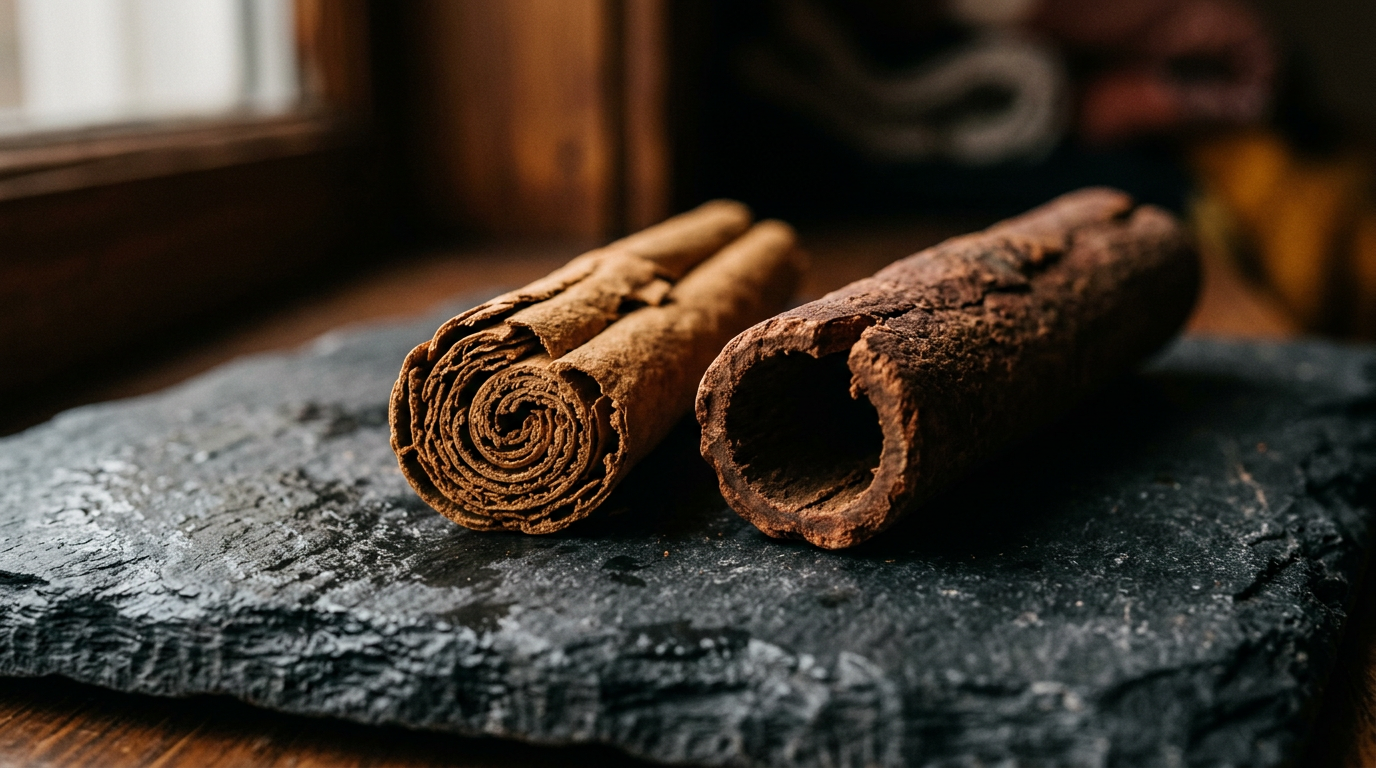
The spice world is full of fascinating families, and the Cinnamomum genus is no exception. The protagonist of our story is Cinnamomum verum—literally, “true cinnamon.” Native to Sri Lanka, it is often called Ceylon cinnamon, after the island’s colonial name. It’s made from the delicate, inner bark of the tree. Harvesting it is an art form passed down through generations. Skilled artisans, known as peelers, meticulously shave the outer bark before carefully scoring and peeling the whisper-thin inner layer. These fragile sheets are then layered and rolled by hand into composite quills, which dry into brittle, papery scrolls with a tawny, light-brown hue.
Its common replacement is cassia. This isn't one species, but several, primarily Cinnamomum cassia (from China), C. burmannii (Indonesia), and C. loureiroi (Vietnam). Cassia is harvested from the tree's thicker, outer bark. It’s a much hardier and less labor-intensive crop to produce. Instead of delicate layers, a dried cassia stick is a single, thick piece of bark that curls inward from both sides to form a hollow tube. It’s darker, harder, and rougher than its Sri Lankan relative.
So why the switch? The answer, as it so often is, lies in the logic of industrial supply chains. Cassia is significantly cheaper to grow and process. Its flavor is also more potent and aggressive—a brash, fiery spice note that stands up to the rigors of commercial baking and food production. Over decades, the blunt force of cassia became the flavor profile that food scientists and product developers reached for, and the one the public palate came to expect. The global spice trade, optimizing for volume and cost, quietly made the substitution complete.
Chemistry, Health, and Flavor
This isn't just a matter of botanical pedantry; the differences are tangible. True Ceylon cinnamon offers a delicate, fragrant, and complex flavor. It has warm, woody notes with hints of citrus and a gentle, floral sweetness. It enhances other ingredients without overpowering them. Cassia, by contrast, is a sledgehammer of spice. It delivers a singular, pungent, and often harsh heat from its primary flavor compound, cinnamaldehyde. This is the familiar flavor of a Red Hots candy or a mass-market cinnamon roll.
Beyond taste, there's a more serious chemical distinction: a compound called coumarin. Coumarin is a naturally occurring plant substance that can be toxic to the liver in high concentrations [1]. While true Ceylon cinnamon contains only trace, insignificant amounts of coumarin, cassia varieties contain substantially more. Indonesian and Chinese cassia can have coumarin levels hundreds of times higher than Ceylon cinnamon, with Saigon cassia packing the most [2].
European health agencies have issued warnings about regular, heavy consumption of cassia, particularly for children and sensitive individuals [3]. Yet, in the United States, the Food and Drug Administration (FDA) does not require manufacturers to distinguish between cinnamon and cassia on labels. They are, for regulatory purposes, interchangeable. This regulatory ambiguity leaves little incentive for large food companies or supermarket chains to source the more expensive, harder-to-procure true cinnamon. They are serving a market that doesn't know to ask for it.
Finding the Genuine Article
When you see a generic jar of "ground cinnamon" for two dollars, you are almost certainly buying cassia. When you see thick, hollow "cinnamon sticks" in the bulk bin, that's cassia, too. True cinnamon has been relegated to a specialty item, hiding in plain sight.
So, how do you find the real thing? You have to become a more demanding reader of labels and products. Look for the words "Ceylon" or the species name Cinnamomum verum. Examine the sticks: are they made of multiple, paper-thin layers rolled into a dense scroll, so brittle you could crush it with your fingers? That’s Ceylon. Is it a single, thick, hollow tube of bark that feels tough as wood? That's cassia.
Seeking out Ceylon cinnamon is more than a culinary upgrade. It’s an act of reclaiming a flavor that has been nearly erased by the economics of convenience. It's a nod to the Sri Lankan farmers and artisans who preserve a centuries-old craft. And it's a choice to value nuance over noise, authenticity over approximation. The true history and delicate soul of cinnamon are still there, waiting for us to pay attention.
Sources & citations
- Blahová, J., and Z. Svobodová. "Assessment of coumarin levels in ground cinnamon available in the Czech retail market." The Scientific World Journal vol. 2012 (2012): 263851. doi:10.1100/2012/263851
- Wang, Y. H., et al. "Cassia cinnamon as a source of coumarin in cinnamon-flavored food and food supplements in the United States." Journal of agricultural and food chemistry vol. 61,18 (2013): 4470-6. doi:10.1021/jf4005864
- German Federal Institute for Risk Assessment (BfR). "High daily intakes of cinnamon: Health risk cannot be ruled out." BfR Health Assessment No. 044/2006, 18 August 2006. https://www.bfr.bund.de/en/press_information/2006/21/high_daily_intakes_of_cinnamon__health_risk_cannot_be_ruled_out-9899.html
- Britannica, The Editors of Encyclopaedia. "Cinnamon". Encyclopedia Britannica, 17 Oct. 2023, https://www.britannica.com/plant/cinnamon. Accessed 23 May 2024.
- U.S. Food & Drug Administration. "CFR - Code of Federal Regulations Title 21." https://www.accessdata.fda.gov/scripts/cdrh/cfdocs/cfcfr/CFRSearch.cfm?fr=182.10