
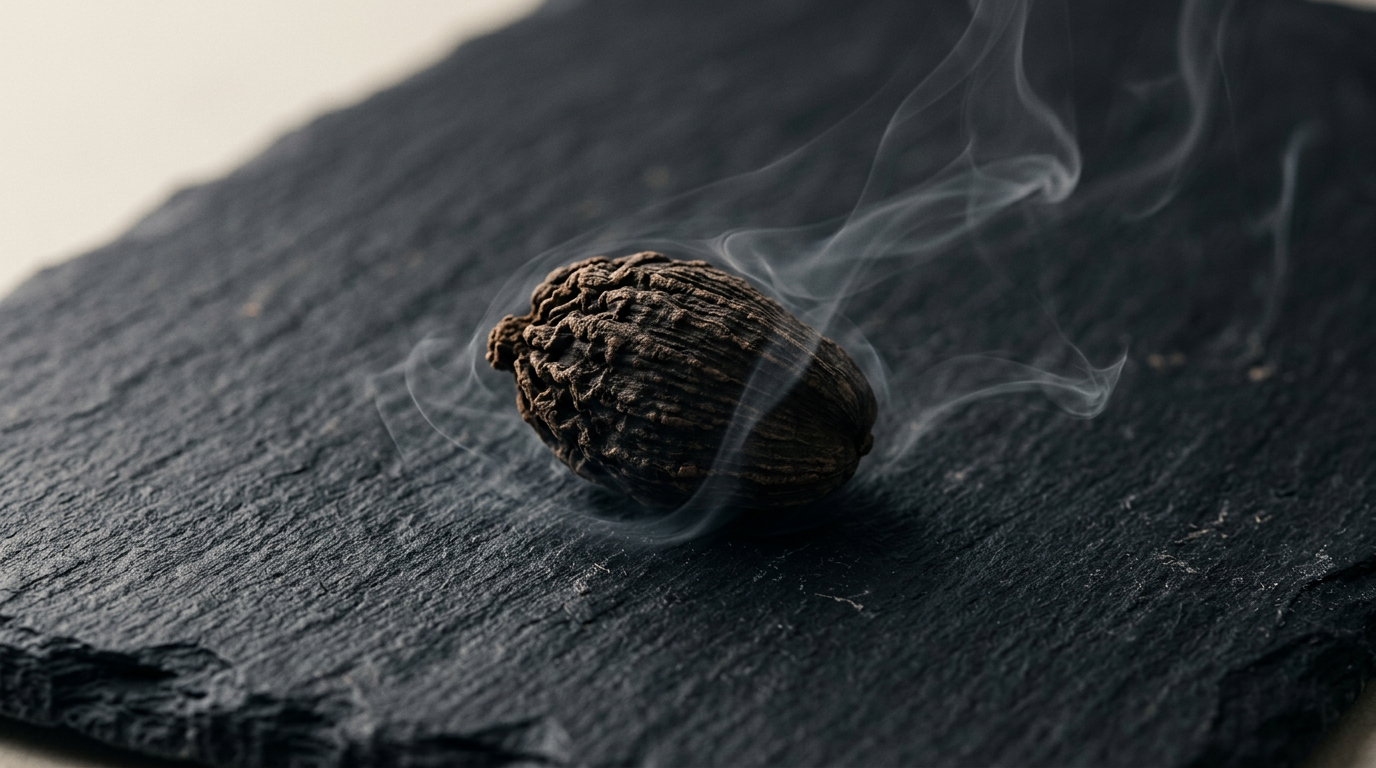
Often relegated to ‘that other cardamom,’ black cardamom uses extend far beyond the sweet treats associated with its green cousin. This smoky, resinous spice pod, often fire-dried in the Himalayan foothills, offers a complex, savory depth essential to robust stews, broths, and rice dishes. It deserves a prime spot in the modern pantry, not as a substitute, but as a star in its own right.
Green cardamom (Elettaria cardamomum) is the ‘Queen of Spices,’ the third-most expensive in the world, a darling of Scandinavian baking and Indian sweets. Black cardamom (Amomum subulatum) is its wilder, more enigmatic relative. They are not interchangeable, and to suggest so is to miss the point of both.
A Tale of Two Pods
To see them side-by-side is to understand their difference. One is small, green, and smooth; the other is large, brown-black, and deeply wrinkled. That difference is more than skin deep—it’s a story of terroir, processing, and history.
| Feature | Green Cardamom (Elettaria) | Black Cardamom (Amomum) |
| :--- | :--- | :--- |
| Flavor | Sweet, floral, menthol, citrus | Smoky, pine, camphor, menthol |
| Aroma | Perfumed, delicate | Resinous, intense, smoky |
| Processing | Dried carefully to preserve color | Dried over an open fire |
| Best For | Desserts, tea, delicate curries | Stews, broths, braises, rich dals |
The Colonised Pantry
The global dominance of green cardamom isn't just about taste; it’s an echo of colonial trade. Western European traders, particularly the British and Dutch, sought spices that were predictable, palatable to the home market, and profitable. Sweet, floral green cardamom—easily ground into a uniform powder for biscuits and cakes—was a perfect commodity. Its price made it aspirational.
Black cardamom, with its assertive, smoky character born from the rustic fire-drying process in the mountains of Sikkim and Nepal, was another matter. For the colonial ledger, its complexity was a liability. It was deemed too ‘ethnic,’ too coarse for a refined European palate. And so, while it remained a cornerstone of Himalayan, North Indian, and even Vietnamese cooking (it's a key ingredient in Phở), it was largely written out of the global spice story we inherited. Your local supermarket aisle in the [/region/us](US) or UK tells this story plainly: you will always find the green pods, but rarely the black ones.
This is the quiet legacy of a colonised-food system: a flattening of diversity, a favouring of the simple over the complex, the sweet over the savory, the commodity over the craft. Finding a one-pound bag of badi elaichi in a Wembley cash-and-carry or buying it by the ounce in a New York specialty shop feels like a small act of reclamation.
Smoked, Not Stirred
The smoky flavour isn't an accident; it's essential technology. In the high-altitude regions where it grows, sun-drying is impractical. Villagers built traditional bhattis (kilns) to dry the pods over carefully tended flames. This process doesn't just preserve the spice; it creates its defining characteristic.
Modern science validates this ancestral wisdom. The smokiness complements the pod’s naturally high concentration of 1,8-cineole, a compound also found in eucalyptus and bay leaf [1]. This gives black cardamom its signature camphor-like, respiratory-clearing aroma. Where green cardamom’s chemistry lends itself to perfume, black cardamom’s belongs to the world of broths, braises, and remedies.
Exploring black cardamom uses today is about appreciating this depth. It is indispensable in a true Dal Makhani, where a single pod infuses the entire pot with a phantom smokiness. It is the bass note in a complex Biryani. Bruise a pod and toss it into your next pot of chickpeas, lentil soup, or beef stew. The flavour it imparts is not overtly ‘cardamom’; it is a resonant, savory foundation that makes everything taste more complex and deeply satisfying.
Embracing this spice is more than a culinary adventure. It's a way to connect with a history that wasn't chosen for us, to taste the smoke from a Himalayan fire, and to add a little more complexity and truth to our pantry.
### FAQ
1. What does black cardamom taste like?
It has a strong, smoky aroma and flavor with notes of camphor, pine, and menthol. It is not sweet and tastes very different from green cardamom.
2. How should I use black cardamom?
Use it whole. Lightly bruise one or two pods to crack the skin and add it to slow-cooked, liquid-heavy dishes like stews, soups, dals, and rice. The long cooking time allows its complex flavours to infuse the dish. It is generally not chewed or ground into a powder for finishing.
3. Can I substitute green cardamom for black cardamom?
No. They are botanically different plants with entirely different flavour profiles. Substituting one for the other would drastically and often unpleasantly alter the taste of your dish.
4. What are the traditional health benefits of black cardamom?
In traditional medicine systems like Ayurveda, black cardamom is used to support respiratory health, aid digestion, and relieve oral malodour, partly thanks to potent compounds like 1,8-cineole [1, 4].
Sources & citations
- Gautam, R., Saklani, S., & Jachak, S. M. (2021). Amomum subulatum Roxb.: A review of its traditional uses, phytochemistry, and pharmacology. Journal of Ethnopharmacology, 275, 114144. https://www.ncbi.nlm.nih.gov/pmc/articles/PMC8118330/
- Kew Science. Amomum subulatum Roxb. Plants of the World Online. https://powo.science.kew.org/taxon/urn:lsid:ipni.org:names:871987-1
- Serious Eats. Spice Hunting: Black Cardamom (2010). https://www.seriouseats.com/spice-hunting-black-cardamom-badi-elaichi
- Britannica. Cardamom. https://www.britannica.com/plant/cardamom