
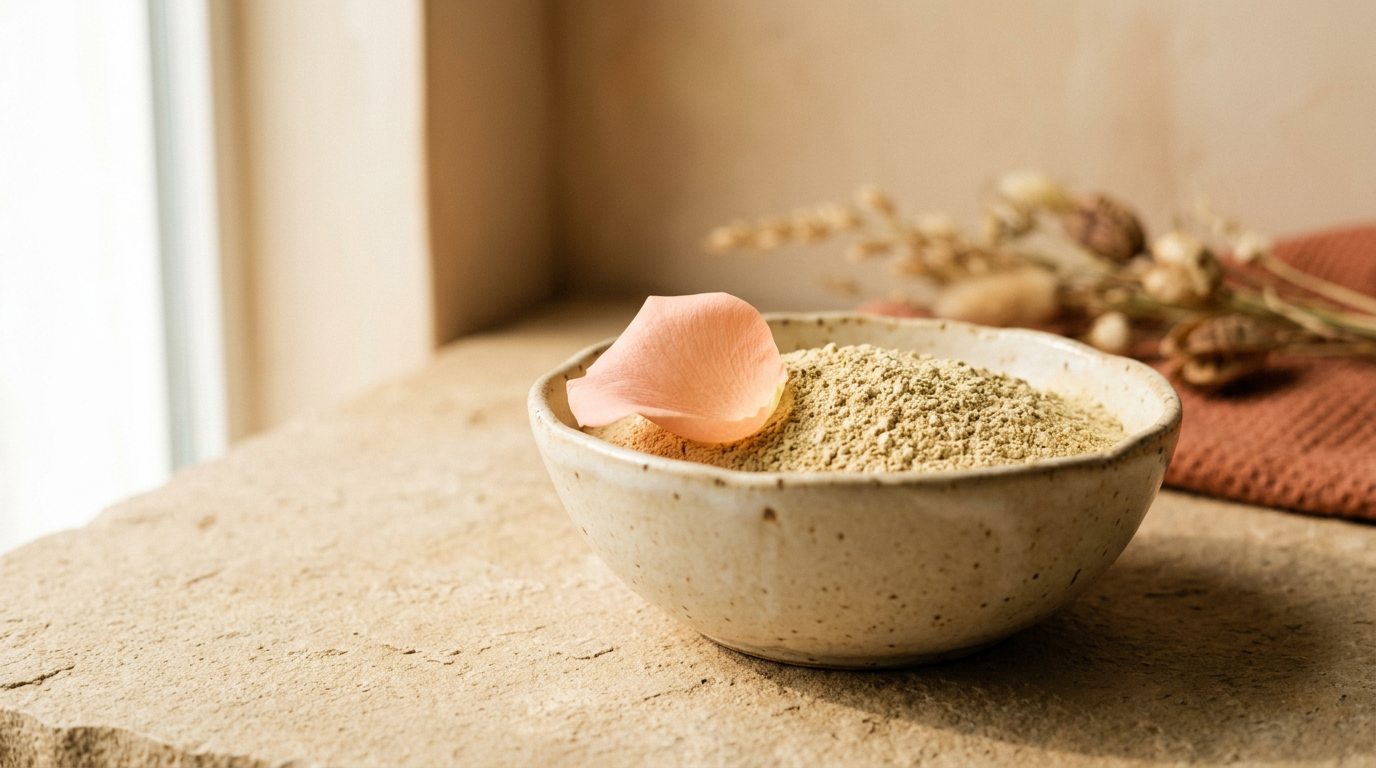
For generations, multani mitti for oily skin has been a staple of South Asian beauty rituals. This mineral-rich clay, also known as Fuller's Earth, is a time-tested, single-ingredient remedy for absorbing excess sebum and impurities. Long before the rise of the modern 'clean beauty' industry, this simple powder offered a potent, practical solution straight from the earth.
It was a ritual of quiet self-care. A spoonful of pale, earthy powder mixed with rosewater or plain water in a small bowl, applied with the fingertips, and left to dry, tightening on the skin. As it dried, it pulled oil, sweat, and grime from pores, leaving skin feeling clean, cool, and matte. This wasn't a 12-step routine sold in elaborate packaging; it was inherited wisdom, passed down through matriarchs.
The Clay from Multan
'Multani mitti' literally translates to 'clay from Multan,' a city in modern-day Pakistan with a history stretching back millennia. This tells a story of the subcontinent's shared heritage, before borders were drawn across it. The clay itself is a type of kaolin, rich in hydrated aluminum silicates, magnesium chloride, and calcium bentonite. Its commercial name, Fuller's Earth, comes from its historical use by textile workers ('fullers') to absorb lanolin, oils, and dirt from wool.
The very properties that made it an effective industrial degreaser are what make it a powerful cosmetic agent. Its magic lies in basic chemistry: the clay particles have a vast surface area and a negative ionic charge. Sebum, dead skin cells, and many environmental toxins carry a positive charge. When the wet clay is applied to the skin, it acts like a magnet, binding to these impurities and lifting them away as it's rinsed off [1]. It is, in essence, a physical deep-clean, powered by geology.
The Journey of a Home Remedy
There is a powerful story in the journey of this humble ingredient. In the bustling markets of [/region/ind](India), you can still find it sold by the kilogram, scooped unceremoniously from a large jute sack into a simple paper bag for a handful of rupees. It’s a raw commodity, its value implicit and understood.
Fly to the UAE, and you might find it in a sprawling Carrefour in Dubai, packaged in a glossy box with English and Arabic text. It's no longer just clay; it’s a 'Purifying Facial Masque,' positioned next to French green clay and Moroccan rhassoul, perhaps priced at 20 dirhams. Its identity has been upgraded for a global consumer.
In a South Asian grocery store in London's Southall, it sits on a shelf as a nostalgic import, a familiar comfort for the diaspora. The packaging might look like it hasn't changed in thirty years, but its price in pounds sterling reflects a long journey across oceans and a new place in a new economy.
The ingredient never changed. The context, the story told about it, and the price tag did. This journey from a grandmother's pantry to a global beauty aisle is a quiet lesson in how value is created, knowledge is packaged, and who gets to tell the story. This is the landscape of the 'colonised-food' and a reminder of the potent wisdom already sitting in our own kitchens.
Multani Mitti vs. Other Clays
While Multani mitti is a powerhouse, it’s part of a global family of cosmetic clays. Here’s how it stacks up against another popular choice, Bentonite clay.
| Feature | Multani Mitti (Fuller's Earth) | Bentonite Clay |
| :--- | :--- | :--- |
| Primary Minerals | Hydrated aluminum silicates | Montmorillonite |
| Origin | Named for Multan (Pakistan/India) | Named for Fort Benton, Wyoming (USA) |
| Absorption | Highly absorbent, excellent for oil | Extremely absorbent, swells when wet |
| Best For | Oily, acne-prone skin; clarifying | Detoxifying, deep pore cleansing |
| Texture | Mild, less 'pulling' action | Strong 'pulling' and tightening sensation|
Ultimately, the choice of clay is less about which is 'better' and more about what your skin needs. But for a straightforward, effective solution for excess oil, Multani mitti’s centuries of use speak volumes. It's a reminder that not all potent [remedies](/remedy) need to be new discoveries.
### Frequently Asked Questions
1. Can I use Multani mitti every day?
It's not recommended. Because of its high absorbency, daily use can strip the skin of its natural oils, leading to dryness or even reactive oil production. For most people, 1-2 times a week is ample.
2. How do I know if my clay is pure?
Look for a single-ingredient product. The powder should be fine, free of clumps, and have a natural, earthy smell. Avoid products with added fragrances, colours, or preservatives. Sourcing from trusted suppliers who can verify its origin and purity is key.
3. Can it be used on hair?
Yes. Traditionally, it's used as a hair and scalp cleanser. Mixed into a thin paste, it can be applied to the scalp to absorb excess oil and product buildup, though it's best for those with oily hair types as it can be drying [3].
4. What is the difference between using multani mitti for oily skin versus bentonite clay?
Both are excellent absorbent clays. Multani mitti is generally considered a milder kaolin-type clay, making it ideal for oily and acne-prone skin. Bentonite clay has a stronger drawing power due to its ability to swell, making it a go-to for 'detoxifying' masks, but it can be too intense for sensitive skin.
Sources & citations
- Williams, L. B., & Haydel, S. E. (2010). Evaluation of the medicinal use of clay minerals as antibacterial agents. International geology review, 52(7-8), 745–770. https://www.ncbi.nlm.nih.gov/pmc/articles/PMC2904249/
- The Editors of Encyclopaedia Britannica. (2023). Fuller's earth. Encyclopædia Britannica. https://www.britannica.com/science/fullers-earth
- Gubitosa, J., Rizzi, V., Fini, P., & Cosma, P. (2019). Hair Care Cosmetics: From Traditional to Modern Formulations. Cosmetics, 6(2), 27. https://www.mdpi.com/2079-9284/6/2/27
- Food and Agriculture Organization of the United Nations (FAO). (n.d.). Bentonite, Kaolin and Selected Clay Minerals. https://www.fao.org/