
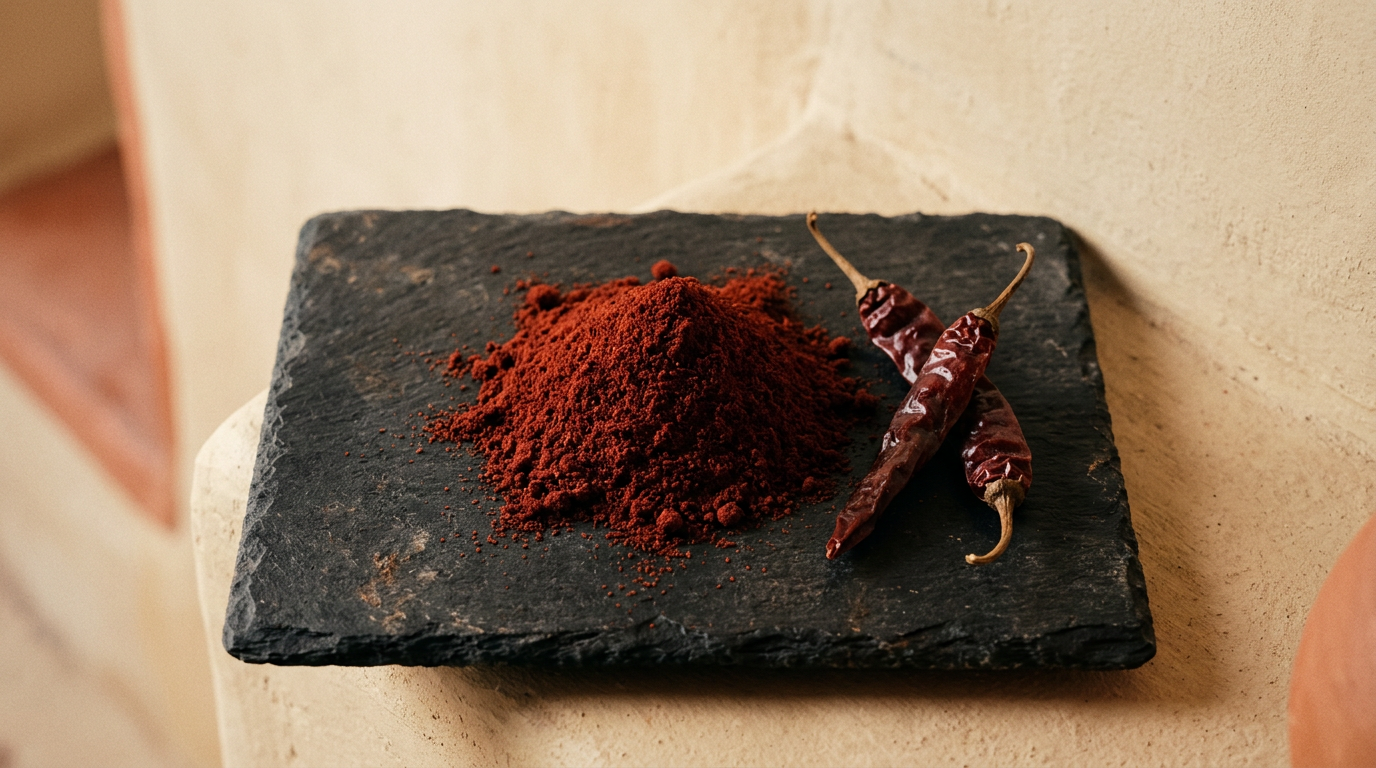
The grocery aisle is a battlefield of reds. From yogurts to cereals to sausages, the color red signals ripeness, flavor, and pleasure. But flip over the package, and that alluring crimson often reveals itself to be born in a lab, listed under codes like Red 40 or E129—names that feel more like algebra than food.
There is, however, a red that needs no apology. A red that comes not from a chemical plant, but from the sun and soil of a singular valley. We’re talking about Kashmiri chili, a spice that offers outrageous color with only the gentlest whisper of heat. In a culinary world increasingly obsessed with the shock-and-awe of Scoville Heat Units (SHU), the Kashmiri chili makes a compelling case for nuance.
The Science of Color and Calm
To understand the magic of the Kashmiri chili (Capsicum annuum 'Kashmiri'), you have to understand the two key compounds that define any chili pepper: capsaicin and capsanthin.
Capsaicin is the loud one. It's the bioactive compound responsible for the fiery burn that lights up your nerve endings [1]. Heat-seekers are chasing high concentrations of capsaicin. Capsanthin, on the other hand, is the artist. It's the main carotenoid pigment that gives red bell peppers and paprika their brilliant color. While most chilies have a mix of both, the ratio is what matters.
A fearsome Bhut Jolokia or Carolina Reaper is all capsaicin, with color as an afterthought. A Kashmiri chili flips the script. It is exceptionally rich in capsanthin, giving its powder a stunningly deep, vibrant red hue. Its capsaicin levels, however, are remarkably low. While a habanero can easily top 300,000 SHU, the Kashmiri chili typically clocks in between a mere 1,000 and 2,500 SHU [2]. That’s gentler than a jalapeño.
This unique chemical profile makes it a tool of incredible finesse in the kitchen. It allows a chef to add profound, natural color and a subtle, smoky sweetness to a dish without overwhelming the other flavors in a blaze of pain. It is heat as a bass note, not a shriek.
A Fingerprint of Place
True Kashmiri chili is not just a varietal; it’s a fingerprint of place. Cultivated in the temperate, highland climes of the Kashmir Valley and its surroundings, the pepper develops its unique characteristics thanks to the region's mild summers and rich, well-drained soil. The long, sunny days allow the capsanthin to develop, while the cool nights keep the capsaicin in check.
Its importance to the region’s culture and economy is so profound that it has been granted a Geographical Indication (GI) tag [3]. This is a form of intellectual property, a declaration that authentic 'Kashmiri Chili' can only come from its designated home territory, much like Champagne from France or Parmesan from Italy.
This protection is desperately needed. The truth is, a vast amount of the powder sold globally as 'Kashmiri' has never seen the Himalayas. It’s often a blend of cheaper, more readily available chilies from other Indian states, like the Byadagi from Karnataka, which is similar in color but carries a different flavor profile and more heat. Worse, unscrupulous suppliers sometimes add synthetic red dyes to inferior chili powders to mimic the signature color [4].
Sourcing authentic, GI-tagged Kashmiri chili requires more than a purchase order. It demands on-the-ground knowledge, trusted relationships with farmers and cooperatives, and a commitment to batch-by-batch verification. It means understanding the difference between the harvest from Pampore and a counterfeit from a distant market.
Beyond the Heat Race
For years, the story of chili peppers has been a shouting match—an arms race for ever-higher SHU scores, fueled by viral challenges and a machismo that prioritizes endurance over enjoyment. We seem to be reaching the end of that road.
The global palate is evolving. There's a growing appreciation for a different kind of complexity, one that values the fruity, smoky, and floral notes that different chilies can bring. The conversation is shifting from “how hot can you go?” to “what else does it do?”
This is where the Kashmiri chili shines. It's a spice for cooks, not daredevils. It’s the key to the stunning red of a traditional Rogan Josh or the terracotta glow of tandoori chicken, providing visual depth and a barely-there warmth that rounds out the other spices. It’s an ingredient that teaches a critical lesson: the most powerful statement isn’t always the loudest one.
In its gentle warmth and dazzling color, the Kashmiri chili offers a more thoughtful way to engage with spice—one rooted in place, validated by science, and celebrated for its contribution to flavor, not just its fire.
Sources & citations
- Srinivasan, K. (2016). Biological Activities of Red Pepper (Capsicum annuum) and Its Pungent Principle Capsaicin: A Review. Critical Reviews in Food Science and Nutrition, 56(9), 1488–1500. https://www.tandfonline.com/loi/bfsn20
- Parry, J. W. (2004). Spices, Volume 2. Chemical Publishing Company. (Note: SHU values for Kashmiri Mirch are widely cited in culinary and agricultural literature; specific scientific papers often focus on single compounds rather than overall SHU of this specific landrace.)
- Geographical Indication Registry, India. (2024). Registered GIs. Intellectual Property India. https://ipindiaservices.gov.in/GIRPublic/Application/Details/635
- Dhaka, A., & Sharma, M. (2020). Food Adulteration: A Comprehensive Review on Substances, Health Implications and Detection Methods. Journal of Food Science and Technology-Mysore, 57(9), 3241-3256.