
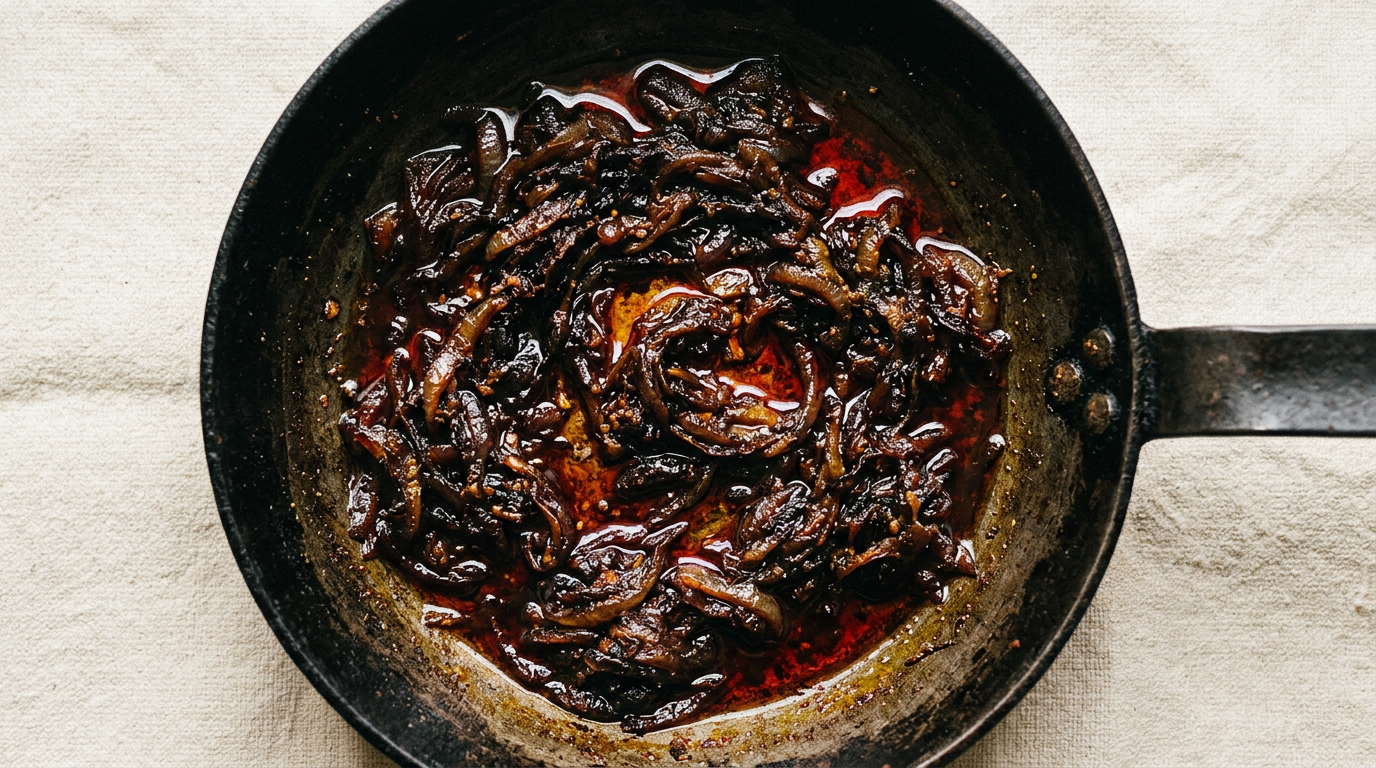
A proper bhuna cooking time chart isn't about minutes; it's about sensory milestones. This guide demystifies the science of bhuna, helping you master the Maillard reaction and caramelization stages that transform simple onions and spices into a foundation of profound depth. For the second-time cook, understanding these stages is the single biggest upgrade you can make to your technique.
‘Bhuna’ comes from the Urdu verb ‘bhun-na,’ meaning “to be fried” or “to be roasted.” It’s not a single dish, but a foundational technique. It is the patient, deliberate art of cooking down aromatics and spices in fat, concentrating their essence and creating layers of flavor that simply cannot be rushed. Get it right, and you create a base so complex it elevates everything that follows. Get it wrong, and your dish will taste disappointingly one-dimensional, like a sketch of the real thing.
The magic lies in transforming a handful of humble ingredients—typically onion, garlic, ginger, and spices like cumin and coriander—into a rich, jammy, umami-laden paste where the oil begins to separate from the solids. This separation is the visual cue that you’ve succeeded. You’ve driven off excess water and built a flavor concentrate. This is the moment of triumph in kitchens across [/region/ind](India), a sign passed down through generations that you're on the right path.
The Science of the Sizzle
Two key chemical reactions are at the heart of a great bhuna: the Maillard reaction and caramelization. You are not just cooking; you are conducting a delicious orchestra of browning reactions.
The Maillard reaction, named after French chemist Louis-Camille Maillard, is a cascade of reactions between amino acids (the building blocks of protein) and reducing sugars in the presence of heat [1]. It’s responsible for the savory, browned flavors in everything from seared steak to toasted bread. In our bhuna, the onions are the star players, full of the necessary precursors. As you cook them slowly, hundreds of new aromatic compounds are created, turning their sharp pungency into a deep, nutty sweetness.
Caramelization is a different process. It’s what happens when you heat sugars alone to high temperatures, causing them to break down and form new, complex molecules that taste sweet, bitter, and nutty [2]. As the onions in your pan cook down, their water content evaporates, the temperature rises, and their natural sugars begin to caramelize, adding another layer of deep, rounded flavor.
A successful bhuna manages both. You cook low and slow enough to allow the Maillard reaction to work its magic without burning the onions, then as water leaves the pan, the rising temperature kicks off caramelization. This is chemistry you can smell and taste.
A Sensory Bhuna Cooking Time Chart
Forget the clock. Your eyes, ears, and nose are the best tools you have. This sensory bhuna cooking time chart maps the stages of transformation. We’ll use cumin and coriander seeds as our anchor spices—a classic pairing that provides an earthy, citrusy backbone.
| Stage | Sensory Cues (See, Hear, Smell) | The Science at Work |
| :--- | :--- | :--- |
| 1. The Bloom (0–1 min) | See: Spices dancing in hot oil. Cumin darkens slightly. Hear: A lively, crackling sizzle. Smell: An intense, toasty, nutty aroma fills the kitchen. | Volatile oils in the whole spices are being extracted into the fat. This is flavor infusion at its most efficient. |
| 2. The Sweat (1–5 mins) | See: Onions turn translucent, releasing water. Hear: A loud, steamy sizzle. Smell: Sharp, pungent onion aroma dominates. | Cell walls are breaking down, releasing water. The temperature is kept relatively low by the evaporating moisture. |
| 3. The Maillard Marathon (5–20 mins) | See: Onions turn from pale to golden to light brown. Volume reduces. Hear: Sizzle quiets, becoming a gentler fry. Smell: Pungency mellows into a distinct sweetness. | Water evaporation allows the pan temperature to rise above 212°F (100°C), initiating the Maillard reaction. Sugars and amino acids are creating new flavor compounds [3]. Patience here is crucial. |
| 4. The Deepen & Separate (20–40+ mins) | See: Onions are a deep brown, jammy paste. Glossy, red-tinged oil slicks the surface and pools at the edges. Hear: A quiet, deep bubbling. Smell: A profoundly rich, complex, sweet, and savory aroma. | Maillard reactions are peaking, and caramelization is well underway. Most of the water has cooked off, making the mixture hydrophobic and forcing the oil to separate. This is the sign of a completed bhuna. |
Mastering this bhuna cooking time chart is about trusting your senses over the recipe's five-minute instruction. In the UK, many British Indian Restaurants (BIR) use a pre-made base gravy to accelerate this process, but the foundational principle of deeply browned aromatics remains the same. A home cook, perhaps using a sturdy American-made cast iron Dutch oven that holds heat beautifully, can achieve an even more nuanced result with simple patience. When you see that shimmering, separated oil, you've built a foundation of flavor that no shortcut can replicate.
Frequently Asked Questions
1. Why did my onions burn instead of browning?
Your heat was too high, or you didn't stir frequently enough. The goal is a gentle transformation, not a scorch. If they start to catch, add a tiny splash of water to lower the pan's temperature and scrape up the browned bits (the fond).
2. What does “oil separation” really look like?
It looks like the paste has “broken.” Instead of a homogenous mass, you’ll see a glossy sheen across the surface and small, shimmering pools of spiced oil gathering at the edges of the pan as you stir. It’s a sign that water content is low and the flavor is concentrated.
3. Can I use red onions or shallots?
Yes, but they behave differently. Red onions contain more sugar and can brown (and burn) faster. Shallots are more delicate. Yellow onions are the standard for their balanced sugar and sulfur content, providing the ideal canvas for the Maillard reaction [4].
4. Is a non-stick pan okay for bhuna?
You can, but it’s not ideal. A heavy-bottomed pan like stainless steel, cast iron, or a Dutch oven provides more even heat and encourages the development of fond (the browned bits on the bottom of the pan), which adds another layer of flavor when scraped back into the sauce.
Sources & citations
[1] Britannica, The Editors of Encyclopaedia. "Maillard reaction". Encyclopedia Britannica, 17 Oct. 2024, https://www.britannica.com/science/Maillard-reaction.
[2] University of Illinois Extension. "Caramelization". In The Kitchen With Extension, https://blogs.extension.illinois.edu/kitchentivities/2021/04/15/caramelization/.
[3] Rose, Peter et al. "A Review of the Bioactivity and Flavor-Impact Compounds of Pungent Alliums." Molecules (Basel, Switzerland) vol. 22,9 1466. 4 Sep. 2017, doi:10.3390/molecules22091466.
[4] McGee, Harold. On Food and Cooking: The Science and Lore of the Kitchen. Scribner, 2004.