
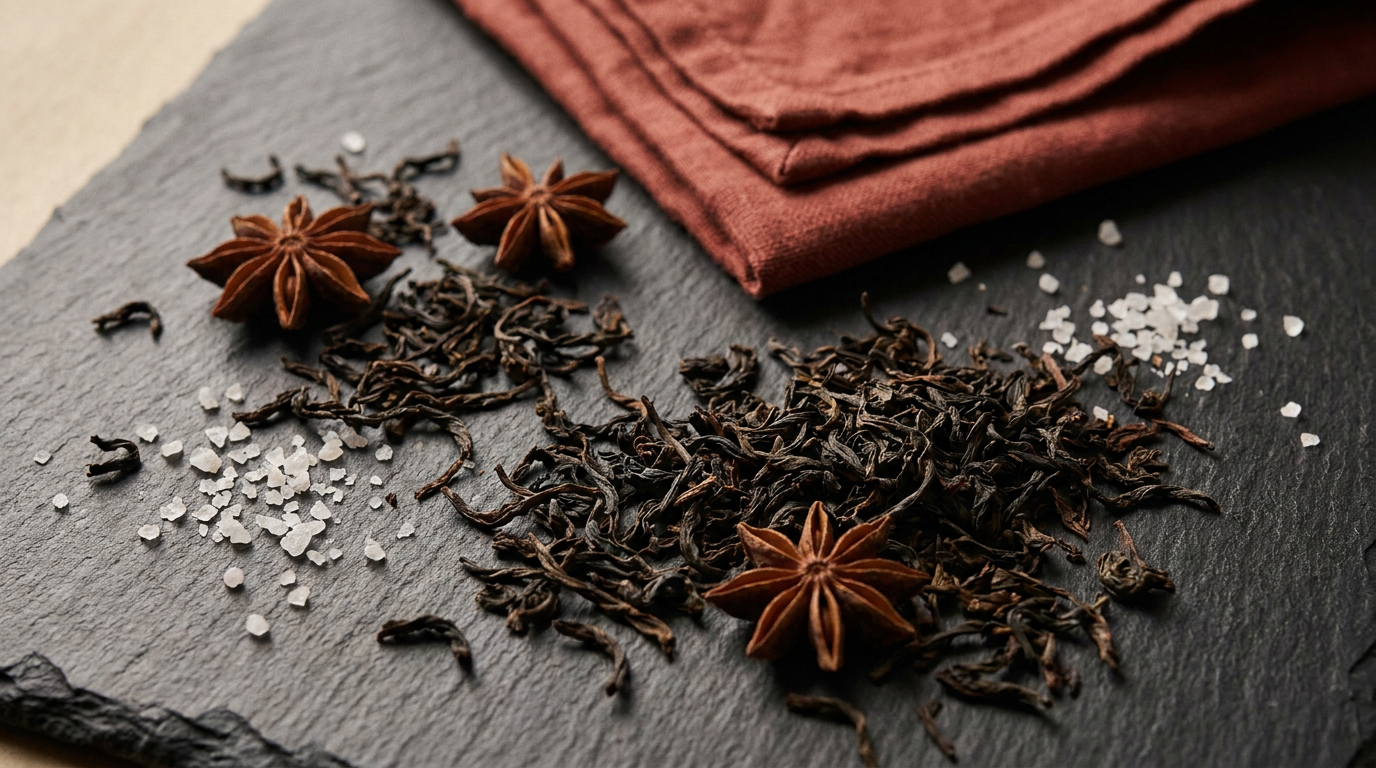
Tea leaves, derived from the perennial evergreen shrub Camellia sinensis, function chemically and culinarily as an aromatic botanical spice. Beyond the steeped infusion, their complex spectrum of polyphenols, astringent catechins, volatile terpenoids, and savoury amino acids allows them to season meats, smoke poultry, tint stocks, and act as a preserved vegetable across historical Asian culinary traditions [1].
We have cordoned tea off into mugs and bone china. In the West, Camellia sinensis is almost exclusively viewed as an infusion, a morning beverage, or an afternoon ritual. This is a culinary blind spot. When you strip away the ceramic pots and strainers, a cured tea leaf is simply an aromatic leaf. It shares chemical behaviours with bay leaves, dried sage, and crushed peppercorns. It carries volatile monoterpenes, bitter polyphenols, and substantial concentrations of savoury glutamic acid and its analogue, L-theanine [1].
In our detailed [tea leaf entry](/spice/tea), the botanical is classified alongside dried herbs and aromatic seeds precisely because of this operational versatility. When treated as a dry rub, a smoking substrate, or a brining agent, tea alters the protein structure and aromatic surface of savoury food.
The chemistry of the leaf in the pan
The fundamental character of tea as a culinary seasoning depends on the degree of enzymatic oxidation the leaf undergoes after harvest. Fresh tea leaves are rich in monomeric flavan-3-ols, commonly termed catechins, notably epigallocatechin gallate (EGCG) [2]. When bruised and left to oxidise, the leaf's polyphenol oxidase converts these into complex, condensed oligomers: the orange-red theaflavins and dark, amorphous thearubigins [1].
These phenolic compounds are powerful astringents. In the mouth, they cross-link and precipitate proline-rich proteins in human saliva, creating the sensation of dryness. When used in a meat cure or marinade, catechins and thearubigins bind to surface myofibrillar proteins. They form a delicate, hydrophobic crust on roasted meat while moderating the perception of heavy animal fats through tactile astringency.
| Leaf Style | Primary Polyphenols | Key Volatiles | Ideal Culinary Application |
| :--- | :--- | :--- | :--- |
| Green (unoxidised) | Monomeric catechins (EGCG, ECG) | Linalool, hexanal, geraniol | Poaching broth for white fish, salt rubs for poultry |
| Oolong (partially oxidised) | Theasinensins, hydrolysed catechins | Nerolidol, indole, jasmonate | Braising pork belly, infusing clarified butter |
| Black (fully oxidised) | Theaflavins, thearubigins | Benzaldehyde, damascenone | Curing venison, marinating boiled eggs, stock bases |
| Lapsang Souchong (pinewood-smoked) | Polymeric polyphenols, pyrazines | Guaiacol, 4-methylguaiacol, syringol | Dry smoking duck, barbecue rubs, bean braises |
Pyrolysis and pan-smoking
Perhaps the most demanding technical application of Camellia sinensis is Zhangcha ya, the tea-smoked duck of Sichuan. Here, tea leaves are not steeped in liquid. They are blended with uncooked rice, brown sugar, and camphor wood sawdust, then scattered across the base of a dry, heated wok until they smoke [3].
Under direct heat, the carbohydrates in the rice and sugar carmelise and dehydrate, while the polyphenols and residual lignin within the dried tea leaves undergo thermal degradation. This dry distillation releases methoxyphenols, predominantly guaiacol and syringol, which yield sweet, medicinal woodsmoke aromas without the acrid creosote common to softwoods [3]. Concurrently, the trace proteins and amino acids within the leaf undergo thermal degradation into alkylpyrazines, imparting a roasted, nutty fragrance that clings tenaciously to the duck's subcutaneous fat.
If you use high-grade green tea for smoking, the exercise fails. Young, unoxidised leaves contain high moisture and delicate hexanals that scorch into an acrid, grassy bitterness. A coarse, heavily oxidised black tea or a wood-fired Lapsang souchong provides the stable phenolic mass required to produce a balanced aromatic smoke [2].
Glutamate and the pickled leaf
Treating tea solely as an aromatic volatile ignores its non-volatile sapid compounds. Camellia sinensis synthesises unusual concentrations of L-theanine (gamma-glutamylethylamide), an amino acid structurally distinct from, but functionally similar to, monosodium glutamate [1]. L-theanine triggers human umami taste receptors (T1R1/T1R3), imparting a rounded, savoury baseline to broths.
In Myanmar, lahpet removes tea from the spice rack and turns it into the meal itself. Young tea leaves are steamed, packed into bamboo vats, weighted down, and subjected to anaerobic lactic acid fermentation for several months. Microorganisms, chiefly Lactobacillus and Lactococcus species, break down the astringent catechins into gallic acid and simpler phenolic acids, softening the aggressive bitterness while preserving the savoury glutamic backbone [4]. The resulting fermented leaf is tossed with toasted garlic, split yellow peas, roasted peanuts, and dried shrimp. It is eaten directly. The leaf is not an extraction; it is the physical medium.
Practical notes for the kitchen
When using dry tea leaves directly in seasoning blends, particle size requires attention. Ground black tea leaves do not dissolve, and their cellulose matrix remains fibrous. If you are creating a dry rub for venison or pork, pulverise the tea in a spice grinder alongside abrasive coarse salt, and sift out the woody midribs.
For wet poaching, avoid prolonged extractions at boiling temperatures. Water above 85 degrees Celsius pulls excessive, coarse tannins out of green leaves within two minutes, which overwhelms the delicate aromatics of fish. If you require deep colour and savoury depth, as in Chinese marble tea eggs (cha ye dan), rely on a low-tannin black leaf simmered with star anise, cassia, and cracked soy sauce, where the surrounding proteins of the egg white can buffer the phenolic astringency.
Frequently asked questions
### Can you grind raw tea leaves directly into a spice blend?
Yes, but texture must be considered. Whole tea leaves contain fibrous cellulose veins that remain tough after cooking. Grind them in a blade or burr grinder until they reach the consistency of fine flour, and combine them with salt and spices for curing meats or seasoning roasted vegetables.
### What does tea smoking do that wood chips cannot?
The combination of tea leaves with sugar and rice produces a faster, lower-temperature smoke rich in guaiacol, pyrazines, and sweetness. It imparts a delicate, aromatic woodsmoke and amber glaze to poultry and fish in fifteen minutes without leaving the heavy, tarry residue often produced by pure hardwood chips.
### Why does tea make meat stock taste less fatty?
The polyphenols in tea, especially theaflavins and catechins, bind to surface fats and salivary proteins. This interaction cuts the oral perception of greasiness in rich broths, providing a clean, drying finish that clarifies the palate between bites.
Sources & citations
- Harbowy, M. E., & Balentine, D. A. (1997). Tea chemistry. Critical Reviews in Plant Sciences, 16(5), 415-480.
- Wang, H., Provan, G. J., & Helliwell, K. (2000). Tea flavonoids: their functions, utilisation and analysis. Trends in Food Science & Technology, 11(4-5), 152-160.
- Pripis-Nicolau, L., et al. (2000). Formation of pyrazines and alkylpyrazines in wine and culinary systems through Maillard-type reactions. Journal of Agricultural and Food Chemistry, 48(5), 1790-1796.
- FAO (2022). World Tea Production and Trade: Current and Future Trends. Food and Agriculture Organization of the United Nations.