
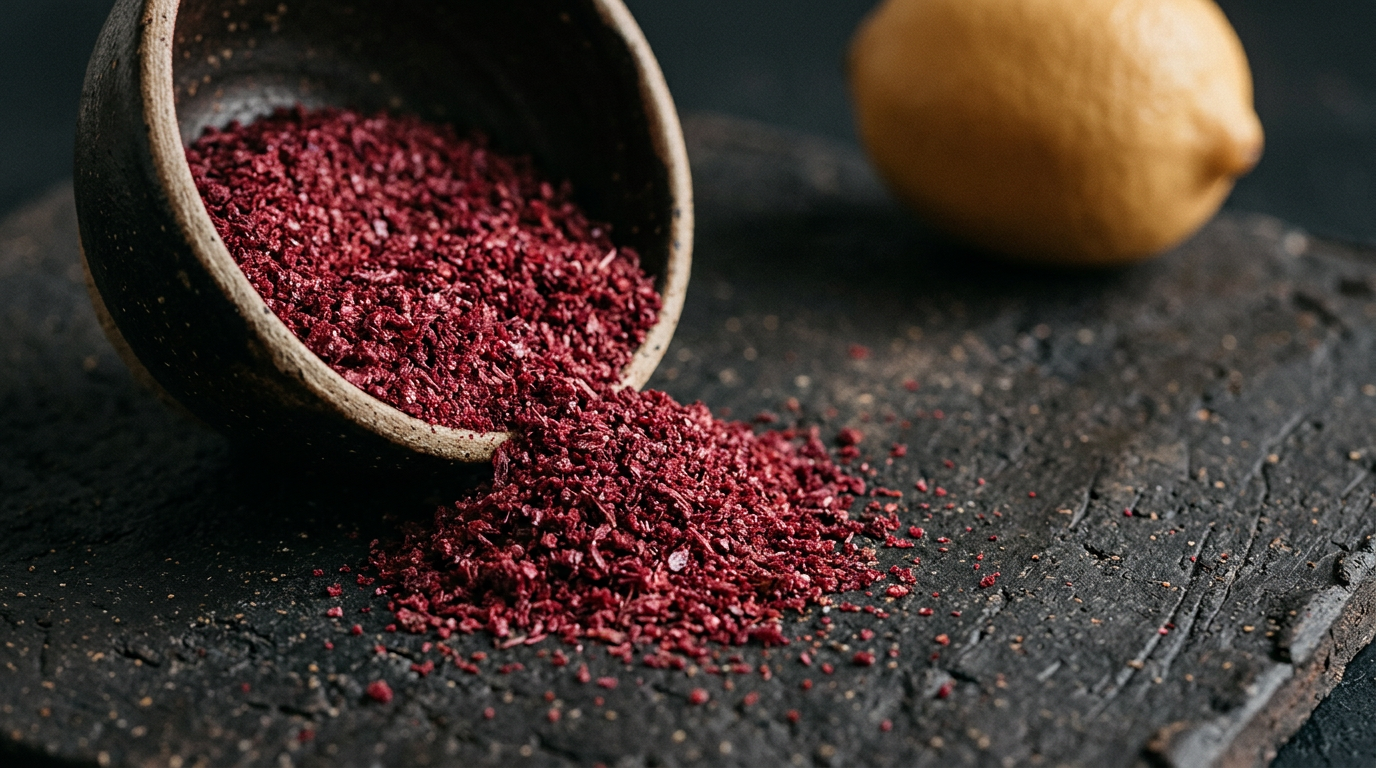
In the debate of sumac vs lemon cooking, sumac offers a complex, tangy flavor without the sharp acidity or added liquid of lemon juice. This deep red spice, derived from the dried berries of the Rhus coriaria shrub, provides a consistent, dry tartness that enhances dishes from salads to marinades, a technique mastered centuries ago across the Levant.
For most of us, sour means lemon. It’s the default, the bright, acidic kick we reach for to finish a fish fillet, dress a salad, or cut through a rich sauce. But this reflex is a relatively modern invention, a product of agricultural trade routes that standardized our global pantry. For millennia before the Eureka lemon became a planetary commodity, cooks across the Middle East, from Anatolia to Palestine, relied on a different primary souring agent: the ruby-hued, ground berries of the wild sumac bush [1].
The Sour Before Citrus
The story of sumac is a story of place. Rhus coriaria grows wild across the Mediterranean basin, and its use as a souring agent and medicine is ancient. The Romans used it for both flavor and dye, and the 1st-century Greek physician Pedanius Dioscorides noted its astringent properties. Long before lemons traveled from their native Assam to the Mediterranean, and centuries before the tomato arrived from the Americas, sumac provided the essential tangy counterpoint in regional diets. It was the original acid, used to brighten everything from stews and kebabs to the iconic spice blend, za'atar.
Its dominance faded not because it was inferior, but because lemons were easier to cultivate and transport at scale. A lemon arrives as a self-contained, juicy package. Sumac requires harvesting wild berries, drying them, and grinding them into a coarse powder. One path lends itself to industrial agriculture; the other remains rooted in a more local, foraged food system. The result was a flattening of the global palate, where one type of sour overshadowed countless regional variations.
The Science of a Better Tart
The choice between sumac vs lemon cooking isn't just about history or flavor preference; it's a question of chemistry. Lemon juice's tartness comes primarily from citric acid dissolved in water. Sumac’s tang is delivered by a complex blend of organic acids—chiefly malic acid, the same acid that gives green apples their characteristic bite—in a dry medium [2].
This single difference—wet versus dry—is a game-changer.
| Feature | Ground Sumac | Lemon Juice |
| :--- | :--- | :--- |
| Flavor Profile | Fruity, tangy, earthy, astringent | Bright, sharp, purely sour |
| Acidity Source | Malic acid, gallic acid | Citric acid |
| Texture | Coarse, dry powder | Liquid |
| Best For | Dry rubs, vinaigrettes where oil ratio is key, finishing garnish | Marinades, drinks, deglazing, any recipe needing moisture |
When you dress a salad, the water in lemon juice can dilute the olive oil, sometimes struggling to emulsify and creating a watery dressing that pools at the bottom of the bowl. Sprinkling sumac over those same greens, however, adds a pure, vibrant tartness without a single drop of extra liquid, letting the olive oil’s flavor shine. When seasoning a chicken before roasting or grilling, sumac acts as a dry rub, its flavor concentrating on the surface as it cooks. A wet lemon marinade, by contrast, can sometimes steam the skin, preventing it from getting perfectly crisp.
A Global Palate, Re-Diversified
Today, a quiet correction is underway. In cosmopolitan cities across the [US](/region/us), from Brooklyn to Los Angeles, chefs are reaching for sumac to add a nuanced acidity that lemon can’t replicate. You can find it on the shelves of stores like Trader Joe’s, a signal of its move from a specialty item to a pantry staple.
In the UK, the 'Ottolenghi effect' has made sumac a familiar friend in home kitchens, used liberally on roasted vegetables and whipped feta. It's no longer an exotic ingredient found only in London's Borough Market but a common sight in local supermarkets. And in the UAE, sumac is not a trend but a foundation. It's the essential soul of za'atar, the herb and spice blend found on every table, sold fresh by the kilogram in the bustling souks of Dubai and Abu Dhabi [3].
This isn't about replacing the lemon. It's about expanding our toolkit. It's about understanding that the seemingly universal ingredients in our kitchens are often just the victors of a long history of trade and agriculture. By exploring the world of [spices](/spice), we’re not just discovering new flavors; we’re rediscovering a more diverse, resilient, and interesting way to cook and eat.
FAQ
1. Is sumac spicy?
No. Sumac is often mistaken as a type of chili powder because of its red color, but it contains no capsaicin and has no heat. Its flavor profile is purely tangy and fruity.
2. How much sumac should I use to replace lemon?
A good starting point is 1 teaspoon of sumac for every 1 tablespoon of lemon juice a recipe calls for. Because its flavor is less sharp, you can often be more generous. Adjust to your own taste.
3. What is the difference between sumac and za'atar?
Sumac is a single ingredient: the ground berry of the Rhus coriaria plant. Za'atar is a spice blend that uses sumac as its primary sour element, typically mixed with thyme, sesame seeds, and salt.
4. How can I tell if my sumac is high quality?
Look for a vibrant, deep red or purplish color and a fluffy, slightly moist, and coarse texture. Avoid brownish, clumpy, or overly fine powders, which may be old or contain additives like salt and dyed flour.
Sources & citations
- Abu-Reidah, I. M., Ali-Shtayeh, M. S., Jamous, R. M., Arráez-Román, D., & Segura-Carretero, A. (2015). Rhus coriaria L. (Sumac): a review of its traditional uses, phytochemicals and pharmacological properties. PubMed Central (PMC). https://www.ncbi.nlm.nih.gov/pmc/articles/PMC4367282/
- Kürklü, A., & Artik, N. (1995). Research on the chemical composition of sumac (Rhus coriaria L.). GIDA. (Note: English summaries often cite this foundational Turkish study on Sumac's organic acids). General link: https://www.gidadernegi.org/
- Fabricant, F. (2020). This Sumac Is Extra Tangy. The New York Times. https://www.nytimes.com/2020/01/13/dining/sumac-roni-helou.html
- Janz, D. (n.d.). The History of the Lemon and the Lemon Meringue Pie. Purdue University Extension. https://hort.purdue.edu/newcrop/history/lemon.html
- Britannica, The Editors of Encyclopaedia. (2023). sumach. Encyclopedia Britannica. https://www.britannica.com/plant/sumac