
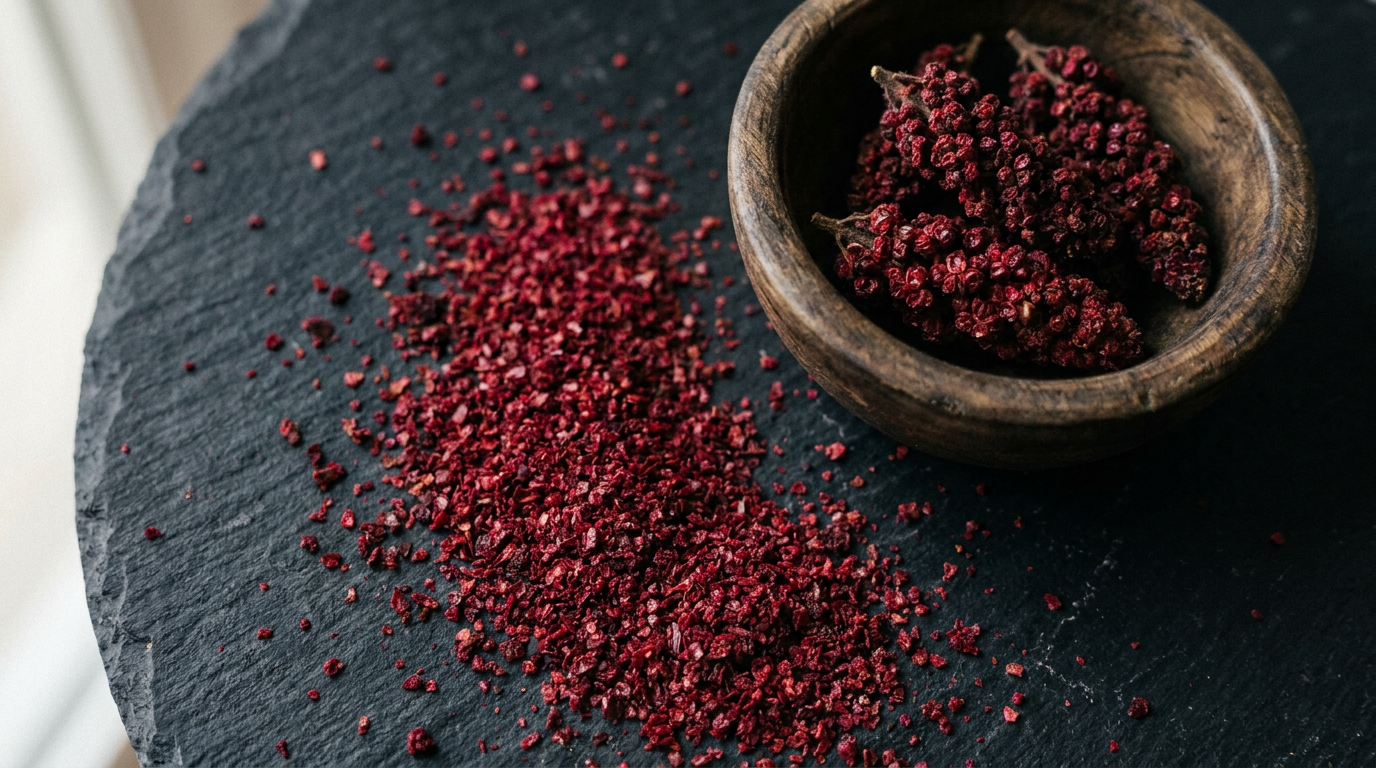
Sumac (Rhus coriaria) is a coarse, crimson spice milled from the dried drupes of a wild Mediterranean shrub. Long before citrus arrived in the Levant from Asia, sumac provided the primary tart, fruity acidity in Middle Eastern cookery. Its sharpness stems from concentrated malic and citric acids, balanced by astringent hydrolysable tannins and deep red anthocyanin pigments.
Modern cooks tend to think of sourness as a liquid property. When an English or French recipe requires acid, it reaches for cider vinegar, white wine, or a sliced lemon. In the eastern Mediterranean, sourness was dry and fruit-borne for centuries before Citrus limon moved westward along trade corridors from northeastern India and China [1]. Roman cooks used sumac as an everyday acidulant; Abbasid-era culinary manuals treated it as a staple building block for balancing game and rich stews [2]. It remains one of the few pantry ingredients that can sharpen a dish without altering its hydration.
The chemistry of sourness
The sour profile of sumac is frequently compared to lemon juice, but the organic acid composition tells a different story. In fresh lemon juice, citric acid makes up nearly all the sourness, producing an immediate, sharp prick on the tongue. In sumac, malic acid dominates, accompanied by citric, tartaric, and fumaric acids [3].
Malic acid is the primary acid found in sour green apples, unripe stone fruits, and rhubarb. It produces a slower, more persistent sourness that broadens across the sides of the palate rather than vanishing in an acute burst. In culinary terms, this means sumac cuts through heavy animal fats with less sharpness than raw citrus juice. When sprinkled over grilled lamb kofta or fattoush, it cuts fat without jarring the palate.
Alongside these organic acids, sumac drupes contain high levels of hydrolysable tannins, particularly gallotannins [4]. These compounds bind to salivary proteins, creating a mild astringency. It is this astringency that cleanses the palate after rich, unctuous bites of meat, functioning more like a structured red wine than a squeeze of citrus fruit.
Souring without water
Liquid acids carry culinary penalties. If you squeeze lemon juice over freshly sliced raw onions, they quickly lose their crisp cell structure and turn soft. If you dress a flatbread or crisp pastry with vinegar, it absorbs the moisture and turns doughy.
Sumac solves this structural problem. Because it is applied as a dry, coarsely ground pericarp, it delivers acute acidity while drawing out surface moisture rather than adding to it. When massaged into thinly sliced red onions alongside sea salt, it pulls water from the cells via osmosis, lightly pickling the onion while leaving the ring structurally firm and pleasantly crunchy.
| Attribute | Sumac (Rhus coriaria) | Fresh Lemon Juice | Amchur (Mangifera indica) |
| :--- | :--- | :--- | :--- |
| Primary Acid | Malic acid, with citric and tartaric [3] | Citric acid | Citric and malic acids |
| Moisture Added | None (absorbent powder) | High (roughly 89% water) | None (fine powder) |
| Secondary Note | Tannic, astringent, dark stone fruit | Volatile citrus oils (limonene) | Musky, resinous, green fruit |
| Palate Effect | Broad, lingering, astringent finish | Piercing, immediate, clean drop-off | Sharp, pungent, slightly earthy |
Sumac also houses a dense polyphenol profile, dominated by anthocyanins (notably chrysanthemin and delphinidin) which provide its characteristic burgundy colour [4]. These compounds degrade under sustained boiling. When sumac is thrown into a fast-bubbling pot, its berry notes turn flat and muddy. In traditional Levantine applications, sumac is applied late: stirred into warm stews moments before service, used as a marinade paste, or dusted raw across the finished dish.
The adulteration of za'atar
In the Levant, sumac is an essential component of the table condiment za'atar, paired with wild thyme (Origanum syriacum), toasted sesame seeds, and sea salt. Sumac provides the necessary acid balance to the volatile carvacrol in the thyme and the heavy, nutty lipids of the oil-rich seeds.
Yet much of the commercial "sumac" sold in supermarkets is degraded. Whole sumac berries possess a naturally sticky, oily outer coat. Industrial milling often strips this coat or strips the yield with excessive filler. Worse, pre-mixed za'atar frequently replaces sumac entirely with industrial citric acid crystals dyed red with synthetic colouring or spent beet powder. Citric acid powder delivers a harsh, synthetic sourness that lacks both the mellow malic curve and the drying tannins of genuine Rhus coriaria.
Real sumac should feel slightly moist between the fingertips, with a coarse, uneven flake rather than a fine, chalky dust. It should taste distinctly like sour cherries and wild blackberries before the acidity hits.
Frequently asked questions
Does sumac taste like lemon juice?
No. While both are tart, lemon juice is dominated entirely by citric acid and volatile limonene oils. Sumac is dominated by malic acid and gallotannins, giving it a slower, darker acidity with an astringent, berry-like finish.
Why is commercial sumac often salted?
Many commercial producers add sodium chloride during the grinding process. The salt acts as an abrasive to help shear the tough dried drupes from their hard inner seeds, and it prevents the naturally oily fruit flesh from clumping the machinery. Check ingredient labels; high-grade sumac should contain little to no added salt.
Can you cook sumac over high heat?
Sumac is best used as a finishing spice or in gentle marinades. Sustained, vigorous heat degrades the anthocyanins and tannins, muting the brightness and turning the ruby colour a dull, oxidised brown.
How should sumac be stored?
Because sumac contains unsaturated fatty acids and light-sensitive anthocyanin pigments, store it in an airtight tin away from direct sunlight and heat. In a cool pantry, it retains its sourness and colour for roughly nine to twelve months.
Sources & citations
- Watson, A. M. (1983). Agricultural Innovation in the Early Islamic World: The Diffusion of Crops and Farming Techniques, 700–1100. Cambridge University Press.
- Zaouali, L. (2007). Medieval Cuisine of the Islamic World: A Concise History with 174 Recipes. University of California Press.
- Kossah, R., Nsour, C., Zhang, H., & Chen, W. (2009). Physico-chemical properties and fatty acid composition of sumac (Rhus coriaria L.) fruits growing in Syria. Food Chemistry, 115(4), 1451-1455.
- Abu-Reidah, I. M., Jamous, R. M., & Shtaya, M. S. (2014). Phytochemical profiling of Rhus coriaria L. (Sumac) fruits using high-resolution LC-ESI-MS. Food Chemistry, 166, 179-187.