
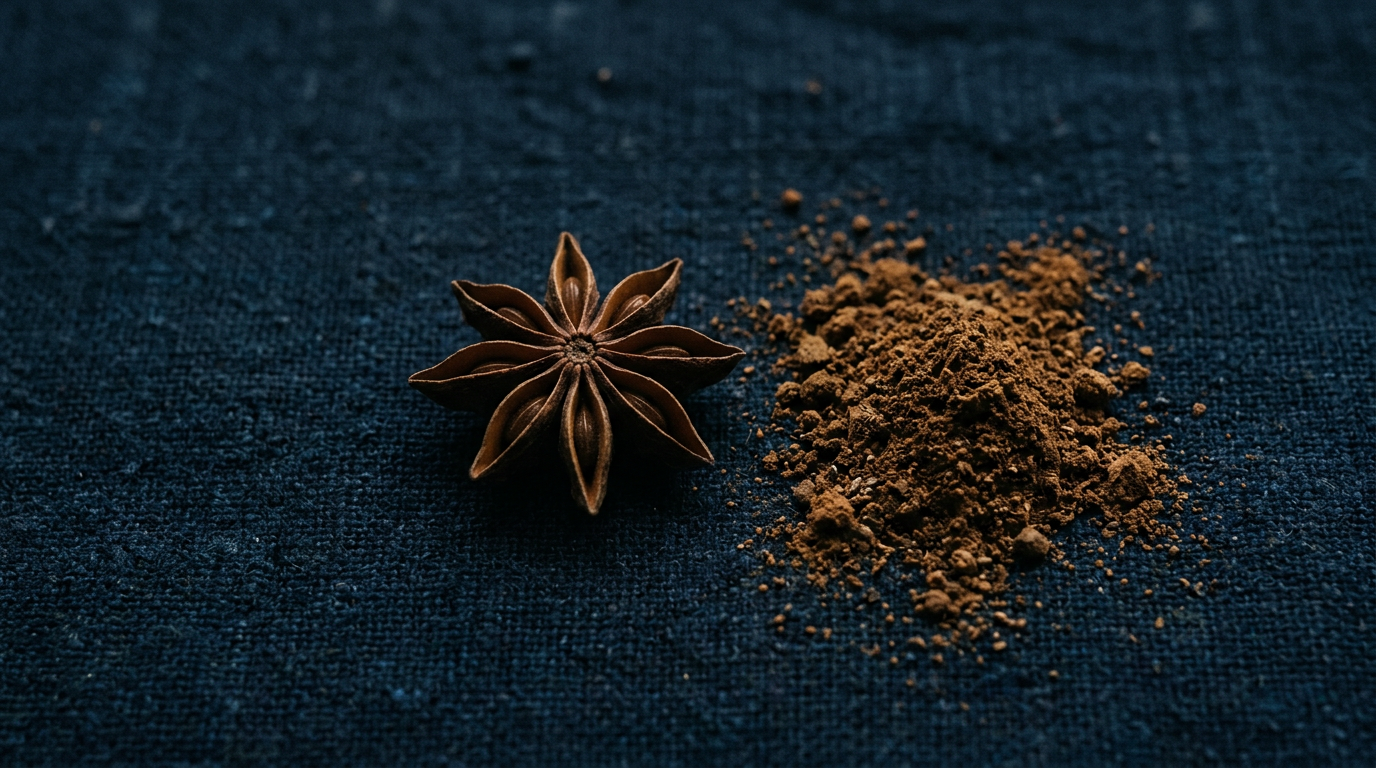
The essential star anise five spice difference is one of composition: star anise is a singular spice from the fruit of the Illicium verum tree, while Chinese five-spice is a composite blend that features star anise as its lead flavor. Understanding this distinction is key to mastering a pantry of nuanced, powerful flavors and moving from a cook to a thoughtful chef.
Imagine you’re reaching into the spice cabinet. In one hand, a jar of beautiful, eight-pointed woody stars. In the other, a fragrant, dark powder. They smell related, but distinct. Choosing the right one can make the difference between a dish that sings with a clear, high note and one that hums with a complex, resonant harmony.
The Soloist: Star Anise
[Star anise](/spice/star-anise) (Illicium verum) is the dried, star-shaped fruit of a small evergreen tree native to northeast Vietnam and southwest China. It is, by all measures, a soloist. Its flavor and aroma are dominated by a single, powerful compound: anethole. This is the same chemical that gives anise seed and fennel their characteristic licorice-like notes, but in star anise, the concentration is potent and the profile is warmer, deeper, and more pungent.
Used whole, its flavor infuses slowly, making it perfect for long, gentle simmers. Think of the clear, fragrant broth of a Vietnamese pho or the spiced poaching liquid for pears. In the `/region/us`, it’s increasingly easy to find whole pods in bulk bins, a far cry from the dusty, forgotten jars of the past. Ground star anise is more assertive and best used in smaller quantities in spice rubs or baked goods where you want that unmistakable sweet-spicy warmth to be front and center.
Beyond its flavor, this spice carries a unique scientific pedigree. It is the primary source of shikimic acid, the chemical building block for the antiviral medication oseltamivir (Tamiflu) [1]. While eating star anise won't cure the flu, this connection underscores the potent biochemistry held within our spice racks—a reminder of the thin wall between kitchen and apothecary.
The Ensemble: Chinese Five-Spice
If star anise is the lead singer, Chinese five-spice is the whole band. It’s a foundational blend in Chinese and Taiwanese cooking, designed to reflect the philosophical balance of the five essential flavors: sweet, sour, bitter, salty, and umami.
While there is no single, rigid recipe, the classic combination includes:
- Star Anise: For its sweet, licorice-like pungency.
- Cloves: For their intense, medicinal sweetness.
- Chinese Cinnamon (Cassia): For its warm, woody sweetness.
- Sichuan Peppercorns: For their unique citrusy aroma and tongue-tingling sensation (málà), which isn't 'hot' but creates a physical vibration [2].
- Fennel Seeds: For their lighter, complementary anise notes.
This is a formula for profound complexity. The star anise five spice difference lies in this very synergy. The anethole from the star anise and fennel plays against the eugenol in the cloves and the cinnamaldehyde in the cinnamon. The whole experience is then electrified by the hydroxy-alpha sanshool in the Sichuan peppercorns [3]. The result is not just a flavor, but a multi-sensory experience. It’s a warm, savory, and tingling hum that adds incredible depth to roasted meats, marinades, and stir-fries. In the UK, you can hardly imagine a plate of crispy aromatic duck without its accompanying five-spice seasoned salt.
Star Anise vs. Five-Spice at a Glance
| Feature | Star Anise | Chinese Five-Spice |
| :--- | :--- | :--- |
| Type | A single spice (Illicium verum fruit) | A blend of five or more spices |
| Primary Flavor | Pungent, sweet, licorice-like | Complex: warm, sweet, savory, numbing |
| Key Compound | Anethole | Anethole, Eugenol, Cinnamaldehyde, Sanshool |
| Best Use Case | Infusing liquids (broths, teas, syrups), long braises | Dry rubs, marinades, roasted meats, stir-fries |
| Form | Typically whole pods; also available ground | Almost always a pre-ground powder |
Frequently Asked Questions
1. Can I substitute star anise for five-spice powder?
No, not directly. Using ground star anise will only provide one of the five flavor dimensions. It will give you the licorice note but you'll miss the warmth of cinnamon, the pungency of cloves, the tingle of Sichuan pepper, and the lighter sweetness of fennel. You would be substituting a soloist for an orchestra.
2. Is five-spice powder spicy hot?
Not in the way of chili peppers. The 'heat' in traditional five-spice comes from Sichuan peppercorns, which create a tingling, numbing sensation (málà) rather than the burning heat from capsaicin. Some commercial blends, particularly Western ones, may add ginger or white pepper for a more familiar peppery warmth.
3. Is Japanese star anise the same as Chinese star anise?
No, and this is critically important. Japanese star anise (Illicium anisatum) is a close relative but is highly toxic and should never be consumed [4]. It is traditionally burned as incense. Always source your star anise (Illicium verum) from a reputable supplier who can verify its species and origin.
Sources & citations
- Wang, G. W., Hu, W. T., Huang, B. K., & Qin, L. P. (2011). Illicium verum: A review on its botany, traditional use, chemistry and pharmacology. Journal of Ethnopharmacology, 136(1), 10–20. https://www.pubmed.ncbi.nlm.nih.gov/
- Hagura, N., Barber, H., & Haggard, P. (2013). Food vibrations: Asian spice sets lips trembling. Proceedings of the Royal Society B: Biological Sciences, 280(1770). https://royalsocietypublishing.org/
- "Chinese Five-Spice Powder." Britannica. Accessed October 26, 2023. https://www.britannica.com/topic/five-spice-powder
- Perret, D. (2019). "How to Tell the Difference Between Chinese and Japanese Star Anise." Serious Eats. https://www.seriouseats.com/