
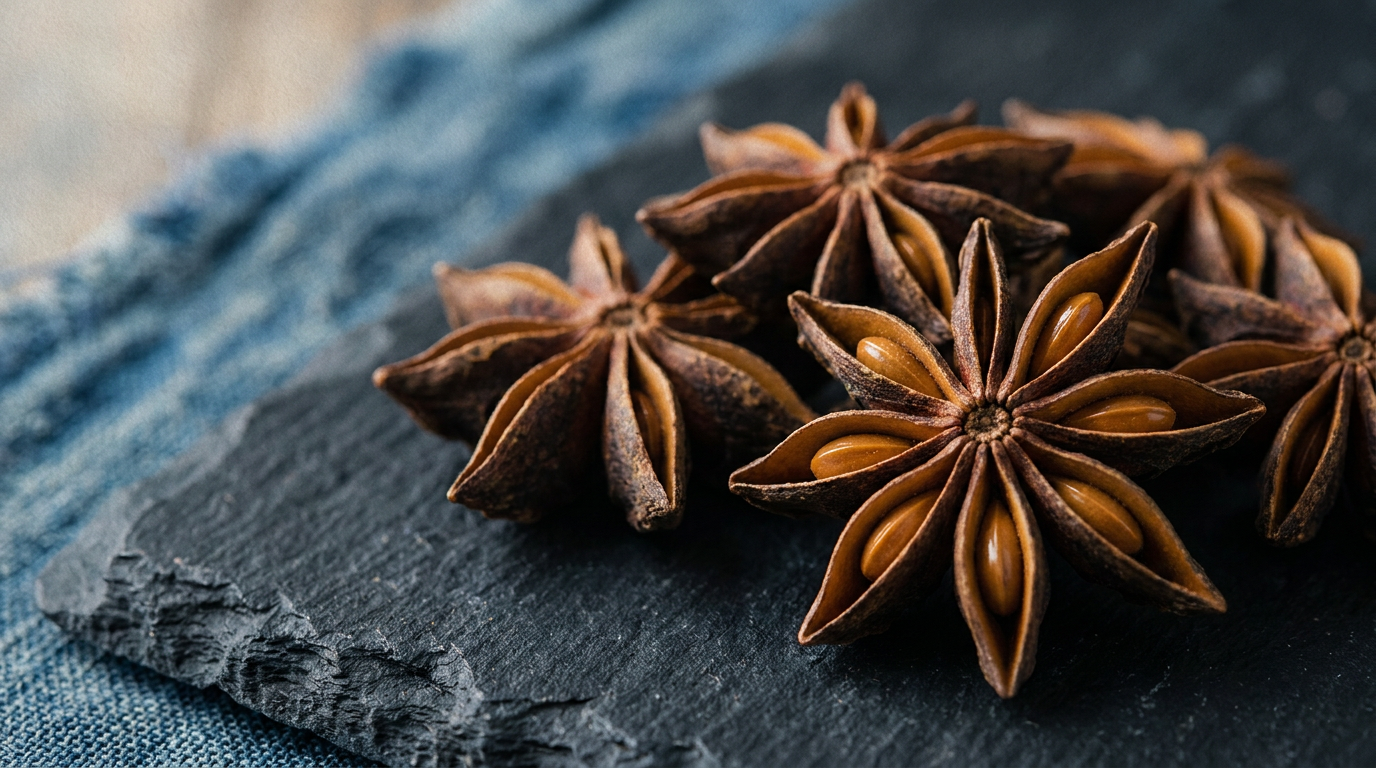
Star anise (Illicium verum) is the dried, star-shaped fruit of a medium-sized evergreen tree native to southwest China and northeast Vietnam. Valued for its high concentration of trans-anethole, it provides an intense liquorice aroma. Though culinarily grouped with aniseed and fennel, it belongs to an entirely distinct botanical order, functioning as both a cornerstone of slow-braised broths and a historical raw material for antiviral synthesis.
Browse the star anise reference entry in the house library for culinary specifications and botanical profiles.
The convergence of anethole
When cooks compare star anise to aniseed (Pimpinella anisum) or sweet fennel (Foeniculum vulgare), they respond to a single shared volatile compound: trans-anethole [1]. In star anise, anethole accounts for 80 to 90 percent of the essential oil found in the woody pericarp.
Yet the plants are not evolutionary neighbours. Star anise is an angiosperm belonging to the ancient basal lineage Schisandraceae. Fennel and aniseed are herbaceous members of the carrot family, Apiaceae. They arrived at the same aromatic signature from completely different branches of evolutionary history.
| Feature | Star Anise (Illicium verum) | Aniseed (Pimpinella anisum) | Fennel (Foeniculum vulgare) |
| :--- | :--- | :--- | :--- |
| Family | Schisandraceae | Apiaceae | Apiaceae |
| Plant Habit | Evergreen tree (up to 15 m) | Annual herb | Herbaceous perennial |
| Used Part | Dried ligneous pericarp (fruit) | Dried schizocarp (seed-like fruit) | Dried schizocarp (seed) and bulb |
| Dominant Volatile | trans-Anethole (80–90%) | trans-Anethole (80–95%) | trans-Anethole (50–70%) + Fenchone |
| Secondary Note | Woody, cineole, faint clove | Sweet, herbal | Camphoraceous, bitter-sweet |
Fennel carries fenchone, which introduces a bitter, medicinal sharpness. European aniseed carries estragole and pseudoisoeugenol, keeping the aroma overtly sweet and confectionery. Star anise balances its anethole load with trace volumes of caryophyllene, limonene, and linalool, alongside faint traces of eugenol. The result is woodier and less syrupy, built to withstand hours in boiling stock.
The shikimate diversion
In the mid-2000s, star anise shifted from an agricultural commodity to a geopolitical consideration. The fruit contains exceptional yields of shikimic acid, up to 7 percent by dry weight in selected Chinese harvests [2].
Shikimic acid is an intermediary metabolite in the shikimate pathway, a seven-step metabolic route used by plants and bacteria to synthesize aromatic amino acids. For humans, it is non-toxic and has no inherent therapeutic value. But for synthetic chemists at Gilead Sciences and Roche, it served as the starting scaffold for oseltamivir phosphate, an influenza neuraminidase inhibitor marketed as Tamiflu [3].
When avian influenza (H5N1) emerged as a potential pandemic threat in 2005, global governments scrambled to stockpile oseltamivir. Traditional chemical synthesis required eleven steps from petroleum precursors, with explosive azide intermediates. Shikimic acid reduced the synthesis to a manageable industrial process.
Virtually overnight, the Chinese star anise harvest was largely committed to European pharmaceutical vats. The pricing fluctuated wildly, illustrating what happens when an agro-forest crop with an eight-year maturation window becomes the sole precursor for an emergency drug. The pressure subsided only after bioengineers successfully expressed the shikimate pathway in genetically modified strains of Escherichia coli, separating antiviral manufacturing from seasonal rainfall in Guangxi.
Solubility and the physics of the stock pot
Throwing a whole star anise point into boiling water produces a pale, faintly medicinal tea. The compound responsible for its appeal, trans-anethole, has a water solubility of approximately 0.1 grammes per litre at room temperature [4]. It is a hydrophobic ether.
In traditional cooking, star anise is rarely dropped into plain water. In a Vietnamese phở bò or a Chinese master stock for red-braised pork (hong shao rou), two factors bypass this chemical bottleneck: temperature and lipid suspension.
As water approaches a sustained simmer of 90 to 95 degrees Celsius, anethole solubility rises slightly, but its volatility increases dramatically. More importantly, simmering bone broth accumulates a layer of rendered animal fat and gelatin. Gelatin acts as a surfactant, while the droplets of rendered tallow or lard act as non-polar solvent traps. The anethole leaves the pericarp and dissolves readily into the suspended fat globules.
There is also a molecular interaction with meat. Anethole suppresses the volatile sulfur compounds and lipid oxidation markers associated with stale fat and gamey beef. Simultaneous extraction of trace linalool and limonene from the fruit wall rounds out the savoury notes without requiring added table sugar.
A note on toxicity
Star anise has a dangerous botanical lookalike: Illicium anisatum, commonly known as Japanese star anise or shikimi.
Illicium anisatum is structurally similar, but its carpels are smaller and hooked at the tips. Chemically, it contains anisatin, neoanisatin, and pseudoanisatin. Anisatin is a non-competitive antagonist of gamma-aminobutyric acid (GABA) receptors. It causes severe neurotoxicity, seizures, and respiratory arrest in infants and adults [5].
Adulteration occurs when wild-harvested Japanese star anise enters commercial streams intended for herbal infusions. Commercial analytical laboratories screen lots using high-performance liquid chromatography or DNA barcoding to confirm that shipments contain only Illicium verum.
Frequently asked questions
### Can ground star anise substitute for whole pods?
Yes, but adjust the quantity carefully. Ground star anise is made by milling the entire woody follicle, including the internal seeds. It releases its volatile oils immediately, rather than over hours of simmering. Use approximately one-quarter teaspoon of ground spice for every whole star.
### Why does star anise cloud cloudy alcoholic drinks?
When star anise extracts are steeped in high-proof spirits and subsequently mixed with water, the liquid turns cloudy. This is known as the ouzo effect or spontaneous emulsification. trans-Anethole dissolves in ethanol but drops out of solution when the alcohol percentage falls, forming microscopic oil droplets that scatter light.
### Are the seeds or the star-shaped shell more flavourful?
The woody shell (the pericarp) contains the majority of the volatile essential oil, particularly trans-anethole. The small, glossy seeds inside contain mostly fixed fatty oils and hold very little aroma.
### How should star anise be stored to prevent stale notes?
Whole pods should remain intact until use, kept in an airtight glass or metal container away from light. In air, anethole slowly oxidises into para-anisaldehyde and 4-methoxyacetophenone, dulling the clean liquorice profile into an overly sweet, damp cardboard smell.
Sources & citations
- Wang, G. W., Hu, W. T., Huang, B. K., & Qin, L. P. (2011). Illicium verum: A review on its botany, traditional use, phytochemistry and pharmacology. Journal of Ethnopharmacology, 136(1), 10–20. https://doi.org/10.1016/j.jep.2011.04.051
- Ghosh, S., Chisti, Y., & Banerjee, U. C. (2012). Production of shikimic acid. Biotechnology Advances, 30(6), 1425–1431. https://doi.org/10.1016/j.biotechadv.2012.03.001
- Kramer, R. M., et al. (2003). Synthesis of the Neuraminidase Inhibitor Oseltamivir Phosphate (Tamiflu) via the Shikimate Pathway. The Journal of Organic Chemistry, 68(19), 7434–7440.
- Royal Society of Chemistry. ChemSpider Record: anethole (CAS 4180-23-8). https://www.chemspider.com/Chemical-Structure.553147.html
- Perret, C., Tabin, R., Marcoz, J. P., Llor, J., & Cheseaux, J. J. (2011). Apparent life-threatening event in infants: think about star anise intoxication. Archives de Pédiatrie, 18(7), 750–753. https://doi.org/10.1016/j.arcped.2011.04.015