
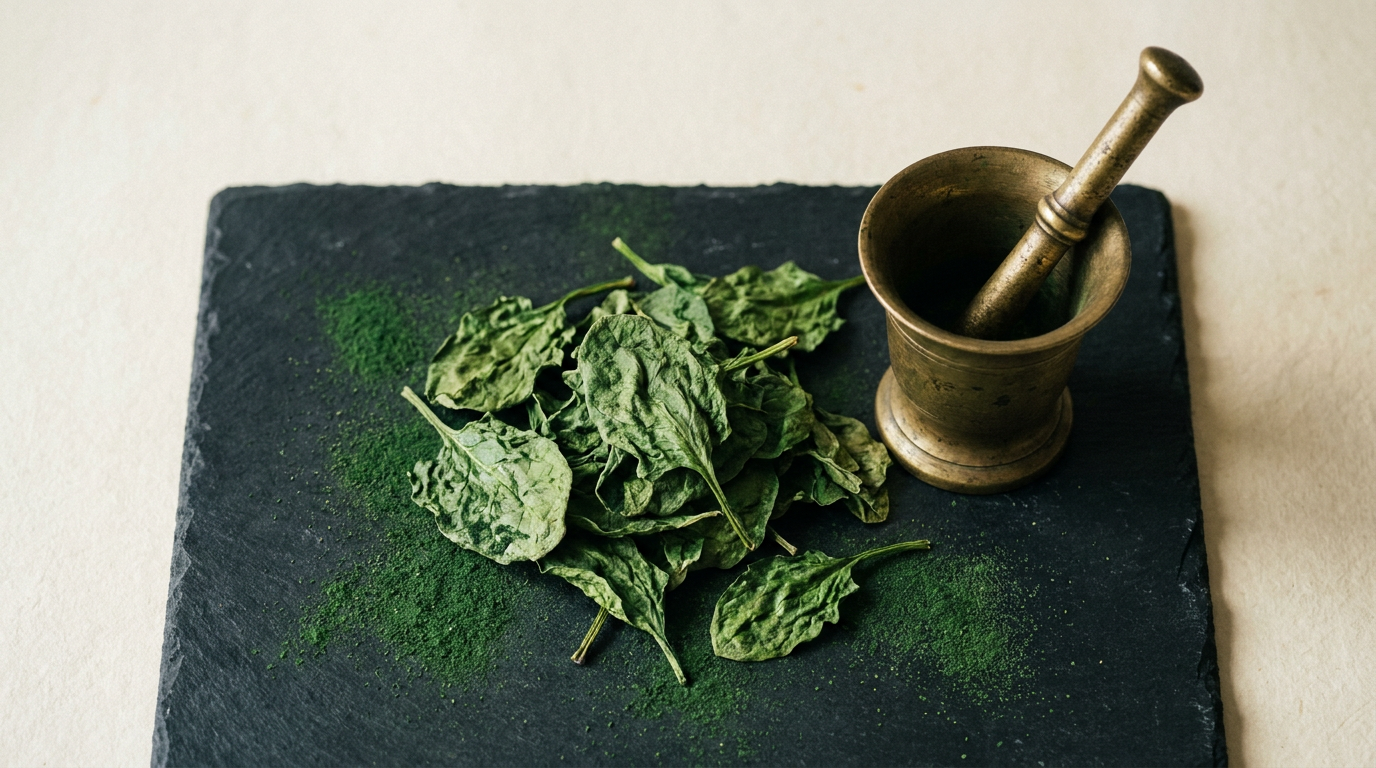
Spinach (Spinacia oleracea) is an annual leafy plant in the amaranth family (Amaranthaceae), cultivated originally in ancient Persia and prized for its mineral density, deep green chlorophyll pigments, and mild, earthy flavour. While predominantly consumed as a fresh vegetable, dried spinach operates functionally as an herb and natural colouring agent in culinary traditions across Central Asia, Europe, and modern food manufacturing [1].
Treating spinach strictly as salad greens obscures its historical and chemical function in the kitchen. In Persian cookery, where the plant originated before moving along medieval trade routes into China and Muslim Iberia, the boundary between vegetable and herb is porous. In dishes such as ghormeh sabzi or kuku sabzi, broad leaves are bundled alongside fenugreek, coriander, and parsley, subjected to long, slow stewing or drying where their primary contribution is not bulk, but background bitterness, savoury depth, and green pigment [1].
When dried and milled into flakes or fine powder, spinach sheds its water weight (which accounts for roughly 91 percent of the fresh leaf) and concentrates two competing chemical systems: pigmenting porphyrins and astringent dicarboxylic acids.
The Chemistry of Leaf Astringency
The dry, chalky sensation left on the teeth after consuming spinach comes from oxalic acid (ethanedioic acid). Spinach accumulates unusually high concentrations of soluble and insoluble oxalates compared to other edible foliage, often ranging between 400 and 1,200 milligrams per 100 grams of fresh tissue [2].
When leaf cells rupture under heat, drying, or mastication, soluble oxalic acid leaks into the oral cavity. There, it binds readily with free calcium ions present in saliva, precipitating into insoluble microcrystals of calcium oxalate. These microcrystals deposit onto dental enamel and mucous membranes, producing the distinctive sandpaper friction often blamed on poor cooking technique.
In high-heat drying or standard culinary blanching, this chemistry shifts. Oxalate solubility depends heavily on temperature and pH. Submerging leaves in boiling water leaches a significant fraction of soluble oxalates into the cooking liquid, reducing that drying astringency. Conversely, dehydrating raw spinach directly into a shelf-stable seasoning preserves the oxalates intact, retaining a sharp, vegetal bite that counters rich dairy or starchy batters.
Chlorophyll Stability and Degradation
Food producers frequently deploy powdered spinach as an additive for pasta, pasta fillings, and sauces. Its primary technological role here is tinctorial: delivering vivid greens without synthetic food dyes. That reliance runs headlong into the instability of the chlorophyll molecule.
Chlorophyll a and b contain a central magnesium ion held within a porphyrin ring. When exposed to heat, prolonged light, or acidic conditions, two protons displace this magnesium ion. The molecule degrades into pheophytin, turning an electric emerald into a dull, brownish olive [3].
| State | Primary Pigment | Dominant Volatiles | Oxalate Impact |
| :--- | :--- | :--- | :--- |
| Fresh raw leaf | Chlorophyll a & b (unaltered) | Hexanal, (Z)-3-hexenal (grassy, green) | Full astringency; high soluble oxalate |
| Blanched leaf | Partial pheophytin conversion | Diminished aldehydes, mild sulfurous notes | 30–50% soluble oxalate leached into water |
| Dehydrated powder | Concentrated chlorophyll or pyropheophytin | Hexanal degradants, methional, pyrazines | High concentration per gram; persistent chalkiness |
Preserving the bright pigment in dried preparations requires rapid thermal inactivation of chlorophyllase (the endogenous enzyme that cleaves the phytol tail) followed by drying at controlled temperatures. If done carelessly, the heat required to dry the leaf catalyses the exact demetallation that bleaches it.
Flavour Beyond the Green Notes
Fresh spinach aroma is governed largely by lipid oxidation products: six-carbon aldehydes like hexanal and (E)-2-hexenal, which generate the generic scent of cut grass. These compounds are volatile and evaporate rapidly upon heating or ambient dehydration.
What remains behind in dried spinach is an earthy, slightly marine profile. Dehydration exposes amino acids and traces of sulfur-bearing compounds to oxidation. When added to warm doughs, broths, or wet spice pastes, dried spinach rehydrates into a vegetal background note with savoury undertones, functioning much like dried lovage or chervil rather than a neutral vegetable. It provides mineral depth without the overpowering terpene lift of mint or the sharp allium punch of garlic.
Understanding spinach through its phytochemistry clarifies why it demands different handling depending on the plate. If the goal is bulk texture, gentle steaming limits cell collapse. If the intention is herb-like seasoning, concentrating the leaf unlocks an assertive, astringent savoury foundation that balances fats and starches with quiet efficiency.
Frequently Asked Questions
### Why does spinach make your teeth feel chalky or fuzzy?
That sensation is caused by oxalic acid binding with calcium ions in your saliva. The reaction forms insoluble calcium oxalate crystals, which deposit temporarily onto your teeth, creating a gritty or chalky mouthfeel [2].
### How does dried spinach compare to fresh spinach as a culinary ingredient?
Fresh spinach contains over 90 percent water and provides volume and crispness to raw or lightly wilted preparations. Dried spinach acts as a concentrated herb and colourant; the water removal amplifies its natural mineral, earthy flavours and preserves pigments for use in breads, pasta, and dry spice blends.
### Does cooking spinach destroy its oxalic acid content?
Cooking does not destroy the oxalic acid molecule outright, but boiling or blanching leaches water-soluble oxalates into the cooking water, significantly lowering the total oxalate concentration left in the drained leaves [2]. Steaming or dry-roasting leaves oxalates intact.
### Why does cooked or dried spinach often turn olive-drab instead of bright green?
Heat and acid displace the central magnesium ion inside the leaf's chlorophyll molecules. This converts chlorophyll into pheophytin, which absorbs light differently and reflects a dull olive-brown hue instead of bright emerald green [3].
Sources & citations
- Food and Agriculture Organization. Traditional High-Nutrient Food Crops: Spinach and Leafy Amaranths. FAO Production and Health Papers, 2018. https://www.fao.org/documents/card/en/c/ca2402en
- Noonan, S. C., and G. P. Savage. "Oxalate content of foods and its effect on humans." Asia Pacific Journal of Clinical Nutrition 8, no. 1 (1999): 64–74. https://pubmed.ncbi.nlm.nih.gov/24394162/
- von Elbe, J. H., and S. J. Schwartz. "Colorants." In Fennema's Food Chemistry, 4th ed., edited by S. Damodaran, K. L. Parkin, and O. R. Fennema, 683–750. CRC Press, 2007.