
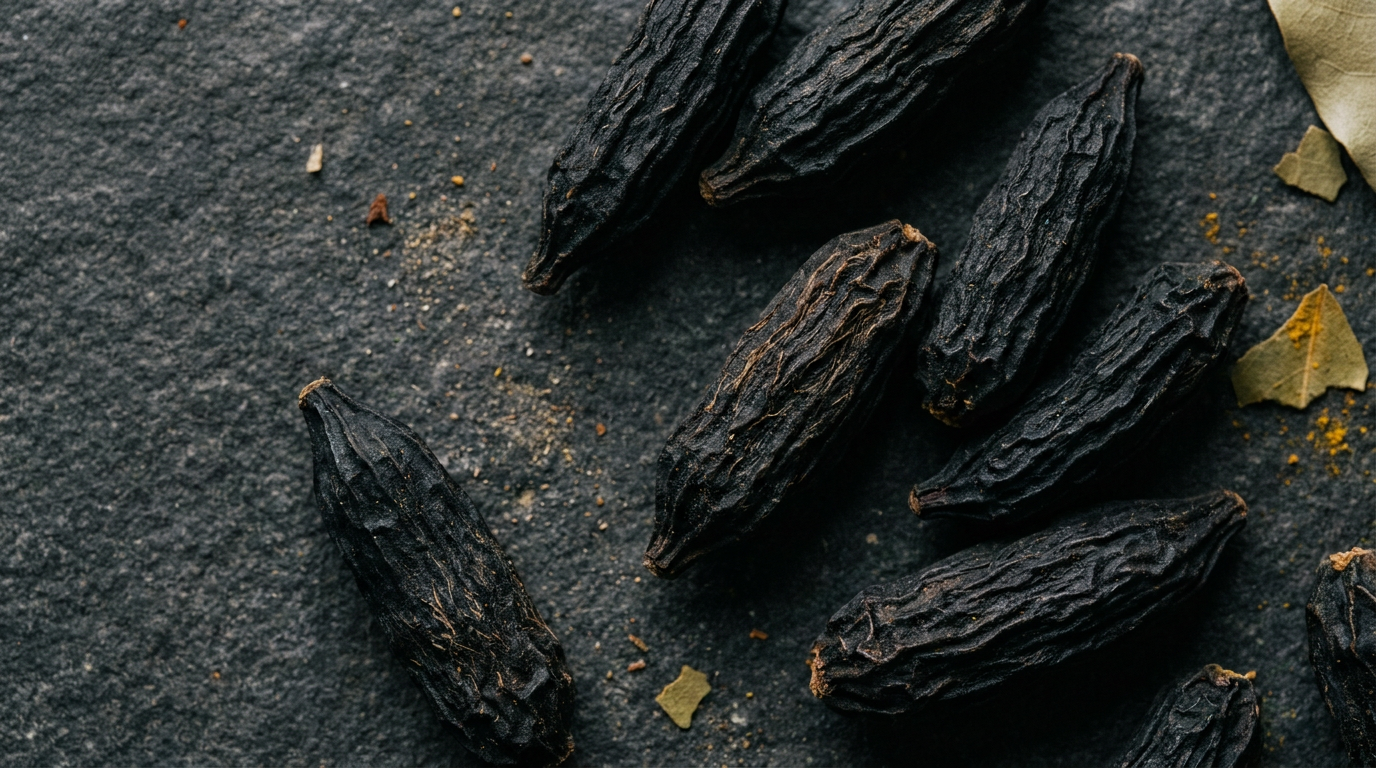
Selim pepper is the dried fruit of Xylopia aethiopica, an aromatic evergreen tree in the Annonaceae family native to West and Central Africa. Known locally as uda, kani, or hwentia, the spice provides a resinous, camphoraceous heat driven by monoterpenes such as 1,8-cineole and beta-pinene, combined with a persistent bitterness generated by diterpenes concentrated in the seeds.
European spice traders called almost anything with an assertive bite a pepper. The label stuck, but selim pepper shares no botanical heritage with Piper nigrum (black pepper) or Capsicum (chilli). It belongs to the custard apple family. What cooks drop into a pot is not a berry or a seed; it is an entire apocarpous fruit cluster consisting of slender, twisted, dark brown pods containing between four and nine small seeds [1].
The Anatomy of the Pod: Pericarp Versus Seed
Most dried spices distribute their flavour evenly through their tissues. Selim pepper divides its labour sharply between its outer hull and the seeds inside.
The pericarp, or pod wall, carries the aromatic volatile oil, often making up two to four percent of its dry weight. The dominant volatiles are monoterpenes: alpha- and beta-pinene, 1,8-cineole (eucalyptol), and myrcene, alongside sesquiterpenes like germacrene D [2]. This gives the outer pod an aroma resembling cracked pine needles, sweet nutmeg, and eucalyptus, layered beneath a woodsmoke finish acquired during post-harvest kiln or air drying.
The seeds inside tell an entirely different story. They contain virtually none of the resinous aromatics found in the husk. Instead, they store high concentrations of xylopic acid, a kaurane-type diterpene [3]. Xylopic acid is astringent and intensely bitter.
This structural division dictates how the spice must be handled in the kitchen. In Nigerian pepper soup and Igbo ofe nsala, cooks routinely crack the pods lightly to release the volatile oils into the broth, but they often discard the seeds first or fish the pods out before service. Leaving cracked seeds to boil over thirty minutes pulls excess diterpenes into the liquid, shifting the dish from aromatic warmth into medicinal bitterness. Conversely, Senegalese Café Touba requires roasting the whole pod alongside robusta coffee beans before grinding them together fine. In coffee, the bitterness of the seeds integrates cleanly into the roasted pyrazines and chlorogenic acids, while the pine-scented cineole lifts the heavy brew.
Chemical Comparison: African Pungency
West Africa possesses several native spices that European merchants collapsed under the vague umbrella of "Guinea pepper". Their sensory mechanisms could hardly be more distinct.
| Spice | Botanical Source | Primary Chemical Drivers | Sensory Profile |
| :--- | :--- | :--- | :--- |
| Selim Pepper | Xylopia aethiopica | 1,8-cineole, beta-pinene, xylopic acid | Camphoraceous, woody, resinous, subtly smoky, bitter |
| Black Pepper | Piper nigrum | Piperine, caryophyllene, limonene | Sharp trigeminal heat, citrus top note, dry finish |
| Grains of Paradise | Aframomum melegueta | 6-paradol, 6-shogaol, gingerol | Warm, cardamom-like, gingery pungency without bitterness |
| Ashanti Pepper | Piper guineense | Piperine, cubebin, myristicin | Piquant, fresh, leafy, distinctively medicinal-peppery |
Black pepper acts directly on TRPV1 nerve endings through the alkaloid piperine. Selim pepper provides heat almost entirely through aromatic volatility and minor diterpene stimulation. It prickles the mucous membranes through vapour rather than burning the tongue through receptor binding.
Extraction Dynamics in the Pot
Because the flavour compounds in Xylopia aethiopica possess varied polarities, the medium in which you cook changes what extracts into your food.
Monoterpenes like pinene and limonene are non-polar hydrocarbons. They do not dissolve well in water. If you drop a whole pod into a light, fat-free stock, the aromatic top notes will largely steam off into the kitchen rather than disperse into the broth. The water will extract mostly the water-soluble phenolic compounds, tannins, and diterpene acids, leaving a harsh, thin aftertaste.
To capture the resinous richness of the pericarp, the pod requires lipid exposure. Cooking the pod in palm oil, butter, or chicken fat at the start of a stew dissolves the non-polar terpenes, holding them in the fat phase of the dish. The smoke compounds, primarily wood-tar phenols from traditional drying kilns, also partition readily into fat.
For ground applications, such as dry rubs or Ghanaian shito paste, grinding the whole pod requires a high-shear mill. The fibrous outer hull is tough and fibrous, composed of reinforced lignified cells designed to protect the carpel in tropical heat. A dull mortar or domestic spice grinder leaves behind fibrous threads that ruin the texture of a sauce. If a high-powered mill is unavailable, the traditional practice of steeping lightly bruised pods in boiling liquid and straining them remains technically superior.
Frequently Asked Questions
### Can I use black pepper as a substitute for Selim pepper?
Black pepper is not a functional substitute. Black pepper relies on piperine for direct pungency, whereas Selim pepper relies on pine-like monoterpenes and bitter diterpenes. A closer substitute is a combination of crushed green cardamom, allspice, and a drop of liquid smoke, though this still lacks the medicinal resin quality of Xylopia aethiopica.
### Should I remove the seeds before cooking?
For light broths, delicate fish soups, or quick infusions, yes. Removing the small dark seeds prevents xylopic acid from releasing excessive bitterness into the dish. Keep the seeds in when making dark, complex, long-cooked sauces, dry barbecue rubs, or spiced coffee, where bitterness balances sweet or fatty notes.
### Why does Selim pepper smell smoky?
Most Selim pepper sold commercially is smoke-dried over wood fires immediately after harvest. This traditional preservation method prevents fungal rot in humid coastal climates and adds phenolic smoke volatiles that complement the natural turpentine-like pinene in the pod.
Sources & citations
- Burkill, H.M. (1985). The Useful Plants of West Tropical Africa, Vol. 1. Royal Botanic Gardens, Kew. https://plants.jstor.org/stable/10.5555/al.ap.upwta.1_206
- Tairu, A.O., Hofmann, T., & Schieberle, P. (1999). Characterization of the key aroma compounds in dried fruits of Xylopia aethiopica. European Food Research and Technology, 209(3), 220–224. https://doi.org/10.1007/s002170050483
- Choumessi, A.T., et al. (2012). Xylopic acid derivatives from Xylopia aethiopica. Journal of Natural Products, 75(6), 1184–1188. https://doi.org/10.1021/np300188z
- Keita, S.M., et al. (2003). Volatile components of the essential oils of Xylopia aethiopica from Guinea. Flavour and Fragrance Journal, 18(4), 265–269. https://doi.org/10.1002/ffj.1213